Plant reproduction
noun phrase (n. phr.)
Definition
Plant reproduction is of two types: sexual and asexual. Sexual reproduction is the fusion of male and female gametes within the flower in flowering plants. Asexual reproduction occurs through stems, roots, and leaves.Diagram of flowering plant reproduction:

Schematic diagram of flowering plant reproduction showing the various parts and stages of the process.
Explanations
Sexual and asexual reproduction methods each have their own advantages. Sexual reproduction is similar to animal reproduction, in which the male gamete from pollen and the female egg cell fuse into a new organism that inherits genes from both parents. The sexually reproductive part of a flowering plant is the flower.
Asexual reproduction involves vegetative propagation through stems, roots, bulbs and bulbils, and leaves. Essentially, the parent plant regenerates itself using one of its parts (roots, stems, or leaves).
In sexual reproduction, the newly formed plant is a combination of genes, giving it an advantage in adapting to changing environments. It can also prevent the transmission of certain diseases, as some genes are dominant and others are recessive.
Asexual reproduction is faster and may be the only way to reproduce in species that do not bear flowers. Because asexual reproduction is essentially cloning of the parent plant, farmers can ensure there are no genetic abnormalities by selecting a healthy plant for propagation.
Sexual and asexual reproduction are different adaptations that plants have used to perpetuate their species even under unfavorable conditions. Flowering plants use sexual reproduction by attracting various pollinating agents. Non-flowering plants rely on stems, leaves, and roots that form buds and produce identical copies!
Sexual reproduction of flowering plants
The flower consists of four whorls or parts (calyx, corolla, androecium, and gynoecium). The first whorl is the calyx, which contains the green sepals. The second whorl is the corolla, which contains the petals.
Petals are brightly colored to attract pollinating agents such as bees and other insects that assist in reproduction. Petals also protect the two inner whorls that are directly involved in reproduction. The third whorl is the androecium, the male reproductive part of the plant. The innermost whorl is the gynoecium, the female reproductive part of a plant.
Reproductive parts of a plant with the gynoecium and androecium:
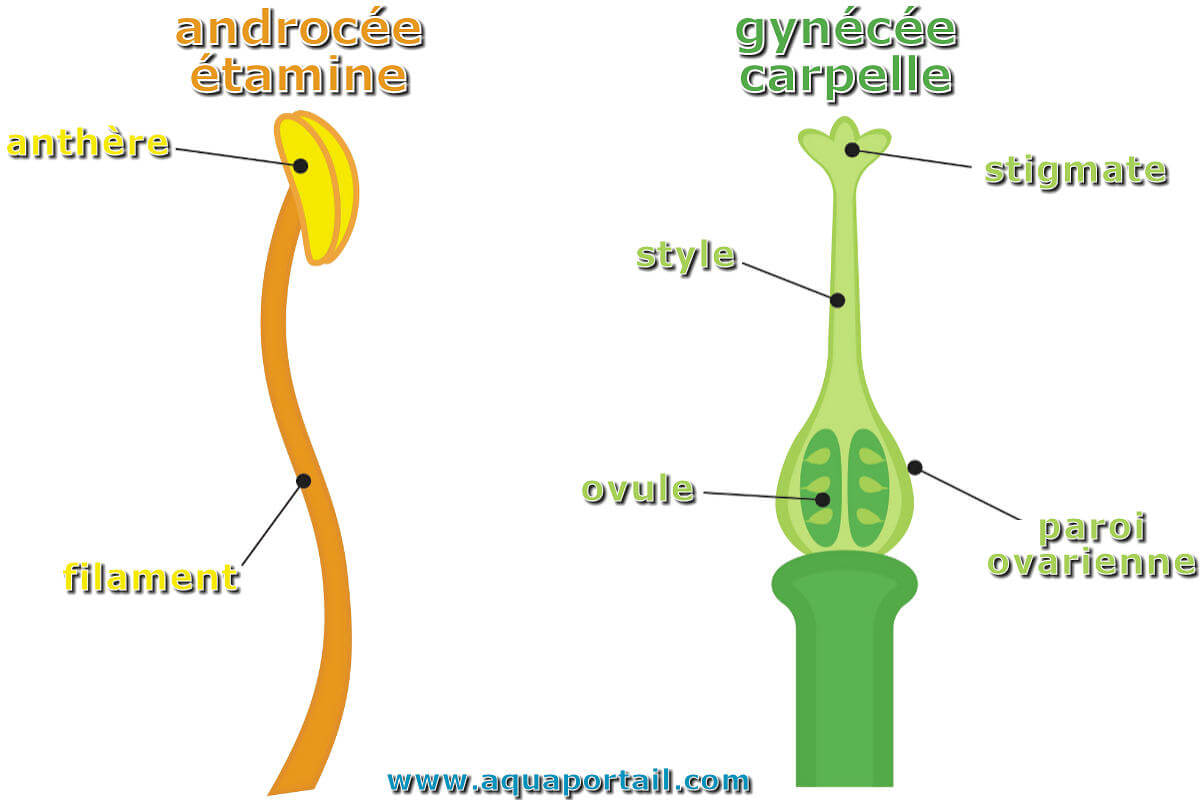
The reproductive parts of a flowering plant are the gynoecium (with carpel and pistil) and the androecium (with stamen and anther).
- the androecium contains a cluster of stamens composed of a filament and a swollen tip called an anther. The anther contains pollen grains. Once mature, the anthers open to release pollen toward the female reproductive part of the flower
- the gynoecium contains the pistil, which is composed of the style leading to the ovary. The swollen tip of the style is the stigma, which receives the pollen grains. Inside the ovary are the ovules, which develop into seeds
- unisexual or diclinous flowers contain one or the other reproductive part (stamen or pistil). Papaya, corn, and cucumber are examples of unisexual flowers. The same plant may bear both male and female unisexual flowers. Bisexual or hermaphroditic flowers contain both male and female organs, stamens and pistil. Examples of bisexual flowers are roses, petunias, and mustard plants
- the transfer of pollen from the anther to the stigma of a flower is called pollination. During fertilization, male and female gametes unite to form a zygote. A zygote then develops into an embryo, which eventually becomes a seed. The seed subsequently germinates into a new plant. There are two types of pollination: self-pollination and cross-pollination.
Types of pollination and pollinators
Two main types of pollination exist in flowering plants for sexual reproduction:
- self-pollination: if the pollen grain from the anther lands on the stigma of the same flower or another flower on the same plant, it is called self-pollination
- cross-pollination: if the pollen grain from an anther lands on the stigma of a flower on another plant of the same species, it is called cross-pollination.
Pollinators such as birds, insects (bees, for example), other animals, water, and wind are all called pollinating agents, as they help plants reproduce.
Wind and water carry pollen grains to other plants. Birds and insects are attracted by the color and scent of the flower.
As they move from one flower to another, pollen grains stick to their bodies and are subsequently transported to other flowers.
Animals and birds eat fruits and disperse seeds, or the seeds are not digested and are thus excreted from their bodies intact.
Asexual reproduction
Asexual reproduction is how the best plant of a species can be cloned. The Bartlett pear (1770) and the Delicious apple (1870) are still propagated asexually to obtain the same quality product. Vegetative propagation is a form of reproduction using the leaves, stems, or roots of the parent plant. Asexual reproduction can also be done artificially by cuttings, grafting, and layering. Reproduction by fragmentation also exists.
Asexual reproduction of the strawberry plant:

Asexual reproduction of the strawberry plant occurs via runners (stolons), a natural equivalent of layering.
Sweet potatoes, dahlias, and asparagus are all propagated by tuberous roots. The roots of these plants contain buds that can form leafy shoots under favorable conditions.
Potatoes and ginger are propagated through stem tubers bearing small buds (eyes). Bryophytes notably reproduce via vegetative propagation or gemmae. If a succulent leaf falls onto moist soil, it can give rise to a new plant.
stolon-producing plants like the strawberry reproduce through creeping stems. Plants such as cacti reproduce when a part detaches from the parent plant. The detached part then begins a life of its own. New plants produced by vegetative propagation are exact copies of their parent plants.
Genesis of a plant
Plants go through two phases during their life cycle: sporophyte and gametophyte.
The sporophyte is the multicellular stage with diploid cells. This is what we usually see in a plant, with the stem, leaves, roots, and remaining plant organs.
The gametophyte is the set of haploid cells present in flowers, and its primary role is first to form gametes and, after fertilization, to enable seed formation.
In plants, sexual reproduction begins with sporogenesis. This occurs when specialized diploid cells of the flower's sporophyte undergo meiosis and become haploid cells called spores. The spores develop into gametophytes, multicellular haploid structures that subsequently produce gametes through gametogenesis.
Fertilization is the fusion of a female gamete (egg cell, derived from the female gametophyte) and a male gamete (sperm cell, derived from the male gametophyte). The zygote is the diploid cell resulting from the fusion of gametes, which after proliferation and differentiation gives rise to the embryo. The sporophyte phase of the plant cycle begins with the zygote.
An angiosperm gametophyte consists of a few cells. There are two types of gametophytes: female and male. The female gametophyte arises from a megaspore (or macrospore) and the male gametophyte from a microspore.
The female gametophyte develops within the ovule and consists of 7 cells: three antipodal cells, one central cell, two synergids, and the egg cell. Formation of the female gametophyte follows two stages: megasporogenesis and megagametogenesis. Megasporogenesis begins with the differentiation of a nucellar cell in the ovule. Within this tissue, one cell differentiates into an archespore, which then becomes the megaspore mother cell.
In some species, however, there is direct differentiation of the archespore into the megaspore mother cell. This cell enlarges, the cytoplasm becomes denser, and the nucleus grows larger. These features distinguish the mother cell from surrounding somatic cells. Just before meiosis, the cell becomes even larger and more elongated. It then undergoes meiosis, resulting in 4 haploid megaspores. Three of them degenerate and a single megaspore survives, generally the one closest to the chalaza.
Megagametogenesis consists of three phases in most species: mitosis (without cytokinesis), cellularization, and cellular differentiation. The megaspore enlarges and the nucleus divides twice, while the cytoplasm remains undivided. During a third division, a separating phragmoplast forms between sister and non-sister nuclei. This is the cellularization phase.
During this process, one nucleus from each pole (polar nuclei) migrates toward the central zone and fuses with the nucleus from the opposite pole. A central diploid cell is thus formed, which is actually homodiploid because it contains duplicated identical genetic information. The remaining nuclei are haploid.
The cells are formed and differentiated into distinct types: three antipodal cells, two synergid cells, and the egg cell, along with the central cell. This is the mature female gametophyte (embryo sac). The nuclei of the central cell and the egg cell are close to each other, and these cells lack a cell wall separating their plasma membranes, facilitating double fertilization of both cells by the male pollen gametes.
Although this is the most common organization of the female gametophyte in angiosperms, other arrangements exist in which the number of cells contributing to sporogenesis or the number and types of cells establishing the final organization of the female gametophyte may vary.
The male gametophyte, or pollen grain, forms in the anthers of the stamens. It contains two sperm cells accompanied by the vegetative cell. The male gametophyte is formed by microsporogenesis followed by microgametogenesis.
Microsporogenesis begins when a diploid cell called an initial sporogenous cell or pollen mother cell undergoes meiosis to form 4 haploid cells. There are numerous initial sporogenous cells, so many haploid cells are produced.
Each tetrad of haploid cells is separated from other tetrads by a wall containing callose. The haploid cells are called microspores. Microspores are released from one another through digestion of the separating wall by the enzyme callase, secreted by somatic cells of the anther tapetum. Microgametogenesis begins with the growth of microspores.
Once a specific size is reached, they divide asymmetrically into one daughter cell larger than the other, thus forming the male gametophyte within the pollen grain.
The larger cell is the vegetative cell, which is responsible for forming the pollen tube during fertilization. The smaller cell is the generative cell, which is engulfed within the cytoplasm of the vegetative cell. The generative cell divides to yield two male gametes (sperm cells). One of them fuses with the egg cell of the female gametophyte. Division of the generative cell occurs inside the pollen grain or the growing pollen tube.
Synonyms, antonyms
Spanish translation: reproducción de las plantas
1 synonym (similar meaning) for "plant reproduction":
0 antonyms (opposite meaning).
Related words and expressions to PLANT REPRODUCTION are directly connected by general or specific meaning.
The expression PLANT REPRODUCTION is listed on page 1 of words starting with P in the dictionary glossary.
Related to "plant reproduction"
beginner aquarium plant

A beginner aquarium plant is an easy-to-grow aquatic plant species with good growth regardless of planting conditions.
green plants
Green plants (subkingdom Viridiplantae) encompass land plants, aquatic vascular plants, and green algae, accounting for roughly one-sixth of all described...
higher plants

Higher plants refer to tracheophytes, plants with stems, roots, leaves, and flowers, or cormophytes, as opposed to lower plants, an expression that designates...
live plants

Live plants are natural plants, generally implied to be herbaceous species, whereas fake plants are artificial.
