Petiole
noun (n.)
Definition
In botany, the petiole is the slender stalk that attaches the base of a leaf blade to the stem. In its absence, a leaf is sessile or apetiolate.
In entomology, the petiole connects the abdomen to the thorax in certain insects.
The petiolate leaf, at top left, has a stalk :

The petiole connects the leaf to the stem via a visible stalk. The leaf blade is attached to the plant stem without directly touching it. When the petiole is absent, the leaf may be: sessile, clasping, amplexicaul, sheathing, perfoliate, decurrent, or connate.
Explanations
An organ is termed petiolate when it bears a petiole, or apetiolate in its absence. The petiole can be diagnostic for identifying plants or insects. The term petiole originates from the Latin word petiolus meaning "little stalk" (connecting stem).
In botany
In botany, the petiole is a slender vegetative organ connecting the leaf blade (lamina) to the stem. It acts as a supporting stalk, sometimes called the leafstalk. A leafstalk is the part of the leaf joining the blade to the leaf-bearing axis. A petiolate leaf is the most common condition in green plants, and its role is to transport fluids.
The petiole develops during seedling germination from embryonic tissue called the hypocotyl. The hypocotyl is an elongation of the cotyledon or plumule (leaf precursor tissue) and the apex or apical meristem. Outer cells differentiate into an epidermal layer. Some inner cells become collenchyma, providing support to young petioles. Groups of elongated cells form provascular strands. The remainder of the petiole consists of parenchymatous cells located between the epidermis and provascular strands forming the cortex, and inside those strands forming the pith (core). The petiole as a whole supplies the leaf venation with fluids between the stem and the blade.
A simple petiolate leaf:

A simple leaf has a petiole connecting the leaf blade to the axil and node on the stem.
A subpetiolate leaf has a very short petiole and may appear sessile. In grasses, leaves are apetiolate, though the leaf blade may narrow at the junction with the leaf sheath to form a pseudopetiole.
In certain plants, notably acacias, petioles are flattened and widened, and true leaves may become reduced or disappear entirely. This morphology is known as phyllodes (not to be confused with cladophylls, which are flattened stems).
In plants such as rhubarb (Rheum rhabarbarum), celery (Apium graveolens), artichokes, and cardoons (Cynara cardunculus), the petioles are cultivated as edible food. The rhubarb petiole grows directly from the rhizome and bears the leaf blade at its tip; botanically it is classified as a vegetable, though culinarily used as a fruit.
The leaf petioles of Melicytus ramiflorus:
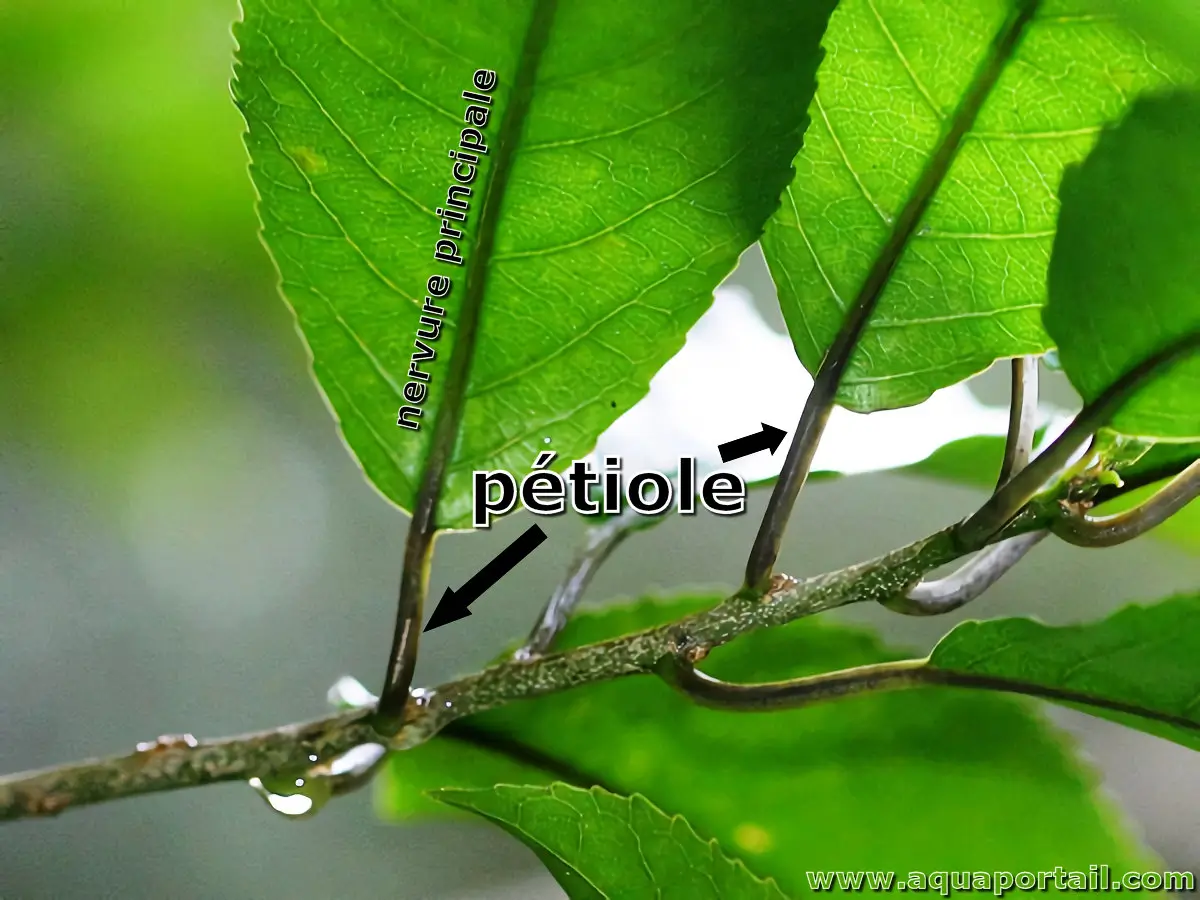
View of the long leaf petioles of Melicytus ramiflorus, a small tree native to New Zealand. The petioles can reach 30 mm (1.18 in) in length. Leaves grow alternately on branched twigs.
In plants with compound leaves, leaflets are attached to an extension of the petiole called the rachis, connected to the rachis by a short stalk called a petiolule. Swollen regions may occur at either end of the petiole, known as pulvini (singular: pulvinus), composed of flexible tissue that enables leaf movement. Pulvini are common in the bean family (Fabaceae) and the prayer-plant family (Marantaceae, including several houseplants). A pulvinus on a petiolule is called a pulvinulus.
In entomology
In insect anatomy, the petiole is the narrow waist of certain hymenopteran insects connecting the abdomen to the thorax. Its role and functions are analogous to the botanical petiole: transporting fluids between two major tagmata while providing extreme mobility between the abdomen and thorax.
The bulbous portion of the abdomen posterior to the petiole (and postpetiole) is called the gaster.
The petiole of a wasp:
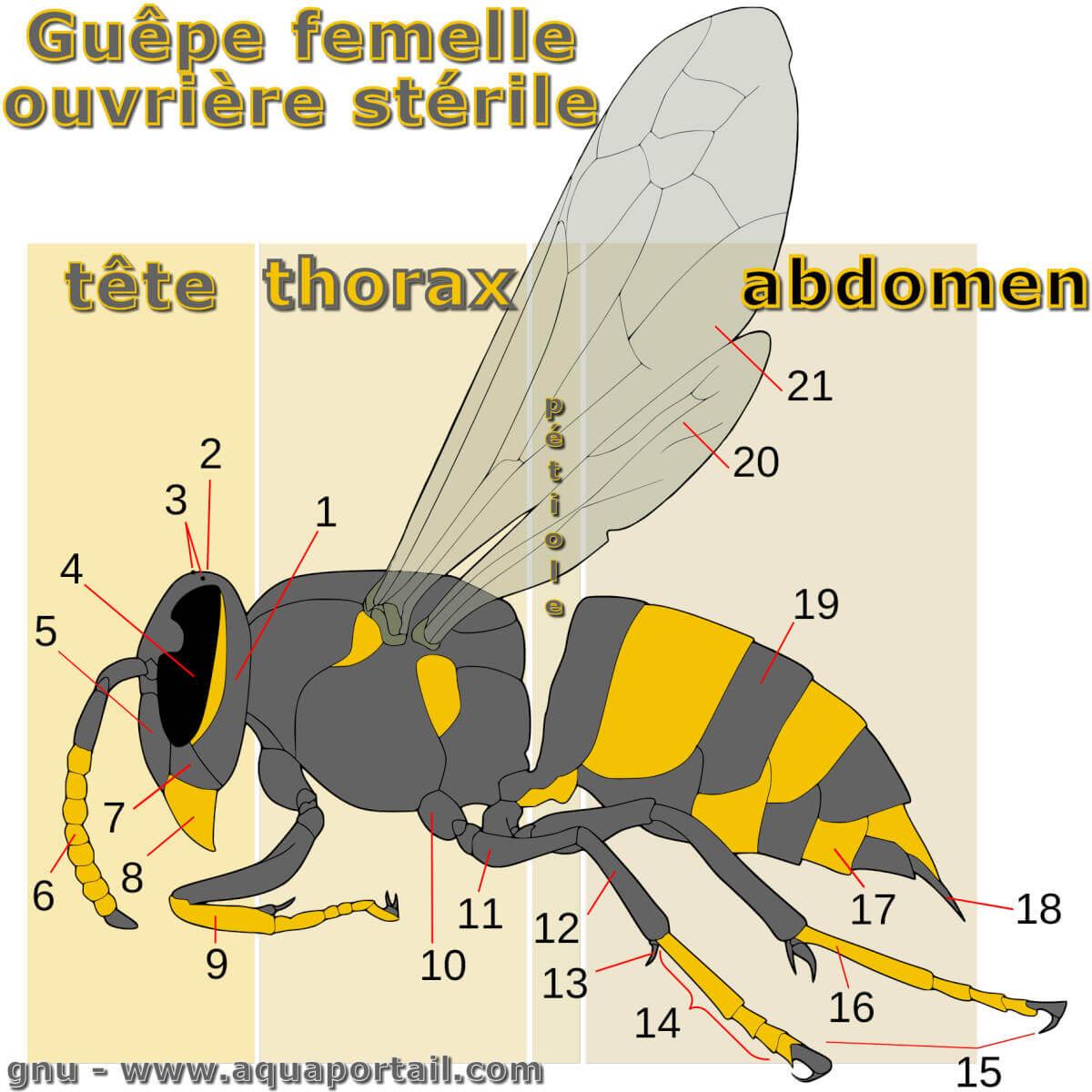
The petiole of an arthropod insect such as this wasp (worker female) is a pre-abdominal, post-thoracic region.
In certain insects (depending on the group or clade), the petiole designates a specific abdominal segment:
- in whiteflies (Hemiptera: Aleyrodoidea), it is the first abdominal segment;
- in apocritan hymenopterans such as wasps (giving rise to the expression wasp waist), it is the second abdominal segment, the first being firmly fused with the thorax into the mesosoma. The petiole forms the base of the metasoma.
In spheciform wasps (and certain other arthropods) with a constricted, stalk-like petiole, it is called a pedicel, and the enlarged posterior part is termed the postpetiole.
Conversely, in certain ants, the third abdominal segment is also called the postpetiole when it forms part of the abdominal waist (for example, in myrmicine ants). Together, the petiole, postpetiole, and gaster (posterior abdomen) make up the metasoma.
In arachnology, "pedicel" is the accepted term defining the constriction between the cephalothorax and abdomen in spiders.
The petiole (and optional pedicel) forms a mobile joint between the thorax and abdomen characteristic of many arthropods. It grants greater freedom of abdominal movement; in ants, for instance, this allows secretions to be sprayed forward or upward, which is particularly useful for depositing pheromones (or other substances).
Petiole may also be used in the context of wing venation, where a normally four-sided wing cell is reduced to a triangle with a stalk (the cell thus being petiolate).
Synonyms, antonyms
Spanish translation: pecíolo
7 synonyms (similar meaning) for "petiole":
- pedicel
- peduncle
- petiolule
- pseudopetiole
- stalk
- stem
- subpetiole
0 antonyms (opposite meaning).
Related words and expressions to PETIOLE are directly connected by general or specific meaning.
The word PETIOLE is listed on page 1 of words starting with P in the dictionary glossary.
Related to "petiole"
paedomorphosis

Paedomorphosis (juvenilization) is a phylogenetic change involving the retention of juvenile or even larval traits into a later (adult) stage.
pandemic

A pandemic is the widespread outbreak of an epidemic infectious disease across a vast geographic area at a given time.
parchment

Historically, true parchment is animal skin prepared (limed, dried, thinned, dressed) to write or print upon.
pasture

Pasture is agricultural land covered with grasses and herbaceous vegetation on which livestock graze.
