Parchment
noun (n.)
Definition
Historically, true parchment is animal skin prepared (limed, dried, thinned, dressed) to write or print upon. Parchment has been made for centuries and is generally made from calfskin, goatskin, or sheepskin. The term "calfskin vellum" refers to parchment made from calfskin.
Today, parchment is a strong, durable, and often somewhat translucent paper of a color giving the appearance of skin. It resembles papyrus.
A paper parchment:
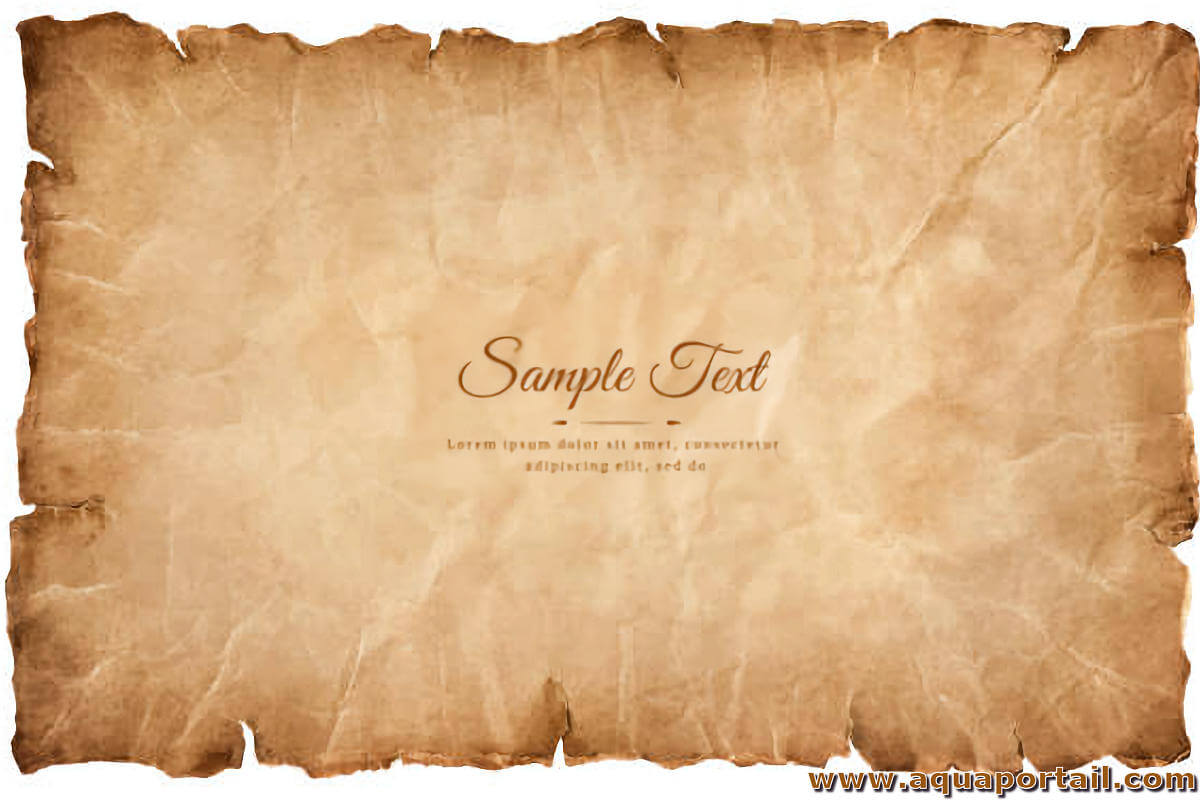
Paper parchment allows writing messages that look ancient or romantic, for example. Some university diplomas are written on parchment. Nowadays, parchment is a sheet of paper with an aged texture.
Explanations
Most ancient manuscripts are written on parchment. For example, an authentic Torah scroll is a complex masterpiece of labor and skill, comprising between 62 and 84 sheets of parchment that are limed, dried, scraped, and prepared according to the exact specifications mandated by Jewish law.
Writing on skin parchment requires inks and pigments suited to the skin texture. The development of papyrus, parchment, and paper, the three media most often used for book leaves, was quite radical!
Made from processed skins of sheep, goats, or calves (generally no more than 3 months old in the case of the latter), parchment production is a rather laborious task. The skin must be soaked in a weak lime solution to soften the hide, allowing the hair follicles to dissolve. Once this is done, the hair is scraped from the skin with a blunt, curved knife. Following this process, the skin is attached to a wooden frame to apply tension. While on the frame, another knife is used to remove any unwanted tissue, and as the skin dries, it thins. The more the skin is worked, the higher the quality of the parchment.
Parchment paper, meanwhile, is made from cellulose fibers, partially fermented in the presence of water. A wooden frame called a "deckle" is dipped into the solution of water and fibers, allowing the fibers to settle onto the wire mold as the water drains away. The fibers are then pressed to remove any excess liquid. Once done, the paper is hung on horsehair lines to dry.
Given that the paper we use today is impeccably clean and crisp, it was very interesting to see that the parchment and paper used for various manuscripts are covered with various patterns, in addition to being irregular in shape.
With regard to paper, the manufacturing process leads to patterns such as laid lines. This ribbed texture comes from the pattern of the wires used in the screen during water drainage. In addition to laid lines, one can look for watermarks identifying the papermaker - a design bent from wire and sewn onto the surface.
Comparing the tactile qualities of the two materials (skin and paper) reveals a major difference in texture between parchment and paper, the latter being much thinner and generally less rough.
⭐ In botany (especially), what has the appearance of parchment, thin and slightly translucent, is called "scarious."
History and historical use of parchment
Parchment, as a writing medium, predates true paper. Although it was thought to have been used as early as 1,500 BC, it was the King of Pergamon (197–159 BC) who was first credited with its invention. Indeed, the name apparently derives from the ancient Greek city of Pergamon (present-day Bergama in Turkey), where parchment is said to have been invented in the 2nd century BC.
Developed in response to the cessation of Egyptian papyrus exports to the region, parchment offered a viable substitute, even though the manufacturing process was rather complicated. Traditionally, parchment was made from split sheepskin. The wool side of the hide was processed into leather, a supple yet strong leather often used in bookbinding, while the flesh side became parchment. The skins required extensive washing, cleaning, and scraping. They were placed in vats of caustic lime and water where they were left to soak for several days, at least until the animal's hair had loosened enough to be easily removed. The wet hides were then removed and stretched tightly, using leather thongs, onto a large wooden frame.
Throughout much of the Middle Ages, dead cattle were the main ingredient of books. What was frolicking in the meadow one month might be a page of the Bible the next. The skin of animals (calves, goats, sheep) was turned into parchment, which was then cut into sheets. Parchment was introduced in late antiquity, when the codex (a book made of folded double leaves) emerged and began replacing the papyrus scroll.
Much can be told from a medieval skin. Like a physician today, the book historian can make a diagnosis by observing it closely. The quality of parchment sheets varied considerably. Like people today, not all medieval creatures had perfect skin. Some cows liked to rub against trees while others were particularly prone to insect bites. These flaws can still be seen today, appearing as tiny holes, gaps, or dark spots when reading.
Animal skin parchment with writing:

Detail showing hair follicles, the irregular edge of the animal skin, and uneven coloration on the parchment of a book likely used in monastic education. The term parchment is a general term designating an animal skin that has been prepared for writing or printing.
Page quality also had much to do with preparation. A scribe producing a book for his own library might be less careful than one working in a monastic community. The finest sheets have a deep white color, with a hint of yellow. They feel like velvet and emit a faint rustle when the page is turned.
Poor skin, on the other hand, crackles. It is uneven in thickness and shows blemishes and a variety of colors (image above). Looking at an imperfect skin is far more interesting than studying its flawless counterpart. Indeed, a flaw tells a story, shedding light on the book's production and providing clues about its use and storage after manufacture.
Medieval craftsmen were well aware of the variable quality of animal skins, which they used as the basis for their books. However, the calves, sheep, or goats that had given up their livelihood and hide for the sake of medieval readers were not always to blame - nor were the scribes. The most common imperfections are holes produced by the parchment-maker's knife.
Preparing parchment was a delicate affair. In order to strip the skin of its flesh and hair, it was attached to a wooden frame, stretched tight as a drum. If the parchment-maker's round knife (the lunellum) cut too deeply during this scraping process, tears or elongated holes would appear. A small puncture easily became a gaping hole. The art of preparing animal hide lay in applying just the right amount of pressure.
However, readers did not seem to mind the holes too much, and scribes generally wrote right around them, or repaired them.
Another skin issue encountered by scribes during book production was the animal's hair follicle, the skin organ that produces hair. These follicles appear as pronounced black dots on the white page. Often, parchment makers or scribes were able to pumice them down, producing the desired smooth, cream-colored surface.
However, if the follicles had been too deep in a calf or sheep, no dermatologist could have removed the blemish, let alone the scribe's blunt tools. The only thing to do was write around the patch. Follicles are useful because they allow us to determine, from the spacing between them, whether the animal was a calf, a sheep, or a goat. This, in turn, can shed light on where the manuscript was produced: the use of goat, for instance, often points toward Italy.
Transition to paper
In the 12th century, another material appeared in Europe: paper. Imported from Arab culture, it was initially used exclusively for documentary purposes, such as account books and letters. In a remarkable shift in scribal practices, by the 14th century, scribes across Europe began using paper for manuscripts.
Conservative scribes, such as monks, ignored the new material for some time, while others, especially those looking to save money, adopted it. Paper and parchment were used for all kinds of manuscripts, from bulky volumes to small portable books.
Difference between parchment and vellum
Anyone seeking to define parchment, and especially to distinguish it from vellum, faces a challenge. There seem to be as many variations in its meaning as there are books and articles written about it.
Some claim that the hides used in parchment making are not only those of sheep, but also of calves, lambs, and kids. Others suggest that the skin of any small animal (young or old) can be made into parchment. Still others believe it was the skin of young animals, particularly calves, that was used to make vellum exclusively, and not parchment.
To some extent, all of this is true, but here is what we really know:
- Today, the terms "parchment" and "vellum" are often used interchangeably to refer to animal skin that has been degreased and specially treated for use in writing, printing, or bookbinding
- Neither parchment nor vellum is tanned, so in a sense they are not true leather. Their lime preparation makes their surface much more paper-like; it certainly shares a similar look and feel
- Vellum, as a rule, is made from the whole skin of the animal; the hide is not split into two layers as with sheepskin parchment
- Vellum is generally distinguished from parchment by its grain and hair marks, which give rise to a somewhat uneven surface. Having been scraped so thin, parchment tends not to exhibit these features.
Synonyms, antonyms
Spanish translation: pergamino
2 synonyms (similar meaning) for "parchment":
0 antonyms (opposite meaning).
Related words and expressions to PARCHMENT are directly connected by general or specific meaning.
The word PARCHMENT is listed on page 1 of words starting with P in the dictionary glossary.
Related to "parchment"
undernourishment
Undernourishment is malnutrition due to insufficient intake, constituting undernutrition in most cases.
paedomorphosis

Paedomorphosis (juvenilization) is a phylogenetic change involving the retention of juvenile or even larval traits into a later (adult) stage.
pandemic

A pandemic is the widespread outbreak of an epidemic infectious disease across a vast geographic area at a given time.
pasture

Pasture is agricultural land covered with grasses and herbaceous vegetation on which livestock graze.
