Siamese fighting fish
noun phrase (n. phr.)
Definition
The Siamese fighting fish (Betta splendens) is a popular aquarium fish known for its large colorful fins and limited sociability. It is suitable for beginners in aquarium keeping, and it requires little space for breeding.
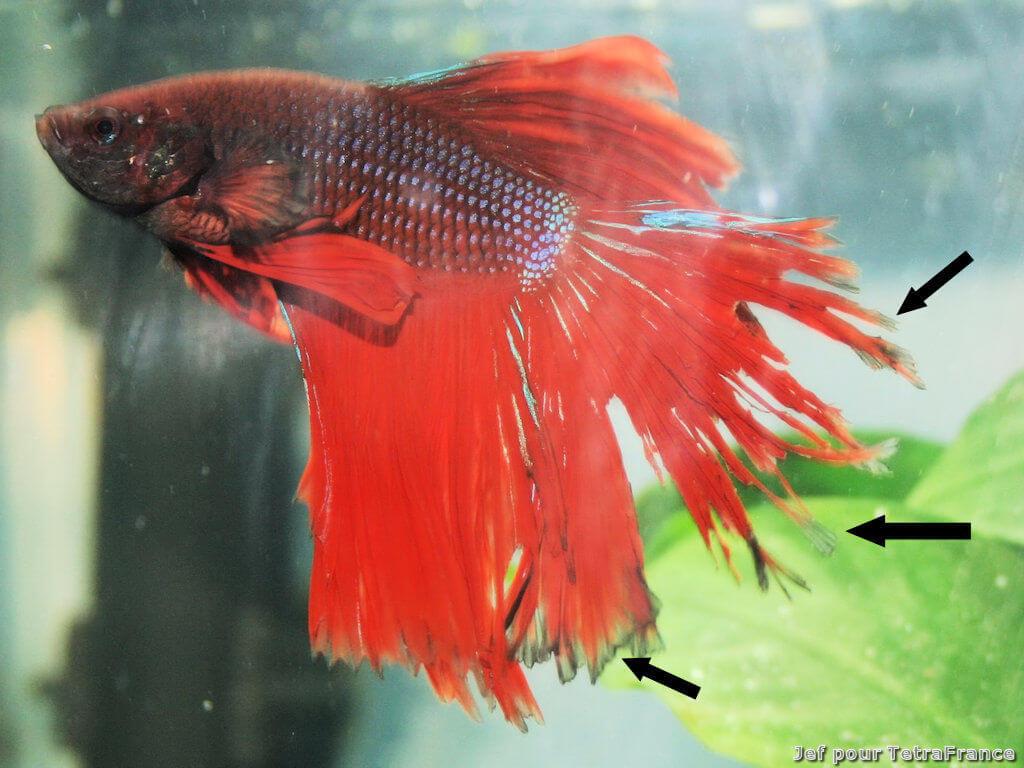
A male Siamese fighting fish:

This Siamese fighting fish has a red-colored body with fins edged with a light blue border. The fins are fully developed.
Explanations
The Siamese fighting fish is native to Southeast Asia, especially Thailand, but commercially available fish come from farms around the world.
Siamese fighting fish are easy to keep in a freshwater aquarium at a temperature of 25 °C (77 °F) if good nutrition is provided. Under the best conditions, the fish lives between 3 and 5 years.
In ichthyology, the name "Siamese fighting fish" brings together the 77 species (May 2025) of the genus Betta. The Siamese fighting fish, species Betta splendens, has its geographic origin in Thailand, in Southeast Asia. The male Siamese fighting fish is almost as popular as the goldfish, but females are less successful. In the wild, Betta mainly feed on worm-like prey (e.g., bloodworms) and aquatic insect larvae. In aquariums, they accept almost all aquarium foods.
Any captive-bred Siamese fighting fish can live for 2 to 3 years in a small-volume aquarium. For more details, see the lifespan of a Siamese fighting fish (and how to improve it).
However, under the best conditions or with perfectly controlled water parameters, male bettas living alone in large individual tanks and able to "exercise" every day have lived 6 years and longer in laboratories.
To achieve this long lifespan, it is mandatory to follow proper feeding of the Siamese fighting fish in an aquarium with excellent water quality, pure water obtained through frequent water changes.
In the aquarium
To keep a Siamese fighting fish B. splendens in an aquarium:
- Choose an aquarium of at least 20 liters (5.3 US gal)
- Heat the aquarium to about 25 °C (77 °F)
- Keep only one single male
- Feed two small meals every day
- Limit cohabitation to peaceful fish
- Avoid any association with small shrimp
- It can live at least 3 years, easily up to 5 years
- Its size is about 5 cm (2 in) SL, or about 6.5 cm (2.6 in) total length with the tail
The Siamese fighting fish lives at tropical temperatures, at least 23 °C (73.4 °F), and ideally at 25–26 °C (77–78.8 °F). It must not be kept without a heater in the aquarium.
Lifestyle
A Betta Siamese fighting fish must not live in a vase or bowl of less than 3 liters (0.8 US gal), but rather in a real aquarium with a minimum volume of 10 liters (2.6 US gal), and 20 liters (5.3 US gal) is better. Heat the aquarium to around 25 °C (77 °F) with a submersible heater, and keep it with one or two real aquatic plants (not plastic).
As a reminder, the natural habitat of the betta fish consists of shallow streams and rice paddies in Thailand. The water depth is not great, whereas the surface area is very large!
A 25-liter (6.6 US gal) Siamese fighting fish aquarium:
The Siamese fighting fish in an aquarium requires a complete set of equipment, like any tropical aquarium.
Siamese fighting fish are excellent jumpers: cover your aquarium, while leaving at least 3 to 5 cm (1.2 to 2 in) of air between the cover and the water surface. These ornamental fish have an organ called the labyrinth, allowing them to breathe atmospheric air, and they must be able to use it.
Above all, do not use an air stone (air pump): air bubbles disturb the water surface far too much, and Siamese fighting fish are perfectly adapted to living without high levels of dissolved oxygen in the water. In this case, the labyrinth compensates for this low dioxygen level if the need arises.
Tricolor Siamese fighting fish:
This tricolor Siamese fighting fish is a marvel of selective breeding among thousands of varieties. It displays the colors of the French national flag, in blue, white, and red.
Cohabitation and temperament
It is the irascible and intolerant nature of males toward one another that earns them the nickname "fighting fish", making the cohabitation of two males impossible. Indeed, two male fighting fish placed together will fight violently by flaring their throats, protruding their gill covers, and spreading all their fins as wide as possible to appear as large and strong as possible.
See also how Siamese fighting fish synchronize their fighting movements.
The wild ancestors of this fish originate geographically from the rice paddies and backwaters of Thailand (formerly called Siam), Malaysia, and Cambodia; they are called pla-kad in Thailand or Trey Krem in Khmer.
The cohabitation of Siamese fighting fish with other aquarium fish, from other species not of the same genus, is generally quite good, especially if the fish do not resemble Betta at all. Thus, other fish can be kept with a Siamese fighting fish if the aquarium volume allows it.
However, you must never put a fish with a large tail fin together with a Siamese fighting fish! Male guppies with long, veil-shaped caudal fins are chased by male fighting fish, and females are ruthless with female guppies, and sometimes even with mollies, platies, etc. Do not mix Siamese fighting fish and Poeciliids.
The Siamese fighting fish Betta splendens is not a high-speed swimmer, as very long fins are a handicap for its movements. Also, very fast and active species (such as many cichlids) risk stressing your handsome "blue", "red", or multicolored fish. Stress will make your fish fearful.
Varieties and breeds
Breeders have selectively bred and created numerous variants of fin shapes, colors, and body morphs of this bony fish. Thus, breeders have developed several different tail shapes, the caudal fin being particularly easy to "work" with.
The selected forms, varieties, and breeds are:
See the full article on the evolution of Siamese fighting fish Betta splendens strains.
Differences between male and female
A male Siamese fighting fish of the HalfMoon variety:
This blue male Siamese fighting fish whose large tail fin is a half-circle, imitating the moon, belongs to the HalfMoon variety-breed.
The male Siamese fighting fish is larger than the female, regardless of the variety. It is the more bellicose of the two sexes. The fins have more varied shapes and the colors are more elaborate. Female bettas tend to have simpler coloration and features.
Wild-type female Siamese fighting fish:
The female Siamese fighting fish differs from the male by its smaller size, a more uniform color pattern, and a less aggressive temperament.
Female bettas can live together comfortably in the same aquarium. As a general rule, a good number to keep together is 4–6 females (avoid keeping only one or two). They like having their own personal space, which means they should have enough vegetation to hide in when they want to be alone.
Aquarium keeping
Betta splendens is popular for several reasons, and its history deserves some detail, as it is also at the root of its success among aquarists. They are typical representatives of the Anabantoidei among labyrinth fishes.
Native to Thailand (formerly Siam), it has been bred there for over 600 years! This does not match the 1,000 years of the goldfish, but it makes it one of the oldest "domesticated" fishes.
Initially, it was the aggressive nature of the fighting fish that was all the rage: fights between two males were organized for betting. Note that fights very rarely went to the death of one of the two fish; a simple retreat was enough to declare the other victorious.
Siamese fighting fish photographed in 1937:
The two Siamese fighting fish, seen in traditional Thai jars dating from 1937, are intended to fight during exhibition bouts for betting. The practice still exists today.
Seeing the popularity of these fights, the King of Siam began collecting fighting fish. In 1840, he gave some of his prized fish to a man who, in turn, gave them to Dr. Theodor Cantor, a medical scientist.
Nine years later, Dr. Cantor wrote an article describing this species under the name Macropodus pugnax. In 1909, Mr. Tate Regan realized that there was already a species named M. pugnax, and he renamed the Siamese fighting fish Betta splendens.
For European aquarium keeping, this species was first imported into France in 1892 by the French aquarium fish importer Pierre Carbonnier in Paris (who had already imported the paradise fish). It was imported into Japan the same year.
There is more than one fighting Betta, and another species is even called the peaceful betta, which is not without irony. In English, it became the "Siamese Fighting Fish" or simply the betta, the genus name being derived from ikan bettah, from a local Malaysian dialect.
A Siamese fighting fish with flared fins (blue and orange):
This Thai Siamese fighting fish has orange and blue fins and a metallic green body.
Like any other aquarium fish, Betta are prone to classic diseases known and seen in freshwater aquariums: various infections (fungal, bacterial), especially fungal infections, white spot disease (ich), etc.
Hyperplasia in the Siamese fighting fish is mainly noticeable by dull eyes and gill covers with abnormally dark gills.
Colors
The color of Betta splendens fighting fish is partly determined by a combination of pigments expressed in their chromatophores and the depth of the cells beneath the scales. There are three main types of pigments that give fighting fish their color: red with erythrin (erythrophore), black with melanin (melanophore), and yellow with xanthin (xanthophore).
This magnificent male Siamese fighting fish is a typical B. splendens:
The species B. splendens comes in as many forms as genetics allows, producing splendid Siamese fighting fish.
Several photographs of Siamese fighting fish are available in this discussion thread: Siamese fighting fish of the Betta Club de Paris.
Related to "Siamese fighting fish"
fin rot
Fin rot in a fish is a common disease symptom in aquariums. This soft rot is a highly fatal disease if not treated promptly. Several expressions describe...
beginner aquarium fish

Every new aquarist wonders about their first aquarium fish. Here are several beginner aquarium fish suitable for unheated coldwater and tropical freshwater...
fish

A fish is a subaquatic vertebrate equipped with gills to extract oxygen from water and whose locomotor limbs are fins.
goldfish

Goldfish (species Carassius auratus) are popular freshwater aquarium fish thanks to their bright colorations, often yellow-orange, as well as golden yellow...
