Guppy
noun (n.)
Definition
The guppy is the South American freshwater fish Poecilia reticulata in the livebearing family Poeciliidae. Very easy to breed, guppies are among the most widespread and popular tropical freshwater aquarium fish today.
A male guppy:

The guppy is prized by aquarists for its colors, particularly those of the males, and its easy reproduction via internal fertilization, as Poecilia reticulata is livebearing.
Explanations
The guppy, Poecilia reticulata, is a livebearing fish of the family Poeciliidae. Male guppies, more slender than females, sport ornate caudal and dorsal fins. In their natural habitat, they feed on benthic algae and aquatic insect larvae. Highly adaptable, guppies thrive in diverse environments and are widely used as model organisms in ecology and ethology studies.
In the aquarium hobby, only goldfish and Siamese fighting fish surpass the countless varieties of guppies in popularity.
The guppy is native to northeastern South America, though the species has been introduced across most subtropical and tropical regions worldwide for its insectivorous (mosquito larvae) and algivorous (aufwuchs) diet. In an aquarium, the guppy is omnivorous, readily accepting any food suited to its mouth size.
A female guppy carrying developing young is termed gravid (or gestating).
Official varieties
Guppies come in numerous shapes and colors, and males exhibit long, large tails following generations of selective breeding. Females quite often remain uniformly gray, with only the tail occasionally colored differently from the wild form.
The 12 guppy fin shapes illustrated:

The guppy exists in a wide variety of shapes categorized into 3 groups of 4 shapes each, forming the international "IKGH" standard of 12 distinct show morphs.
"Broadtail" guppies:
- "Fantail" shape: the caudal fin angle is 45°; the dorsal fin is pointed.
- "Triangletail" (Delta) shape: the caudal fin angle is 70°; the dorsal fin is broad; this is one of the most common forms in the aquarium trade.
- "Veiltail" shape: the caudal fin is fairly elongated and curved; the dorsal fin has a rounded tip.
- "Flagtail" (Scarftail) shape: the caudal fin has parallel upper and lower edges; the dorsal fin is pointed.
"Swordtail" guppies:
- "Doublesword" shape: the two straight sword extensions diverge at roughly 60°; the dorsal fin and swords are pointed.
- "Topsword" shape: the sword extension is horizontal or angled up to 30° above the body axis.
- "Bottomsword" shape: the sword forms a 30° angle below the body axis, making this morphological trait very similar to the green swordtail Xiphophorus hellerii.
- "Lyretail" shape: the base of the caudal fin is rounded and the two swords curve outward, while the dorsal fin curves upward.
"Shorttail" guppies:
- "Spadetail" (Cofertail) shape: the caudal fin has a very regular spade shape; the dorsal fin is short and pointed.
- "Speartail" shape: the caudal fin is pointed, resembling a spearhead; the dorsal fin curves upward.
- "Roundtail" shape: the caudal fin is rounded; the dorsal fin is rounded.
- "Pintail" (Needletail) shape: the caudal fin is rounded at the base and tapers to a needle-like point; the dorsal fin is pointed.
Several varieties of male guppies grouped in this image:
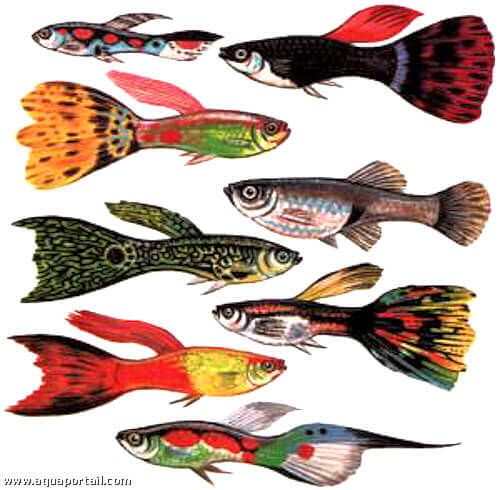
Guppies display attractive shapes and colors whose genetic study fascinates ichthyologists.
With a "Triangletail" (letter B), the blue male guppy shown in the species profile photo is representative of the ornamental fish classically kept in aquariums by beginners and livebearer specialists alike.
There is also the "Endler's guppy," a smaller relative with distinct colors and traits that can be maintained in a pico aquarium.
Diseases
Guppies have high tolerance for diverse water conditions and physicochemical parameters because aquarium specimens are captive-bred rather than wild-caught. Under good husbandry conditions, they rarely fall ill.
However, aquarists must watch out for what English speakers call the "guppy killer" disease, capable of wiping out an aquarium of guppies (and other Poeciliids) within a few days.
Guppy killer disease is often confused with ich (white spot disease), though only microscopic examination can confirm it. Infected fish may exhibit white cysts on the body and fins, along with labored breathing, lethargy, and clamped fins. Muscular swellings and grayish mucus patches, particularly in dark-bodied fish such as black mollies, may also appear.
Despite its name, guppy killer disease affects various fish species, including cichlids, catfish, and tetras, although guppies and their close relatives (e.g., mollies and Limia spp.) are most vulnerable. Unlike ich, guppy killer disease progresses rapidly and can prove fatal within a single day. Standard treatments for ich or velvet disease are generally ineffective.
This disease is caused by ciliated protozoans of the genus Tetrahymena, such as Tetrahymena corlissi and Tetrahymena pyriformis. These protozoans are not obligate parasites and usually coexist harmlessly in aquariums, feeding on organic matter on fish surfaces. They become pathogenic under conditions of malnutrition, stress, or poor water quality, which weaken fish immune defenses and lead to tissue invasion and lesions.
Aquariology
Guppy is the common name of Poecilia reticulata, a hugely popular ornamental fish sometimes also called "veiltail" in reference to long-tailed male varieties.
Poecilia reticulata has been known to the aquarium world since 1866, when the English naturalist Dr. Robert John Lechmere Guppy caught several small, hardy, brightly colored fish in the St. Ann's River in Trinidad. After donating them to Dr. Albert Günther, keeper at the Natural History Museum in London at the time, Günther named these little fish Girardinus guppyi, believing them to be a new species.
Scientific literature revealed that this guppyi had already been described in 1859 by Dr. Wilhelm Peters from specimens collected in Venezuela; the scientific name Poecilia reticulata already existed. Nevertheless, the aquariological history of this fish did not end there, and the guppy acquired roughly a dozen binomial synonyms over time. The most recent name change occurred in 1963, when Lebistes reticulatus was reclassified back to its original name, Poecilia reticulata. The common name "guppy" endured in everyday usage, perpetually honoring Dr. Guppy's discovery. The original specimens collected by Mr. Guppy are preserved at the Natural History Museum in London.
The subgenus Lebistes contains five other species, all native to South America, several of which were imported into Europe starting in 1979. These are small fish: Poecilia parae Eigenmann 1894, for example, does not exceed 2 cm (0.8 in), while Poecilia branneri Eigenmann 1894 is barely larger. Acclimating them is delicate because they originate from a restricted geographic range with minimal biotic fluctuations.
Synonyms, antonyms
French translation:
guppySpanish translation: gupi
2 synonyms (similar meaning) for "guppy":
- Poecilia reticulata
- veiltail
0 antonyms (opposite meaning).
Related words and expressions to GUPPY are directly connected by general or specific meaning.
The word GUPPY is listed on page 1 of words starting with G in the dictionary glossary.
Related to "guppy"
gabelle
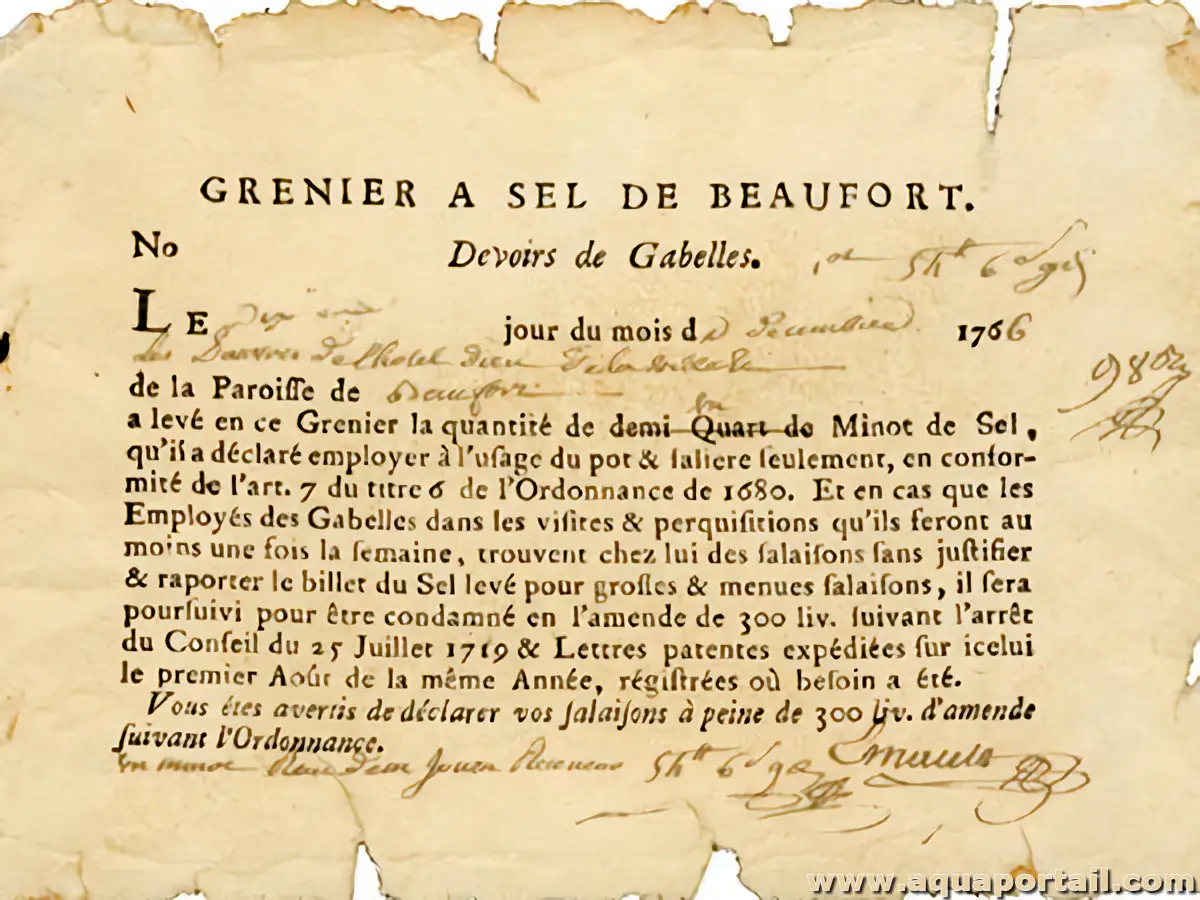
The gabelle was an ancient excise tax on salt. This indirect tax remained the main source of revenue for the French monarchy until the Revolution of 1789...
gardening

Gardening is the practice of growing plants in a garden, encompassing planting and plant care activities in a domestic and family setting.
genital

Genital refers to what relates to biological genesis (generation), animal reproduction, and reproductive organs such as the genital tract, genital organs...
genus

In biology, the genus is a unit of the systematic classification of living beings, a taxonomic rank within which species sharing common characteristics...
