Gabelle
noun (n.)
Definition
The gabelle was an ancient excise tax on salt. This indirect tax remained the main source of revenue for the French monarchy until the Revolution of 1789 (abolished on March 21, 1790). The gabelle existed in several regions, including France, Savoy, Lorraine, Switzerland, as well as China, Japan, and British India.
An excise is an indirect tax (duty, levy) on the quantity (and not on the price as VAT does today) sold or used of certain goods, such as alcohol, tobacco, and energy, and historically wheat, flax, spices, and salt.
A 1766 text on the gabelle:
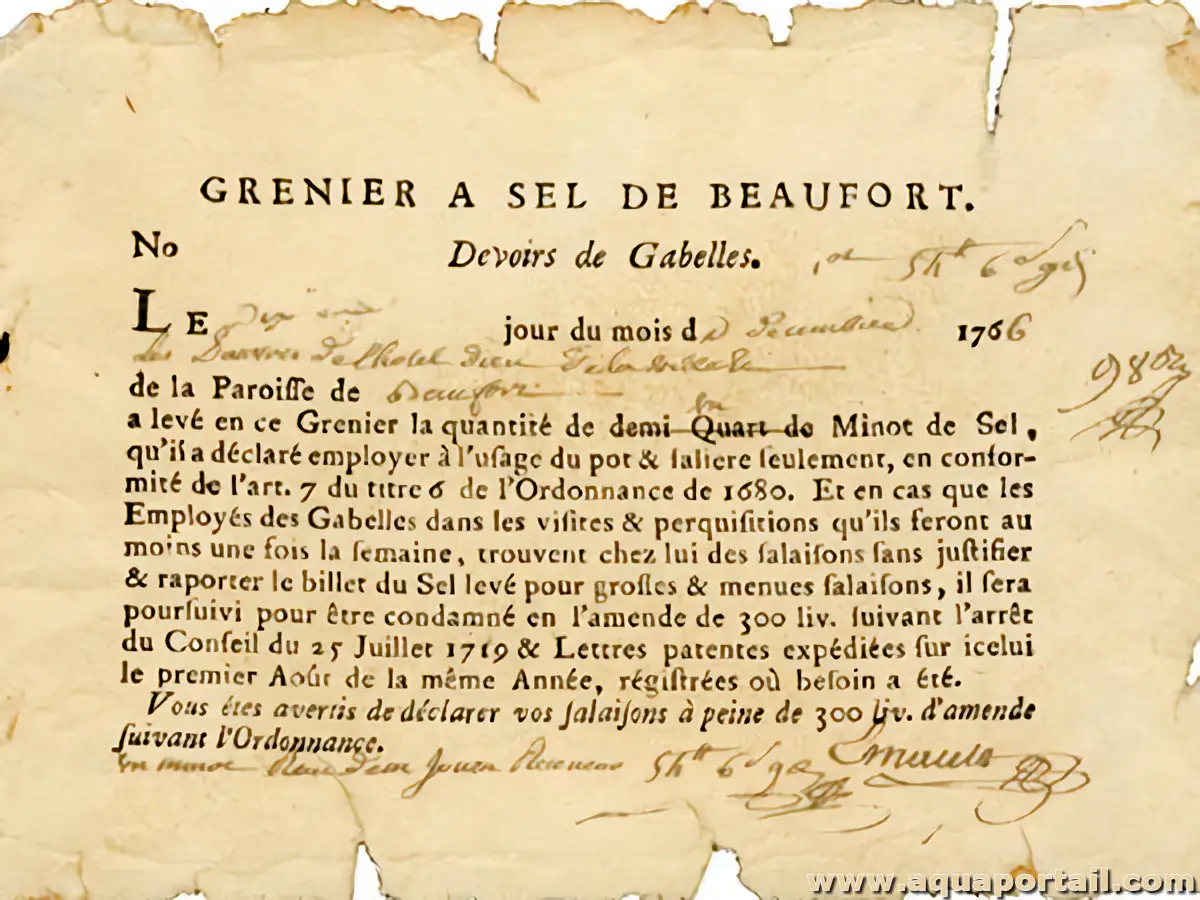
The gabelle, a word first recorded in 1342, remained a major source of revenue for the kings of France until 1790.
Explanations
Appearing as early as 1246 during the reign of King Louis IX, the word "gabelle," derived from Occitan Gabèla and Italian Gabella, became an official term in the year 1342. Those who collected this tax were called "gabelous" (tax collectors).
The gabelle became a permanent tax under Charles V (King of France from 1364 to 1380). The royal government required every person over the age of eight to purchase a minimum weekly quantity of salt at a fixed price. The excise thus functioned as a state monopoly.
The gabelle, as a permanent excise tax for over 400 years, sparked several rebellions! During the Middle Ages, the "taille" was another deeply unpopular tax, an arbitrary levy collected by a lord from his peasants in exchange for his "protection."
Because the tax affected all French citizens (for cooking, food preservation, cheesemaking, and livestock) and propagated extreme regional disparities in salt prices, the gabelle remained one of the most hated and unequal sources of revenue in the country's history.
Thus, for some, the salt tax, the gabelle, was "a crime destroying one of nature's blessings"!
Repealed in 1790 by the National Assembly amid the French Revolution, it was later reinstated by Napoleon Bonaparte in 1806. The gabelle was briefly suspended and then restored during the French Second Republic (1848–1851) and finally abolished in 1945 after the liberation of France from Nazi Germany.
When the gabelle was first introduced, it was levied uniformly across all provinces of France, but for most of its history it varied across different provinces, which can be classified into five groups:
- Pays de grandes gabelles, with the highest tax: Normandy, Champagne, Picardy, Île-de-France, Maine, Anjou, Touraine, Orléanais, Berry, Burgundy, Bourbonnais
- Pays de petites gabelles, where the tax was half the former rate (grey quarter): Dauphiné, Vivarais, Gévaudan, Rouergue, Provence, Languedoc
- Pays de salines, where the tax was levied on salt from salt marshes (olive quarter): Lorraine, Alsace, Franche-Comté, Lyonnais, Dombes, Roussillon
- Pays rédimés, which purchased a tax exemption in 1549 (green quarter): Poitou, Limousin, Auvergne, Saintonge, Angoumois, Périgord, Quercy, Bordelais, Guyenne
- Pays exemptés (pays de franc-salé), which required a tax exemption upon uniting with the Kingdom of France.
Producers had to deliver their salt to salt granaries (salt stores established since 1342) set up in each province. Failure to comply with this obligation resulted in confiscation. The "Salt Chamber" set the price it paid for the salt and then sold it to retailers at a higher rate.
Synonyms, antonyms
Spanish translation: gabela
1 synonym (similar meaning) for "gabelle":
0 antonyms (opposite meaning).
Related words and expressions to GABELLE are directly connected by general or specific meaning.
The word GABELLE is listed on page 1 of words starting with G in the dictionary glossary.
Related to "gabelle"
gardening

Gardening is the practice of growing plants in a garden, encompassing planting and plant care activities in a domestic and family setting.
genital

Genital refers to what relates to biological genesis (generation), animal reproduction, and reproductive organs such as the genital tract, genital organs...
genus

In biology, the genus is a unit of the systematic classification of living beings, a taxonomic rank within which species sharing common characteristics...
geography
Geography is the science studying the physical features—geomorphology—of Earth and its atmosphere.
