Throat
noun (n.)
Definition
In anatomy, the throat is the passage, composed of the pharynx and larynx, leading from the back of an animal's mouth. It is a ring-like muscular tube that serves as a passageway for air, food, and liquids (fluids from the nose and mouth). The throat also helps form speech.
In geology, a gorge is a canyon, a large cleft between two cliffs through which a watercourse runs, with a deep, narrow valley with steep sides.
Anatomy of the throat:
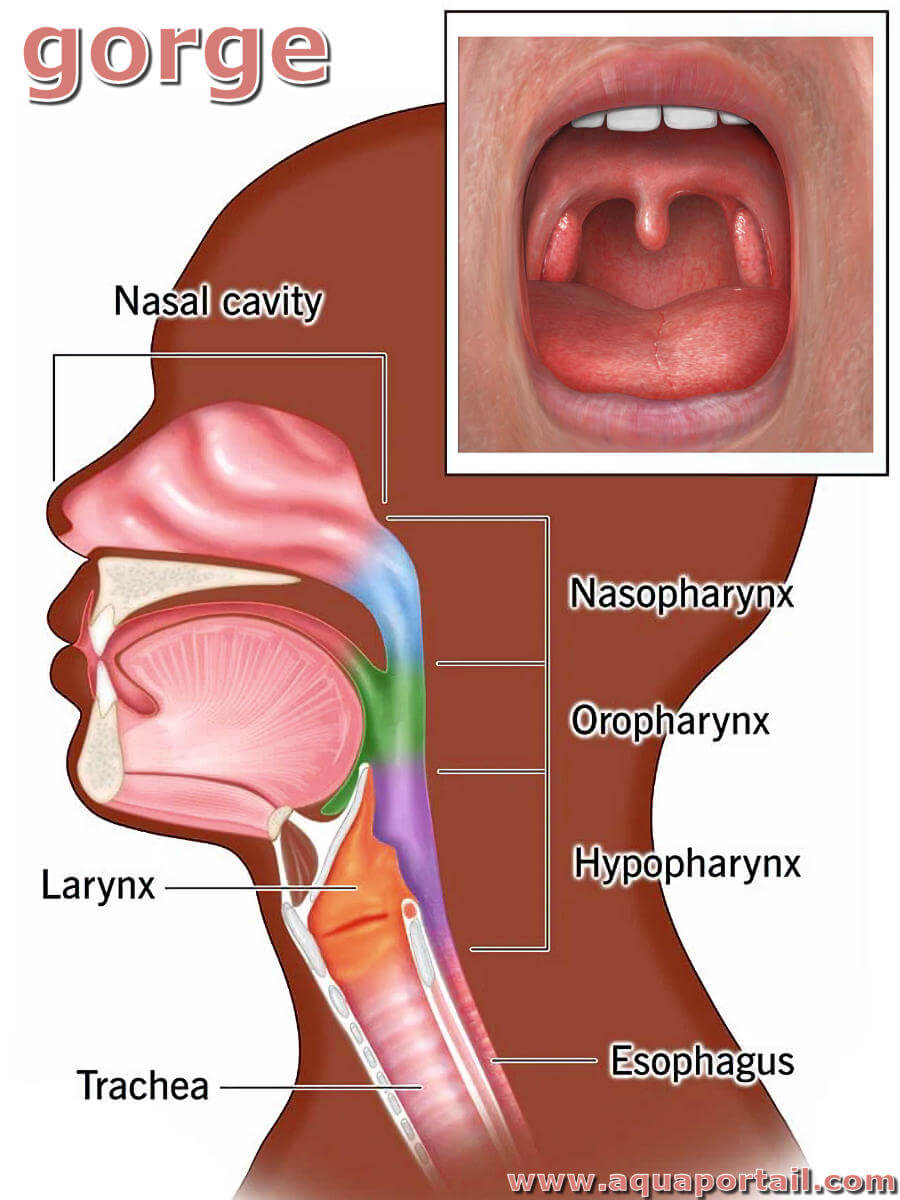
Anatomical view of the human throat. The throat includes the esophagus, trachea, larynx, tonsils, and especially the epiglottis. The pharynx is a hollow muscular tube inside the neck that begins behind the nose and opens into the larynx and esophagus. The three parts of the pharynx are the nasopharynx, oropharynx, and hypopharynx.
Anatomical throat
The throat is the front part of a person's or animal's neck, behind which lie the esophagus, trachea, and blood vessels supplying the head.
✅ See also the jugulum, which is a lower part of the throat above the sternum.
The pharynx is the site of common illnesses, notably sore throat and tonsillitis.
The throat contains:
- Tonsils and adenoids: made up of lymphatic tissue. The tonsils are located at the back and sides of the mouth, and the adenoids are located behind the nose. Both help fight infections. Removing the tonsils and adenoids, if necessary, will not reduce your child's ability to fight infections, as many other tissues perform this function
- Pharynx: the muscle-lined space connecting the nose and mouth to the larynx and esophagus (food pipe)
- Larynx: a cylindrical grouping of cartilages, muscles, and soft tissues containing the vocal cords. The larynx is the upper opening of the trachea, the passageway to the lungs
- Epiglottis: a flap of soft tissue and cartilage located just above the vocal cords. The epiglottis folds over the vocal cords to help prevent food and irritants from entering the lungs
- Subglottic space: the space immediately below the vocal cords. It is the narrowest part of the upper airway.
Geological gorge (canyon)
A gorge is a narrow valley with steep rocky walls located between hills or mountains. The term "gorge" is often used to mean "canyon," though a gorge is almost always steeper and narrower than a canyon.
A geological gorge is a deep V-shaped land area cut by steep rocky slopes. Gorges channel torrents, rivers, or streams through the Earth's crust over millions of years.
The Verdon Gorge in France:

The Verdon Gorge, in France, is the largest gorge in Europe, a prime destination for hiking, rock climbing, and whitewater sports.
A gorge is often smaller than a canyon, although both words are used to describe deep, narrow valleys with a stream or river flowing along their bottom.
⭐ The Kali Gandaki Gorge in Nepal is the largest gorge in the world. Sandwiched within the Himalayas, the Kali Gandaki Gorge in Nepal is surrounded by the towering massifs of Annapurna and Dhaulagiri, rising to over 8,000 m (26,247 ft) in elevation.
Synonyms, antonyms
French translation:
gorgeSpanish translation: garganta
7 synonyms (similar meaning) for "throat":
- canyon
- crop
- esophagus
- gullet
- jugulum
- neck
- trachea
0 antonyms (opposite meaning).
Related words and expressions to THROAT are directly connected by general or specific meaning.
The word THROAT is listed on page 1 of words starting with T in the dictionary glossary.
Related to "throat"
tagma

A tagma is a group of fused segments formed by series of metameres differentiated from the rest of an arthropod's body.
tapeworm

The tapeworm, or solitary worm, is a long, ribbon-like, segmented flatworm, a parasitic cestode of the genus Taenia.
tectonics

Tectonics is a branch of geology that studies the structure of the crust of a planetary body, such as Earth or the Moon, particularly the formation of folds...
teliospore

A teliospore (teleutospore) is a thick-walled, multicellular fungal spore from which the basidium develops.
Simple summary
The throat designates the anatomical structure forming the anterior part of the neck. This region encompasses several vital elements, notably the pharynx and larynx, which are involved in respiration, phonation, and the passage of food. The throat serves as a conduit connecting the oral and nasal cavities to the trachea and esophagus, thus participating in both the respiratory and digestive systems.
