Himalayas
proper noun
Definition
The Himalayas, or Himalayan range, constitute a vast and imposing mountain system spanning five South Asian countries: Bhutan, India, Nepal, China, and Pakistan. This massif is renowned for harboring the highest peaks in the world, including Mount Everest, which rises to 8,848 meters (29,029 ft) above sea level.
A peak in the Himalayan range:

The Himalayas are a mountain system featuring iconic summits such as Mount Everest and Annapurna. The formation of the Himalayas resulted from the tectonic collision between the Indian Plate and the Eurasian Plate millions of years ago, a process that continues to shape the geology of surrounding regions.
Explanations
Geomorphologically, the most unique feature of the Himalayas is the dizzying elevation they have attained, crowned by several of the highest snow-capped peaks on Earth, including 10 of the world's 14 eight-thousanders (peaks exceeding 8,000 m / 26,247 ft). Most of the highest peaks on Earth are located across various sections of the Himalayas, predominantly in the central sector.
The Himalayas form a massive crescent-shaped mountain range stretching over 2,500 km (1,550 mi) from the southern Indus valley, beyond Nanga Parbat in the west, to Namcha Barwa in the east. The width of the Himalayan range varies from 350 km (217 mi) in the west to 150 km (93 mi) in the east. Displaying a prominent southward convexity, the majestic mountain chain stands like a wall bordering the entire northern margin of the Indian subcontinent.
The Himalayas are the highest and most majestic mountain range in the world, as well as the natural boundary between the Tibetan Plateau and the Indian subcontinent, stretching continuously for 2,500 kilometers (1,550 mi) from west to east. Acting as both a natural barrier and a climatic divide, the Himalayas play a decisive role in the region's climate and hydrology.
✅ Himalaya (Sanskrit: हिमालय) means "abode of snow" in Sanskrit.
Mountain ranges do not belong to any single country, though China (Tibet), Nepal, and Bhutan hold sovereignty over most of the Himalayas, with Pakistan and India also occupying portions. Most of the Himalayas lie along the border between China and Nepal, including their highest summit, Mount Everest (8,848 m / 29,029 ft), the highest peak in the world.
The four main highest peaks of the Himalayan region are:
- Everest (8,848 m / 29,029 ft, China and Nepal), the highest mountain above sea level in Asia and on Earth (world record).
- K2 (8,611 m / 28,251 ft, China and Pakistan), regarded as the second most difficult mountain to climb after Annapurna (a 24% fatality rate on K2 attempts versus 40% on Annapurna).
- Kangchenjunga (8,598 m / 28,209 ft, India and Nepal).
- Annapurna (8,091 m / 26,545 ft, Nepal).
View of Mount Everest in the Himalayas (Nepal and China):

Mount Everest is the highest peak in the world, rising to 8,848 m (29,029 ft) above sea level.
An important geomorphotectonic feature of the Himalayas is the sharp bending of the Himalayas and associated ranges, which at the western end meet the Sulaiman and Kirthar ranges at the southwestern terminus. A similar bend occurs at the eastern end, where the mountain chain meets the north-trending Indo-Burman ranges represented by the Naga Hills and Arakan Yoma. These two tight bends on either side of the mountain chain are commonly known as the "syntaxes" (syntaxial bends) of the Himalayan mountain belt.
Geographical map of the Himalayan range:
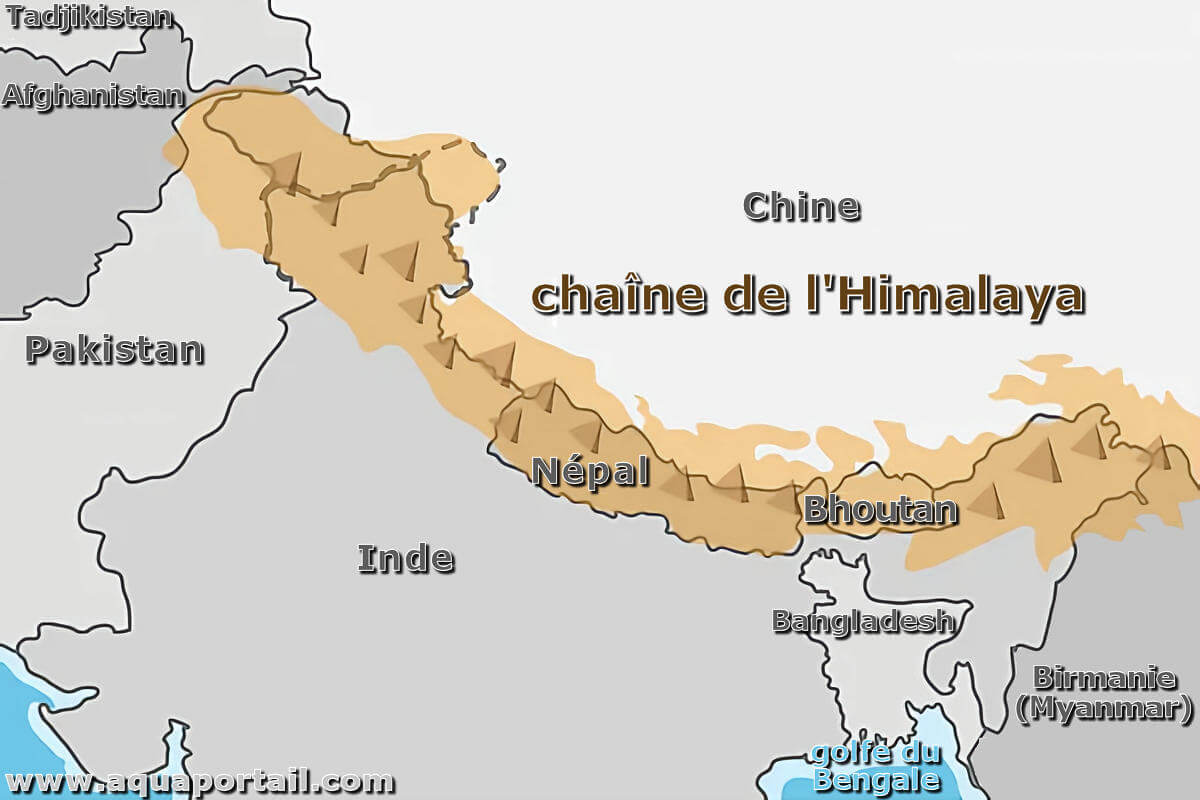
The Himalayan range spans several neighboring countries, but encompasses primarily Nepal and Bhutan, two nations situated wholly within the Himalayas.
The northernmost part of the Himalayas lies in Pakistan, Kashmir, and Ladakh, followed by much of the northern foothills across central Tibet, while the southern foothills lie in India, Nepal, Sikkim, and Bhutan. Neighboring Asian countries south of the Himalayas, from west to east, are Afghanistan, Pakistan, India, Nepal, Bhutan, and Myanmar; to the north of the Himalayas lies a single country: China.
The Himalayas lie mainly across five countries, namely China (Tibet), Nepal, Bhutan, India, and Pakistan.
The geophysical characteristics of the Himalayas are as remarkable as the geomorphotectonic features of the range. Their most distinctive trait is the thickness of Earth's crust, which increases from about 35 to 40 km (22 to 25 mi) beneath the Indo-Gangetic-Brahmaputra plains to between 65 and 80 km (40 and 50 mi) beneath the High Himalayas. The thick continental crust underlying the Himalayas is reflected in a strong negative gravity anomaly ranging between -150 and -350 mGal along the entire length of the mountain belt. Increasing crustal thickness is mirrored in the dip of the Moho discontinuity (Mohorovičić discontinuity), estimated at 7 to 8°N beneath the Sub-Himalayas and increasing to over 15° further north. A complex Moho architecture featuring subducting and overlapping segments indicates lithospheric imbrication.
Synonyms, antonyms
Spanish translation: Himalaya
2 synonyms (similar meaning) for "himalayas":
- Himalayan mountain chain
- Himalayan range
0 antonyms (opposite meaning).
Related words and expressions to HIMALAYAS are directly connected by general or specific meaning.
The word HIMALAYAS is listed on page 1 of words starting with H in the dictionary glossary.
Related to "Himalayas"
halitosis

Halitosis (bad breath) is primarily caused by sulfur-producing bacteria that normally live on the surface of the tongue and in the throat.
hallux

The hallux is the big toe (great toe) of a foot, homologous to the thumb of a hand. It is located on the medial (inner) side of the foot, whereas the little...
hand

The human hand, the most distal part of the upper limb, is a remarkable feat of engineering and evolution.
hardiness

Hardiness characterizes what is hardy, enduring time and weather like things living in the countryside.
