Homoplasy
adjective (adj.)
Definition
Homoplasy is the parallel evolutionary change that leads two organisms to exhibit the same trait acquired independently. This technical term is encountered in the concepts of parallelism, convergence, and reversal. It is primarily used in molecular biology to compare gene sequences, whereas in morphology it more commonly refers to a convergent feature.A homoplasy between two species:
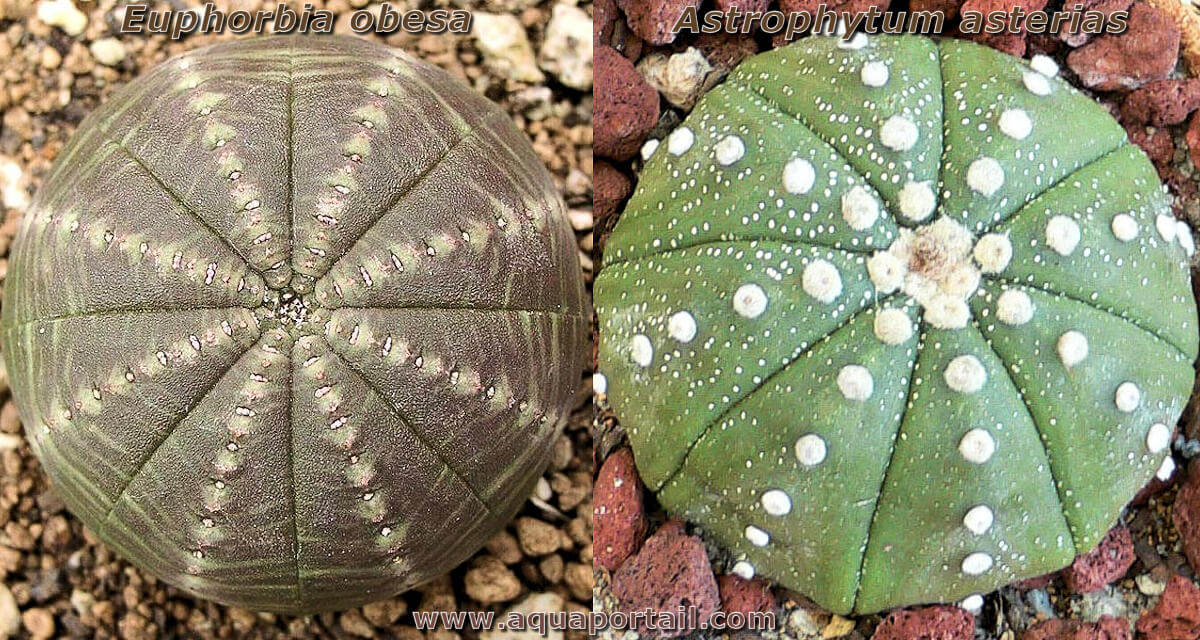
To speak of homoplasy, the equivalence must involve homologous structures (shown here in two species: Euphorbia obesa and Astrophytum asterias), or structures that may be regarded as homologous until homoplasy is demonstrated and they are shown not to be truly homologous.
Explanations
Homoplasy is the cladistic term for convergent evolution. Convergent evolution, or convergence, is the independent evolution of similar features in species of different lineages. Convergence creates analogous structures that have a similar form or function, yet were not present in the last common ancestor (cenancestor) of those groups.
Differences between homoplasy and convergent evolution
The convergent evolution of a homoplasy is distinguished from parallel evolution or divergent evolution. An example of convergent homoplasy is the recurrent evolution of flight, as in insects, birds, and bats, which independently evolved the capacity for powered flight.
Numerous cases of convergent evolution are known in plants, including the repeated development of C4 photosynthesis and seed dispersal via fleshy fruits adapted to be eaten by animals.
⭐ A homoplasy is a character shared by a set of species but absent in their common ancestor. A classic example is the evolution of the eye, which originated independently across many different lineages. When this occurs, it is sometimes referred to as convergence.
The opposite of homoplasy is homology. Homoplasy is also broadly understood in the sense of analogy (analogous traits). The term "homogeneity" contrasts with homoplasy or evolutionary convergence. The adjective derived from homoplasy is homoplastic (or homoplasious), whereas homoplastic in cytology derives from homoplasty. The term homoplasy was introduced into technical usage in 1870 by Ray Lankester.
Molecular homoplasy
In molecular biology, the term homoplasy is used when discussing molecular markers. Many molecular markers rely on the polymerase chain reaction (PCR), which amplifies (creates numerous copies of) short DNA fragments.
Some examples of PCR-based molecular markers include RAPD, AFLP, SSR, and SNP, among others. PCR-based molecular markers also employ polyacrylamide gel electrophoresis, or PAGE, to separate PCR products according to their length in base pairs.
Under these conditions, fragments of identical size but differing base sequence are termed homoplastic alleles. Molecular markers using PAGE under denaturing conditions (preventing secondary structure formation in DNA fragments so they remain in a linear configuration) rely on the assumption that equal-sized fragments share the same sequence. Consequently, homoplastic alleles are misleading in that they can suggest two fragments are identical when in fact they share only base-pair length. Molecular markers represent a major modern phylogenetic tool.
See also biological character, sexual character, apomorphy, and plesiomorphy.
Synonyms, antonyms
Spanish translation: homoplasia
3 synonyms (similar meaning) for "homoplasy":
- convergence
- convergent evolution
- parallelism
1 antonym (opposite meaning):
Related words and expressions to HOMOPLASY are directly connected by general or specific meaning.
The word HOMOPLASY is listed on page 1 of words starting with H in the dictionary glossary.
Related to "homoplasy"
halitosis

Halitosis (bad breath) is primarily caused by sulfur-producing bacteria that normally live on the surface of the tongue and in the throat.
hallux

The hallux is the big toe (great toe) of a foot, homologous to the thumb of a hand. It is located on the medial (inner) side of the foot, whereas the little...
hand

The human hand, the most distal part of the upper limb, is a remarkable feat of engineering and evolution.
hardiness

Hardiness characterizes what is hardy, enduring time and weather like things living in the countryside.
