Heat wave
noun (n.)
Definition
A heat wave is a prolonged period of excessively high temperatures lasting at least 3 days, exceeding climatic normals for a given region and season. High temperatures, both day and night, can expose people to health risks. It may occur with or without high humidity.
Orange heat wave vigilance thresholds in France:
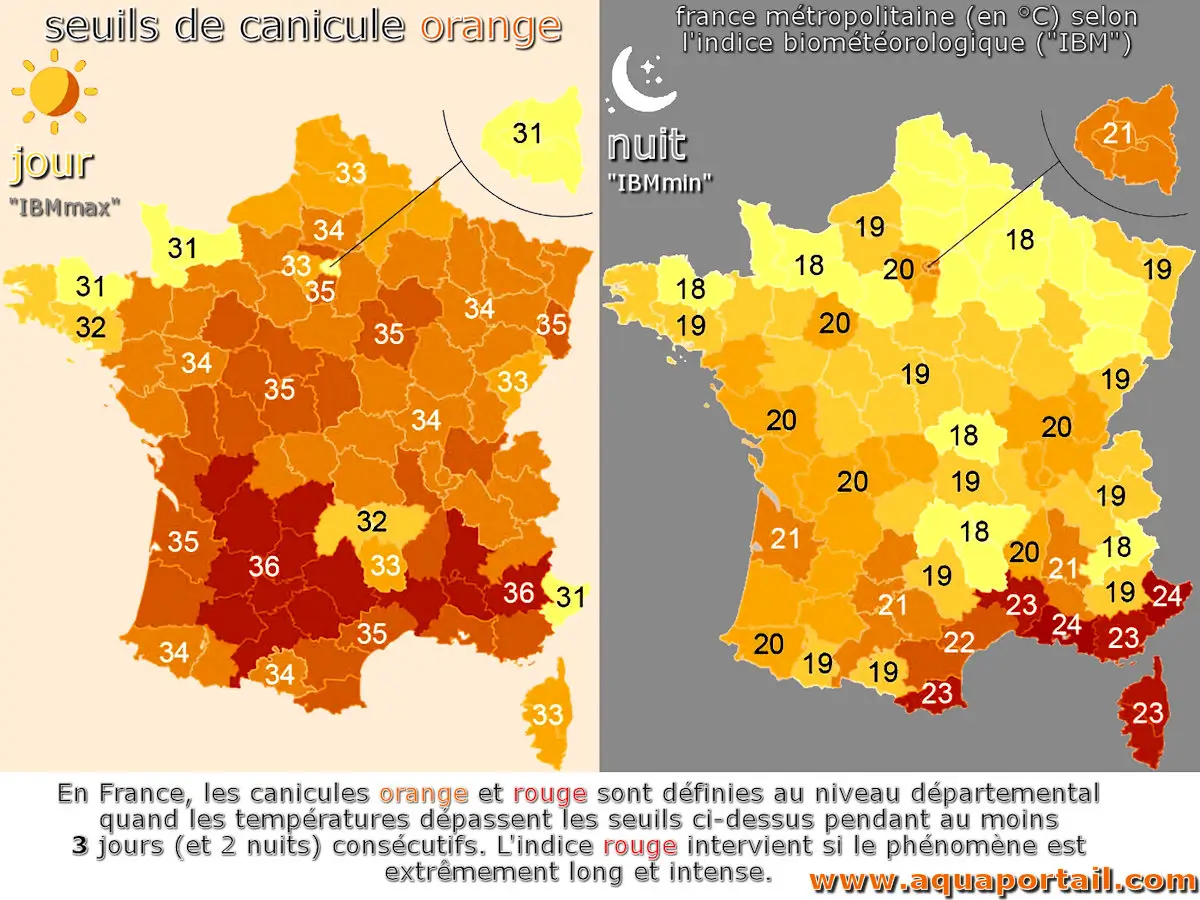
A heat wave is declared by meteorologists and governments when a hot spell lasts for several days with temperatures exceeding a legal threshold that varies by country (and latitude). Vigilance thresholds are often set around 30 °C (86 °F) by day and 21 °C (70 °F) at night, though they depend on the average temperature of the country or region. See the map of "heat wave vigilance" thresholds.
Explanations
A heat wave ("canicule" in French) is a period of abnormally hot weather lasting more than three days and two nights. Heat wave alert thresholds are set locally (at the department level in France). A broader heat spell also lasts several days, though thresholds are set nationally, whereas a heat spike is a brief event (1 to 2 days).
In France, the "heat wave vigilance" alert system is activated when its color indicator reaches orange or, worse, red. Vigilance turns "red" if both daytime ("IBMmax") and nighttime ("IBMmin") biometeorological indices exceed orange alert thresholds over an extended duration with extreme intensity.
If the hot spell is short (1 or 2 days), it remains a temporary heat spike. However, if the duration exceeds 2 nights and 3 days, a heat wave state may be declared.
A heat wave involves high temperatures:
A heat wave is associated with a prolonged spell of extreme temperatures, both day and night. Heat waves can potentially cover a vast area, exposing large numbers of people to dangerous heat, and can be very taxing on the body.
Extreme heat also impacts infrastructure, from transportation and utilities to drinking water and agriculture. High heat can damage and buckle pavement and railway tracks and exceed the operational limits of certain types of aircraft.
Electricity consumption rises as air-conditioning and refrigeration units in homes and offices work harder to keep interiors cool. Transmission capacity along power lines decreases when temperatures are high, putting additional strain on the electrical grid.
Water resources are also affected because cooling power plants requires large volumes of water, crops may require increased irrigation, and people increase their water intake to stay hydrated and cool.
Heat can have lasting effects as crops may be damaged, reducing yields and leading to shortages or higher costs for farmers and consumers.
Vigilance thresholds
Daytime and nighttime temperature thresholds vary by region, including across France, Belgium, Switzerland, and Canada.
Thus, a heat wave is declared if the following temperatures are exceeded for 3 days and 2 nights:
- Paris: 31 °C (88 °F) by day and 21 °C (70 °F) at night
- Marseille: 36 °C (97 °F) by day and 24 °C (75 °F) at night
- Brest: 30 °C (86 °F) by day and 18 °C (64 °F) at night
- Lille: 32 °C (90 °F) by day and 15 °C (59 °F) at night
- Toulouse: 36 °C (97 °F) by day and 21 °C (70 °F) at night
- Belgium: 30 °C (86 °F) by day and 15 °C (59 °F) at night
- Switzerland: 30 °C (86 °F) by day and 20 °C (68 °F) at night
- Canada: 30 °C (86 °F) by day and 20 °C (68 °F) at night
Orange vigilance thresholds for heat waves by French department are:
| Number | Department | Day T °C | Night T °C |
|---|
| 01 | Ain | 35 | 20 |
| 02 | Aisne | 33 | 18 |
| 03 | Allier | 35 | 19 |
| 04 | Alpes-de-Haute-Provence | 36 | 19 |
| 05 | Hautes-Alpes | 34 | 18 |
| 06 | Alpes-Maritimes | 31 | 24 |
| 07 | Ardèche | 35 | 20 |
| 08 | Ardennes | 33 | 18 |
| 09 | Ariège | 34 | 19 |
| 10 | Aube | 35 | 18 |
| 11 | Aude | 35 | 22 |
| 12 | Aveyron | 36 | 19 |
| 13 | Bouches-du-Rhône | 35 | 24 |
| 14 | Calvados | 31 | 18 |
| 15 | Cantal | 32 | 18 |
| 16 | Charente | 36 | 20 |
| 17 | Charente-Maritime | 35 | 20 |
| 18 | Cher | 35 | 19 |
| 19 | Corrèze | 36 | 19 |
| 2A | Corse-du-Sud | 33 | 23 |
| 2B | Haute-Corse | 33 | 23 |
| 21 | Côte-d'Or | 34 | 19 |
| 22 | Côtes-d'armor | 31 | 18 |
| 23 | Creuse | 36 | 19 |
| 24 | Dordogne | 36 | 20 |
| 25 | Doubs | 33 | 19 |
| 26 | Drôme | 36 | 21 |
| 27 | Eure | 34 | 19 |
| 28 | Eure-et-Loir | 34 | 18 |
| 29 | Finistère | 32 | 19 |
| 30 | Gard | 36 | 23 |
| 31 | Haute-Garonne | 36 | 21 |
| 32 | Gers | 36 | 20 |
| 33 | Gironde | 35 | 21 |
| 34 | Hérault | 35 | 22 |
| 35 | Ille-et-Vilaine | 34 | 19 |
| 36 | Indre | 35 | 19 |
| 37 | Indre-et-Loire | 35 | 19 |
| 38 | Isère | 34 | 19 |
| 39 | Jura | 34 | 20 |
| 40 | Landes | 35 | 20 |
| 41 | Loir-et-Cher | 35 | 19 |
| 42 | Loire | 35 | 19 |
| 43 | Haute-Loire | 32 | 18 |
| 44 | Loire-Atlantique | 34 | 20 |
| 45 | Loiret | 34 | 19 |
| 46 | Lot | 36 | 20 |
| 47 | Lot-et-Garonne | 36 | 20 |
| 48 | Lozère | 33 | 18 |
| 49 | Maine-et-Loire | 34 | 19 |
| 50 | Manche | 31 | 18 |
| 51 | Marne | 34 | 18 |
| 52 | Haute-Marne | 34 | 19 |
| 53 | Mayenne | 34 | 19 |
| 54 | Meurthe-et-Moselle | 34 | 18 |
| 55 | Meuse | 34 | 18 |
| 56 | Morbihan | 32 | 19 |
| 57 | Moselle | 34 | 19 |
| 58 | Nièvre | 34 | 19 |
| 59 | Nord | 33 | 18 |
| 60 | Oise | 34 | 18 |
| 61 | Orne | 34 | 19 |
| 62 | Pas-de-Calais | 33 | 18 |
| 63 | Puy-de-Dôme | 34 | 19 |
| 64 | Pyrénées-Atlantiques | 34 | 20 |
| 65 | Hautes-Pyrénées | 34 | 19 |
| 66 | Pyrénées-Orientales | 35 | 23 |
| 67 | Bas-Rhin | 34 | 19 |
| 68 | Haut-Rhin | 35 | 19 |
| 69 | Rhône | 34 | 20 |
| 70 | Haute-Saône | 34 | 18 |
| 71 | Saône-et-Loire | 30 | 20 |
| 72 | Sarthe | 35 | 20 |
| 73 | Savoie | 34 | 19 |
| 74 | Haute-Savoie | 34 | 19 |
| 75 | Paris | 35 | 21 |
| 76 | Seine-Maritime | 33 | 19 |
| 77 | Seine-et-Marne | 34 | 18 |
| 78 | Yvelines | 33 | 20 |
| 79 | Deux-Sèvres | 35 | 20 |
| 80 | Somme | 33 | 18 |
| 81 | Tarn | 36 | 21 |
| 82 | Tarn-et-Garonne | 36 | 21 |
| 83 | Var | 35 | 23 |
| 84 | Vaucluse | 36 | 21 |
| 85 | Vendée | 34 | 20 |
| 86 | Vienne | 35 | 19 |
| 87 | Haute-Vienne | 34 | 20 |
| 88 | Vosges | 34 | 18 |
| 89 | Yonne | 35 | 19 |
| 90 | Terr. de Belfort | 33 | 18 |
| 91 | Essonne | 35 | 20 |
| 92 | Hauts-de-Seine | 31 | 21 |
| 93 | Seine-St-Denis | 31 | 21 |
| 94 | Val-de-Marne | 31 | 21 |
| 95 | Val-d'Oise | 35 | 20 |
List for metropolitan French departments.Health guidelines
Heat can be very taxing on the body, and anyone can be vulnerable to extreme heat, though some people are at higher risk than others.
Health guidelines during a heat wave:
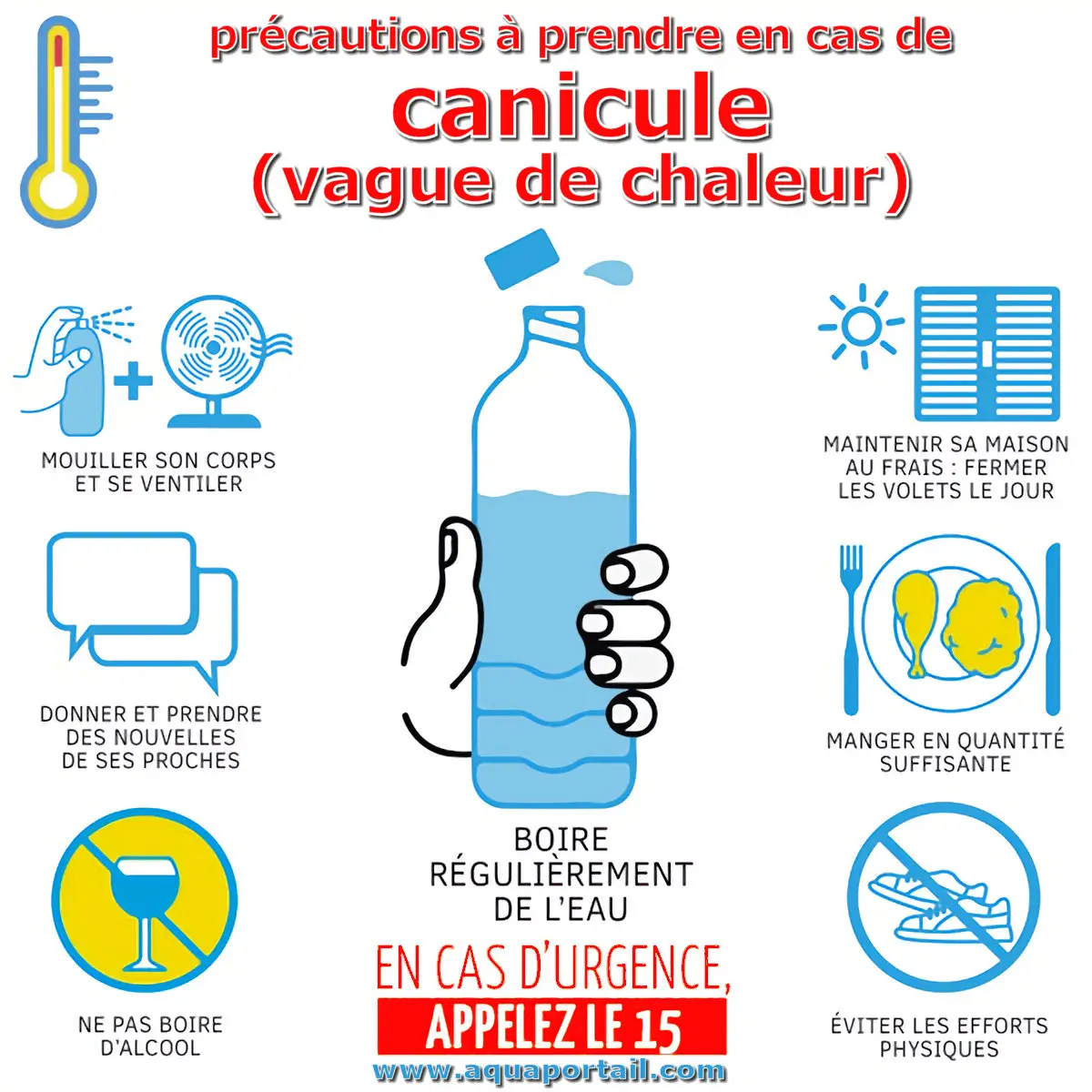
Essential health precautions to follow during a heat wave to prevent dehydration and heatstroke.
The main groups of people most sensitive to extreme heat waves are:
- Young children and infants are particularly vulnerable to heat-related illnesses and death because their bodies are less able to adapt to heat than adults.
- Older adults, particularly those with pre-existing medical conditions, taking certain medications, living alone, or having limited mobility and exposed to extreme heat, can suffer multiple adverse effects.
- People with chronic illnesses are more likely to experience a serious health problem during a heat wave than healthy individuals.
- Pregnant women also face a higher risk. Extreme heat episodes have been linked to adverse birth outcomes such as low birth weight, preterm birth, and infant mortality, as well as congenital cataracts.
🚩 It is NEVER safe to leave a child, a person with a disability, or a pet locked inside a car, even in winter.
If you have a young child in your household, keep your car locked even in your own driveway. Children play in cars or wander outside and climb into a vehicle, where they can die within 10 minutes!
Synonyms, antonyms
Spanish translation: ola de calor
3 synonyms (similar meaning) for "heat wave":
- extreme heat
- heat spike
- hot spell
1 antonym (opposite meaning):
Related words and expressions to HEAT WAVE are directly connected by general or specific meaning.
The expression HEAT WAVE is listed on page 1 of words starting with H in the dictionary glossary.
Related to "heat wave"
halitosis

Halitosis (bad breath) is primarily caused by sulfur-producing bacteria that normally live on the surface of the tongue and in the throat.
hallux

The hallux is the big toe (great toe) of a foot, homologous to the thumb of a hand. It is located on the medial (inner) side of the foot, whereas the little...
hand

The human hand, the most distal part of the upper limb, is a remarkable feat of engineering and evolution.
hardiness

Hardiness characterizes what is hardy, enduring time and weather like things living in the countryside.
