Tagma
noun (n.)
Definition
A tagma is a group of fused segments formed by series of metameres differentiated from the rest of an arthropod's body. It corresponds to heteronomous metamerism and contrasts with homonomous metamerism (as in annelids), in which all metameres and appendages are equivalent. Homonomous refers to organismal parts having the same shape, role, and origin.
Anatomy of a chelicerate composed of two tagmata:

In chelicerates, the body is composed of two tagmata: the prosoma for the anterior part, and the opisthosoma for the posterior part.
Tagmatization (tagmosis)
The differentiation of body regions or tagmata is called tagmatization. The fusion of metameres can form a tagma such that external segmentation is completely lost. The various tagmata making up arthropod bodies vary in morphology and number, sometimes making it difficult to standardize the designation of "tagmata" across different arthropod groups. Furthermore, within each group, this terminology is commonly applied to specific body regions, and tagmata bearing the same name in different groups (for example, the cephalothorax) are not homologous to one another.
Tagmosis refers to the genesis and specialization of tagmata in segmented Metazoans.
Arthropod tagmata
Depending on the arthropod group, tagmata differ, sometimes enabling different classifications:
- In trilobites, the body is divided into two tagmata, the cephalon and the trunk, which is itself divided into thorax and pygidium.
- In arachnids, merostomes, and uropygids, the body is divided into two tagmata, the prosoma and the opisthosoma; these anatomical regions, in turn, may be subdivided into mesosoma and metasoma. The prosoma is sometimes called a carapace, a discouraged term because it is non-homologous to the crustacean carapace; the same applies to the opisthosoma, which is often called the abdomen.
- In pycnogonids, the body is divided into three tagmata: cephalon, thorax (together forming the prosoma or trunk), and abdomen or opisthosoma (very small).
- In crustaceans, the body is divided into three tagmata: the cephalon, the thorax (the pereion for free segments), and the pleon. In many groups, the cephalon and thorax are fused, forming the cephalothorax, separated by a septum and partially or completely covered by a hard shell forming the carapace.
- In myriapods (millipedes and centipedes), the body is divided into two tagmata, the head and the trunk.
- In insects, the body is divided into three tagmata: the head, the thorax, and the abdomen.
Synonyms, antonyms
French translation:
tagmeSpanish translation: tagma
1 synonym (similar meaning) for "tagma":
0 antonyms (opposite meaning).
Related words and expressions to TAGMA are directly connected by general or specific meaning.
The word TAGMA is listed on page 1 of words starting with T in the dictionary glossary.
Related to "tagma"
tapeworm
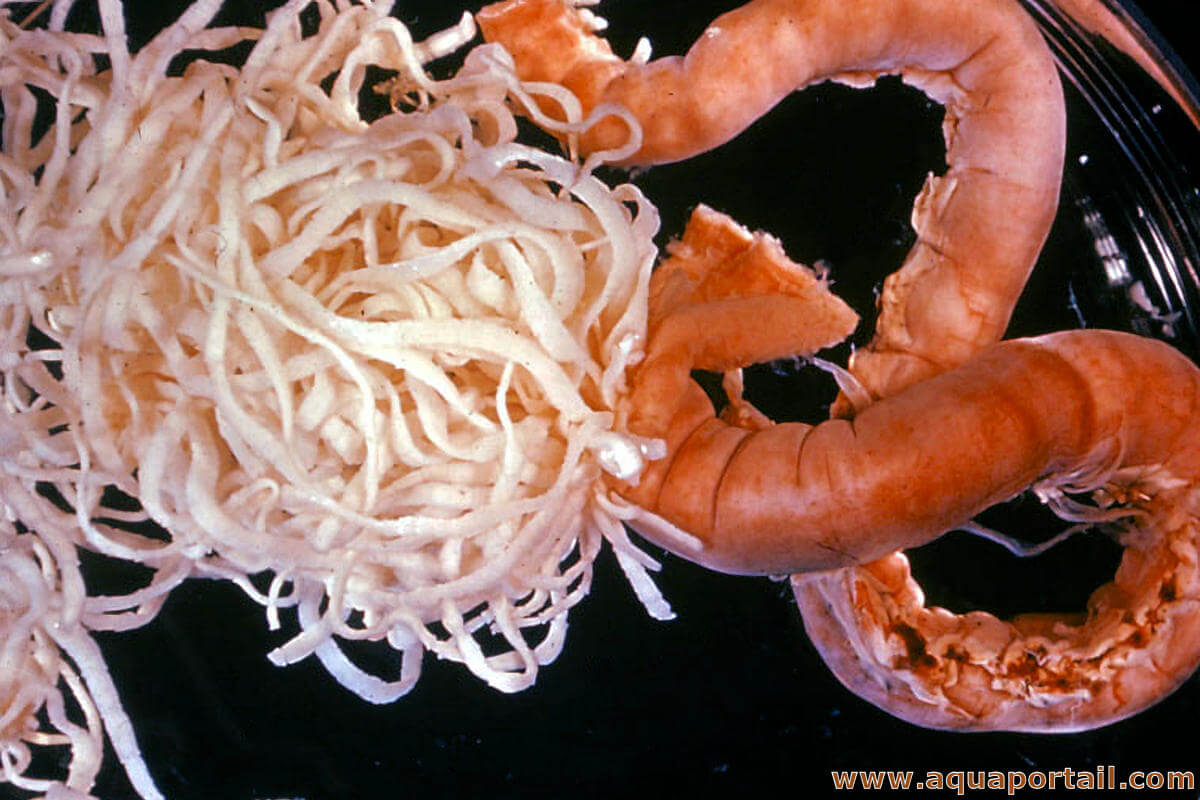
The tapeworm, or solitary worm, is a long, ribbon-like, segmented flatworm, a parasitic cestode of the genus Taenia.
tectonics

Tectonics is a branch of geology that studies the structure of the crust of a planetary body, such as Earth or the Moon, particularly the formation of folds...
teliospore

A teliospore (teleutospore) is a thick-walled, multicellular fungal spore from which the basidium develops.
tentacle

In biology, a tentacle is an unsegmented, generally flexible appendage of an animal's body, used as a tactile organ, for locomotion, or for feeding.
