Arthropod
noun (n.)
Definition
An arthropod is an invertebrate animal of the phylum Arthropoda, which is the most diverse in the animal kingdom, including insects, spiders, crustaceans, and others. The arthropod group comprises animals endowed with an external skeleton with metameres (segments, tagmata, or rings) and jointed legs.
Various arthropods (Arthropoda):
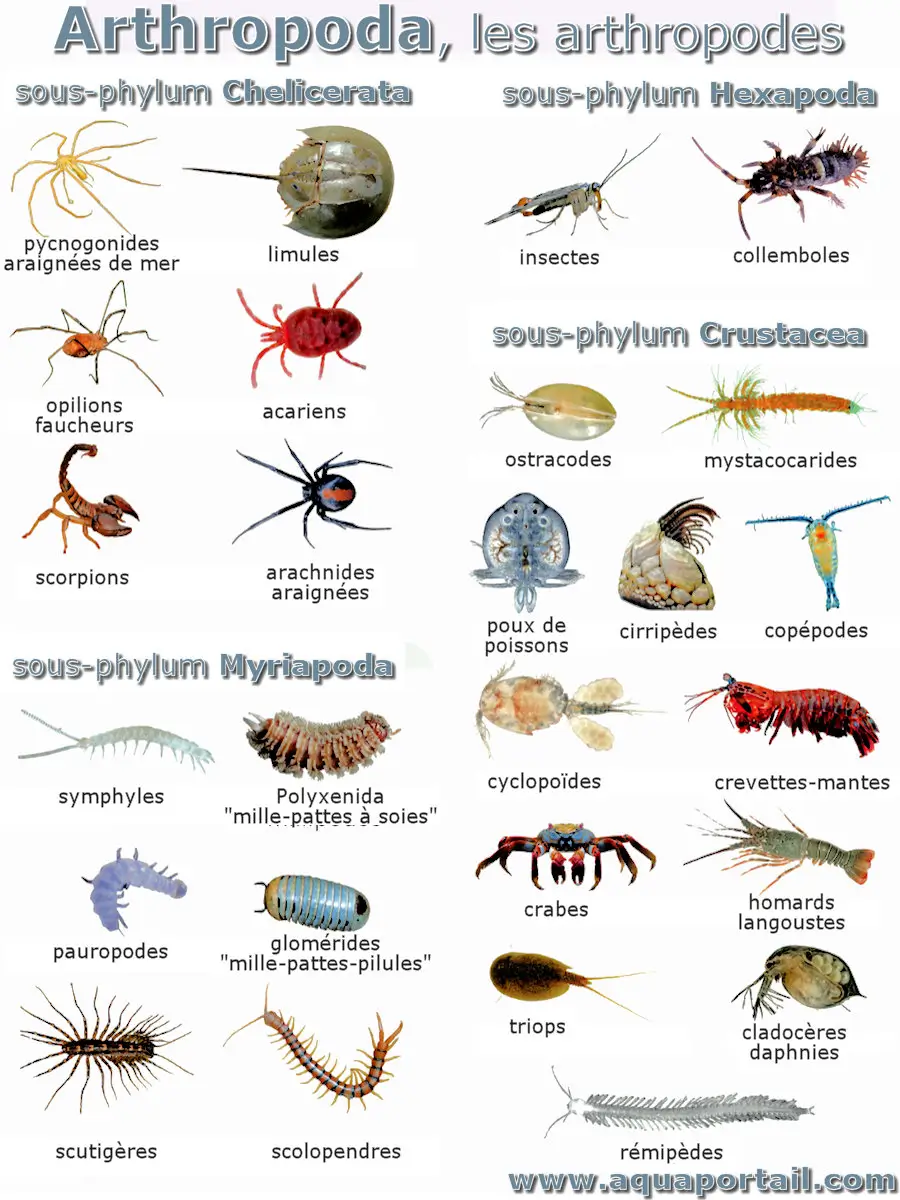
An arthropod is an invertebrate animal belonging to the vast phylum Arthropoda, such as a chelicerate (spiders, mites), a hexapod (insects), a myriapod (millipedes, centipedes, house centipedes), or a crustacean (crabs, shrimp, copepods, etc.).
Explanations
An arthropod is an animal from the lineage of invertebrates with an external chitinous skeleton, characterized by a segmented body, an exoskeleton, and limbs or appendages made up of segments (jointed legs). Blood is replaced by hemolymph.
Many arthropods are well known to all, such as: crustaceans (crabs, lobsters, shrimp, amphipods, copepods, isopods), myriapods, chelicerates (spiders, scorpions, mites, horseshoe crabs), insects, and related species. Arthropods account for 80% of all animal species, with over 1.2 million described species.
There are four main living groups of arthropods:
- crustaceans
- hexapods (insects and their close relatives)
- myriapods (centipedes and millipedes)
- chelicerates (scorpions, arachnids -spiders- and horseshoe crabs).
To these four groups are added the fossil trilobites, which are associated, depending on the author, with crustaceans or chelicerates.
It may be that the earliest arthropods resembled their supposed ancestors, the annelids. The body was long and soft, and had numerous segments, all very similar and equipped with a pair of legs. Later, the body surface hardened to form an external skeleton, the exoskeleton, or a cuticle containing chitin, proteins, lipids, and calcium salts.
Arthropods constitute one of the major divisions of the animal kingdom, subdivided into various categories, some of which contain a large number of genera and species. They are so named because they are equipped with jointed legs. Arthropods not only have legs (6 in insects, 8 in arachnids, 10 in decapods), but moreover, the entire body is formed of several segments connected by joints.
Arthropoda
Arthropoda is a phylum encompassing arthropods, invertebrate animals with a chitinous skeleton whose body is segmented and whose limbs or appendages are composed of segments, comprising more than half of the species in the animal kingdom (crustaceans, myriapods, insects, arachnids).
Anatomy of an arthropod (Norway lobster):
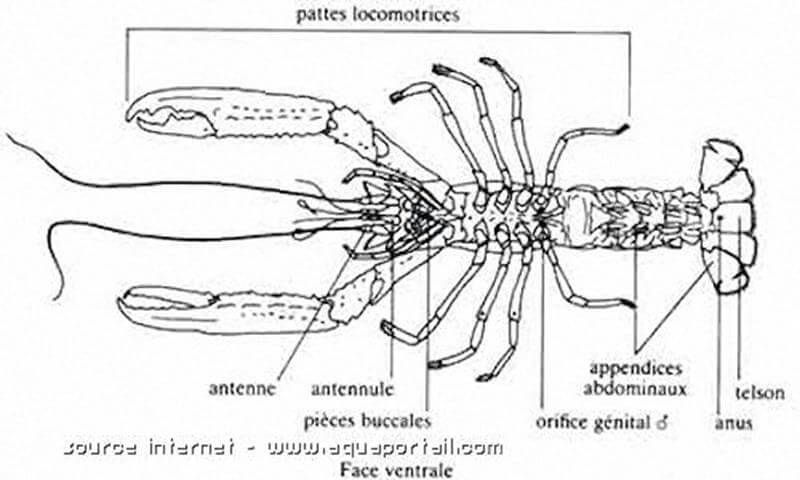
Several groups of arthropods are perfectly adapted to life in the air, like amniote vertebrates, unlike all other animal phyla, which inhabit aquatic or moist environments. The anatomy, physiology, and behavior of an arthropod reveal a simple yet remarkably efficient design.
Anatomical characteristics
Despite their variety and disparity, arthropods share fundamental anatomical (morphological and physiological) characteristics:
- Presence of jointed appendages showing enormous evolutionary plasticity, giving rise to the most diverse structures (antennae, legs or pods or podites, gills, lungs, mandibles, chelicerae, etc.)
- Presence of an external skeleton or chitinous exoskeleton with periodic molting (ecdysis). With respect to the cuticle, some authors report that arthropods, together with nematodes and related groups, form a clade called Ecdysozoa
- Body composed of repetitive segments, a phenomenon known as metamerism; the body appears in modules built and repeated along the segmentation along an anteroposterior axis. The body is divided into two or three regions in most cases.
Most arthropods are equipped with eyes, of which there are several different models: simple eyes and compound eyes. The vision of many arthropods has advantages often lacking in vertebrates, such as the ability to see in an extended spectrum that includes near-ultraviolet, or to distinguish the direction of light polarization. Color vision is almost always present and can be very rich; the crustacean Squilla mantis, the mantis shrimp, has thirteen different pigments with distinct color sensitivities, contrasting with the poor trichromatic system (three pigments) of most primates, including our species.
Arthropods are generally equipped with simple yet effective position sensors that help them maintain posture and balance, such as the chordotonal organs of a dipteran.
Anatomy of an arthropod leg
Crustacean appendages differ considerably in number, size, and shape. Three morphological groups are distinguished by leg organization (pods or podites): uniramous (a single ramus), biramous (two rami), and phyllopodous (no true ramus). The generalized arthropod appendage consists of three elements: a protopodite, an endopodite (telopodite), and an additional exopodite in biramous limbs.
Anatomy of an arthropod leg:
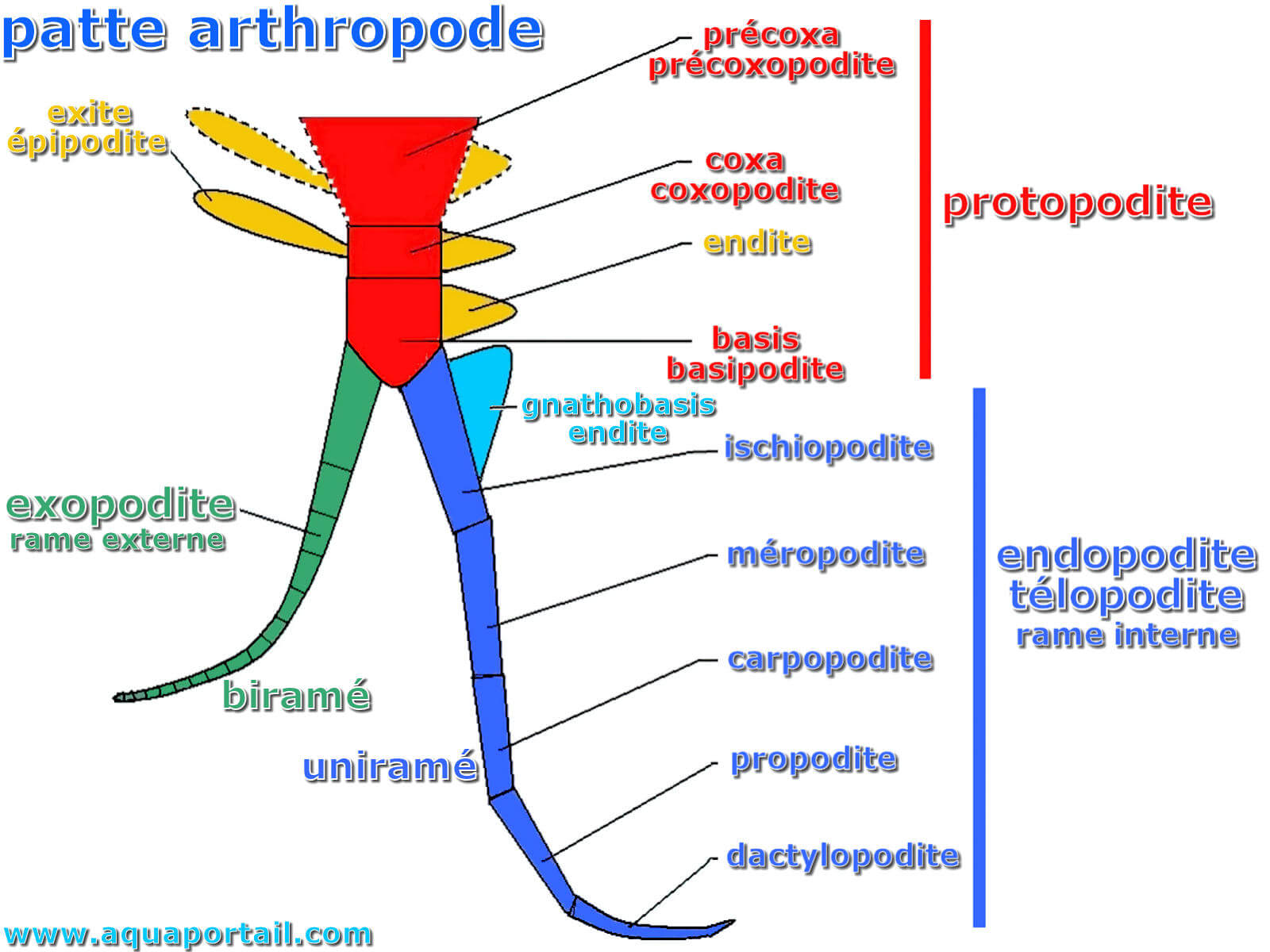
The leg of an arthropod is essentially composed of a protopodite and an endopodite in uniramous animals, whereas biramous animals also have an exopodite.
The nomenclature of arthropod legs is due to Geoffrey Allan Boxshall (1950–...), a British zoologist working primarily on copepods. This nomenclature has been favored since 2004.
The names of the constituent elements of an arthropod leg (uniramous and biramous) are as follows:
- protopodite, the upper part of the leg, which includes:
- precoxa or precoxopodite
- coxa or coxopodite ("hip")
- basis or basipodite
- endites (biramous)
- exites or epipodites (biramous).
- endopodite or telopodite: the sole ramus of uniramous limbs or the inner ramus of biramous limbs, which includes:
- ischiopodite (with an endite -gnathobasis- in biramous limbs)
- meropodite
- carpopodite (or tarsus)
- propodite (or tarsus)
- dactylopodite.
- exopodite: the second, outer ramus of biramous limbs, articulated on the protopodite.
Synonyms, antonyms
Spanish translation: artrópodo
6 synonyms (similar meaning) for "arthropod":
1 antonym (opposite meaning):
Related words and expressions to ARTHROPOD are directly connected by general or specific meaning.
The word ARTHROPOD is listed on page 1 of words starting with A in the dictionary glossary.
Related to "arthropod"
insect

An insect is a small invertebrate arthropod of the class Insecta. Its body consists of three tagmata—head, thorax, and abdomen—encased in a chitinous...
spider
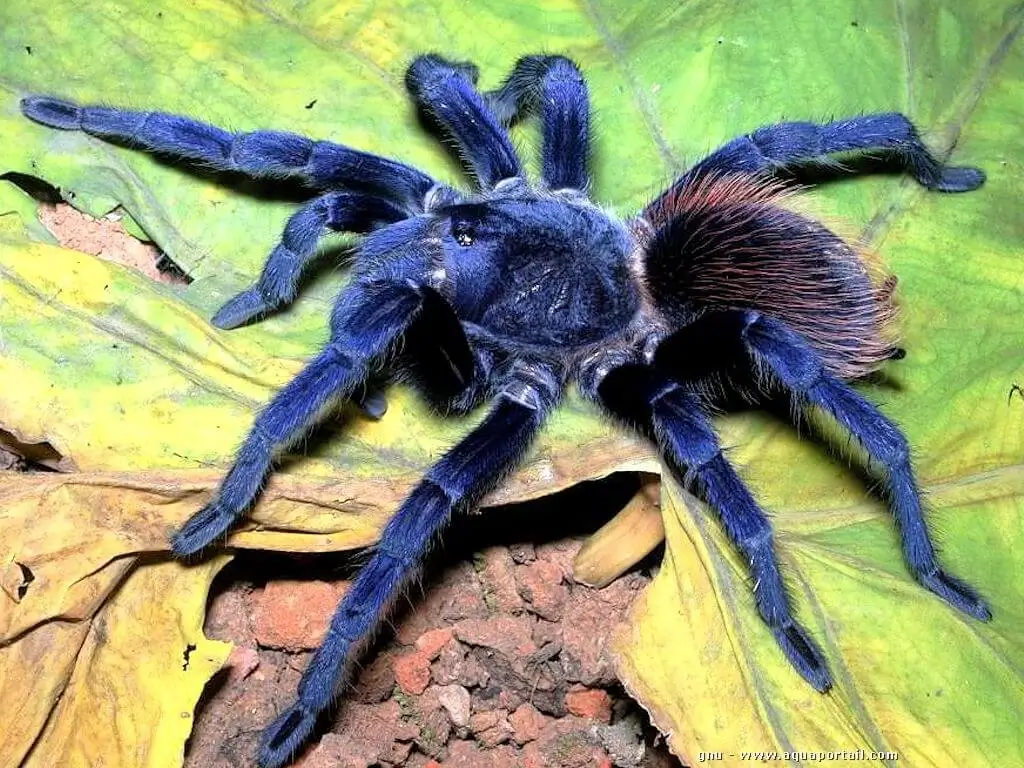
A spider is an araneid arthropod of the class Arachnida (arachnids). Spiders are terrestrial animals equipped with chelicerae, with a body divided into...
mesogastropod
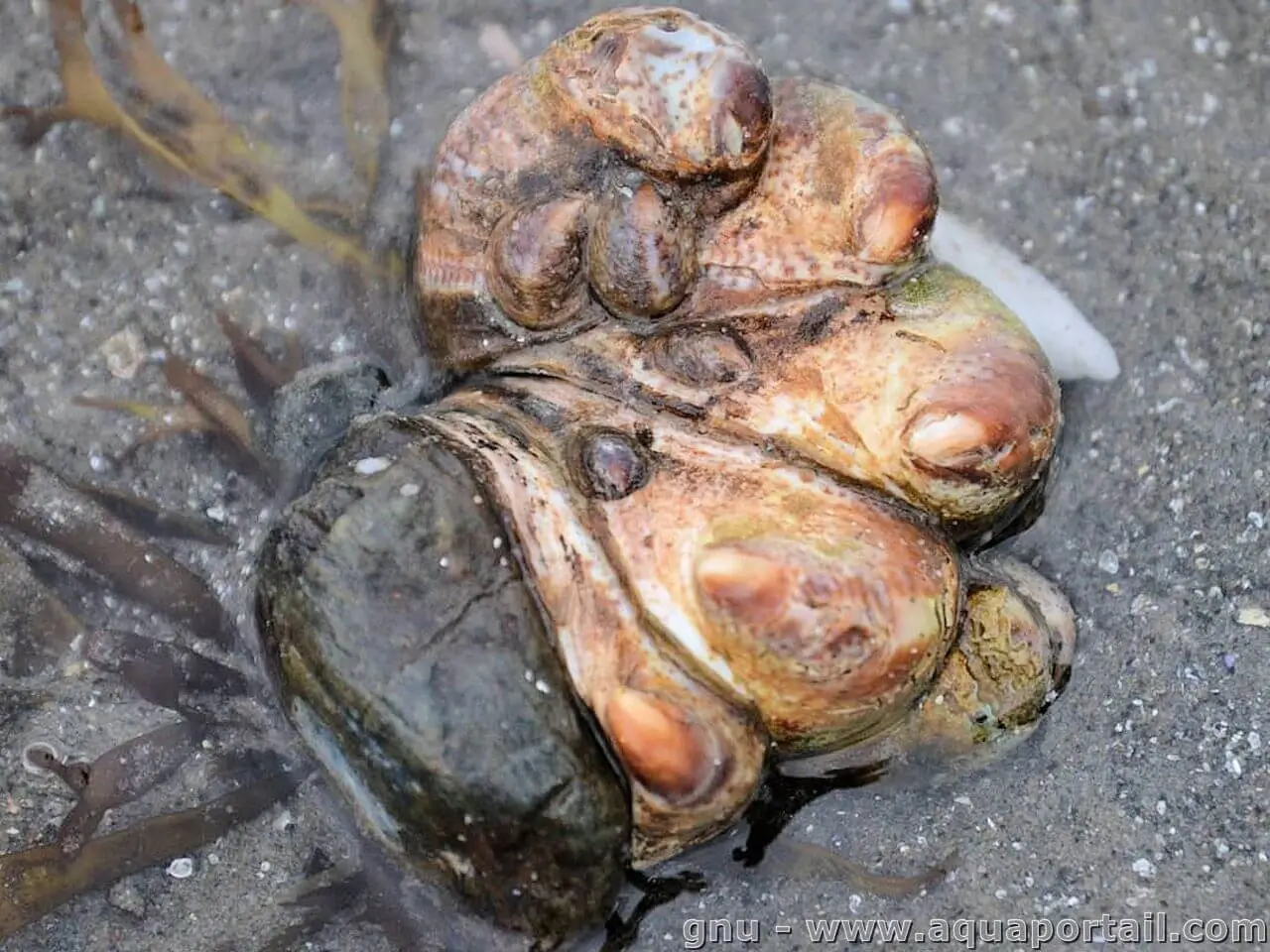
A mesogastropod is a marine mollusk, such as the slipper limpet, belonging to the former taxonomic order Mesogastropoda.
abiotic

In biology and ecology, abiotic refers to what is not biotic, that is, not part of living beings.
Simple summary
An arthropod is a type of invertebrate animal characterized by an exoskeleton, a segmented body, and jointed appendages. This diverse group includes insects, arachnids, crustaceans, and myriapods.
