Antenna
noun (n.)
Definition
An antenna, in certain animals, including insects, is a sensory appendage for thigmotaxis borne on the head of annelids, crustaceans, etc. In other words, antennae are sensory appendages at the front of the head of antennate arthropods. There may be one or two pairs.
The antennae of a white butterfly:
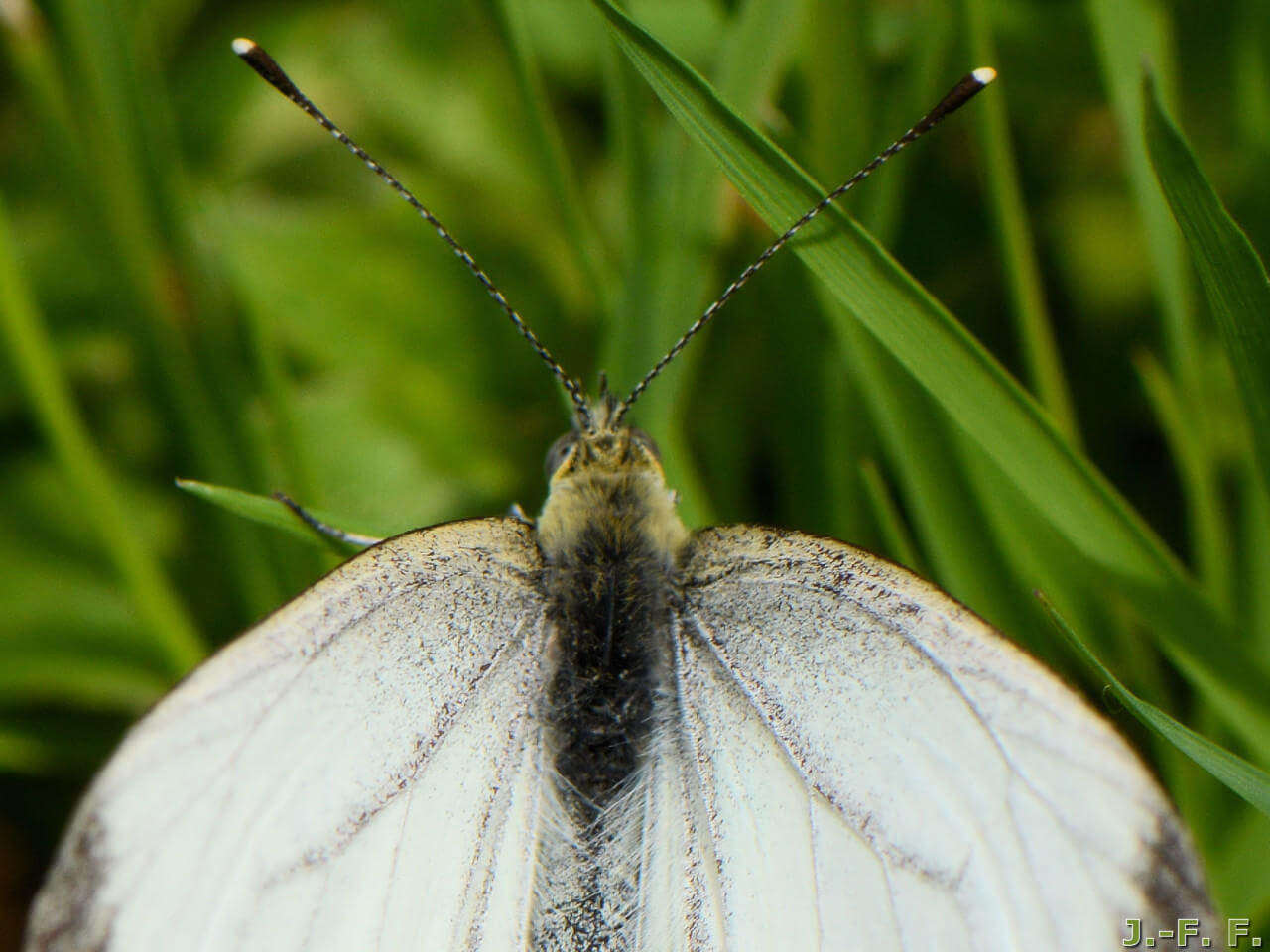
Butterfly antennae (here a white butterfly) are always quite long, often nearly as long as the insect's body.
Explanations
In crustaceans (two pairs), the antennae of the anterior pair, which are smaller, are called antennules. A serra is a serrated segment of the antenna in certain crustaceans.
See also light-harvesting antenna for photosynthesis.
An antenniferous organism is simply synonymous with an antennate animal, that is, bearing antennae.
A chaetosome (chaetosema), in Lepidoptera insects, designates each of the two bristle-covered prominences on the top of the head, behind the antennae.
An animal is longicorn when it has long horns, long antennae; for example, among crustaceans, the spiny lobster is longicorn.
An antenniform organism possesses an appendage that resembles an antenna or has its shape, typically like insect antennae. For example, the arachnid Damon medius has legs shaped like antennae.
A squama is a flattened segment of the antenna in certain crustaceans. The squama also denotes a squamous cell, which is the origin of the word desquamation.
Synonyms, antonyms
Spanish translation: antena
1 synonym (similar meaning) for "antenna":
0 antonyms (opposite meaning).
Related words and expressions to ANTENNA are directly connected by general or specific meaning.
The word ANTENNA is listed on page 1 of words starting with A in the dictionary glossary.
Related to "antenna"
light-harvesting complex

A light-harvesting complex (antenna complex) consists of photosynthetic pigments capable of intercepting photons of various wavelengths, and therefore various...
abiotic

In biology and ecology, abiotic refers to what is not biotic, that is, not part of living beings.
aboral

Aboral refers to what is situated away from or opposite the mouth in zoology, and especially in marine biology.
absence

Absence refers to non-presence at an expected location, or the complete non-existence of something.
