Anisogamous
adjective (adj.)
Definition
What is anisogamous relates to anisogamy. Gametes are anisogamous when the male reproductive cell differs from the female one, or in other words, male and female gametes are morphologically and/or physiologically different.
Types of planogametes:

Three types of planogametes exist in fungi: isogametes (e.g., Catenaria sp.), anisogametes (e.g., Allomyces arbuscula), and heterogametes (e.g., Monoblepharella taylori).
Explanations
In cytology, sexual reproduction involves the union or fusion of two dissimilar gametes, that is, anisogamous ones.
Anisogamous planogametes (anisogametes), which are morphologically similar to isogametes but differ in size, are produced only by a group of lower fungi belonging to the genus Allomyces.
Isogamy is the fusion of male and female gametes of similar size. Anisogamy is the fusion of male and female gametes of different sizes. Here, either both gametes are motile, or both are non-motile. Oogamy is the fusion of a large, non-motile female gamete with a smaller, motile male gamete.
In this type of reproduction, male gametes are smaller than female gametes, or the gametes may be flagellated or non-flagellated. Anisogamous reproduction occurs in Fucus (algae), where the male gamete is smaller than the female gamete.
⭐ Many unicellular eukaryotes and some multicellular algae are isogamous. Conversely, multicellular animals and plants, as well as most other multicellular eukaryotes, are anisogamous. There is a trade-off between the size of gametes and the number of them an organism can produce (a few large ones versus many small ones).
Synonyms, antonyms
Spanish translation: anisógamo
1 synonym (similar meaning) for "anisogamous":
1 antonym (opposite meaning):
Related words and expressions to ANISOGAMOUS are directly connected by general or specific meaning.
The word ANISOGAMOUS is listed on page 1 of words starting with A in the dictionary glossary.
Related to "anisogamous"
anisogamy
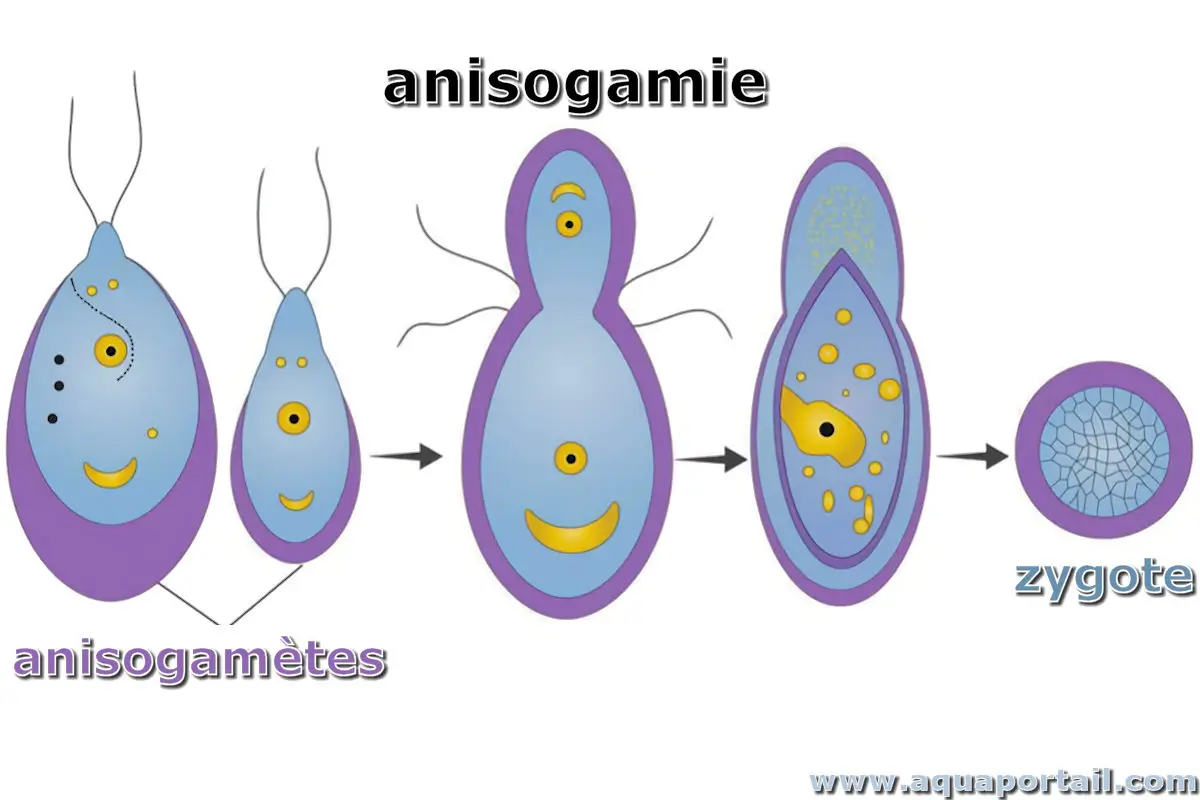
Anisogamy, a form of heterogamy, corresponds to the fusion of dissimilar gametes. Anisogamy may be morphological (the female gamete is larger than the male)...
abiotic

In biology and ecology, abiotic refers to what is not biotic, that is, not part of living beings.
aboral

Aboral refers to what is situated away from or opposite the mouth in zoology, and especially in marine biology.
absence

Absence refers to non-presence at an expected location, or the complete non-existence of something.
