Anhydrogalactose
noun (n.)
Definition
An anhydrogalactose (AHG) is a galactose that has lost a water molecule. 3,6-Anhydrogalactose, contained notably in agars, results from the elimination of a water molecule formed by an oxygen atom and a hydroxyl radical (OH) originating from carbons 3 and 6 of the galactose molecule (forming a 3,6-anhydrogalactose bridge).
With a 3,6-anhydrogalactose bridge, galactoses are either esterified with sulfuric acid or bear an oxygen bridge between carbons 3 and 6 of the anhydrogalactose. See also carrabioses.
Comparison of anhydrogalactose and carrabiose:
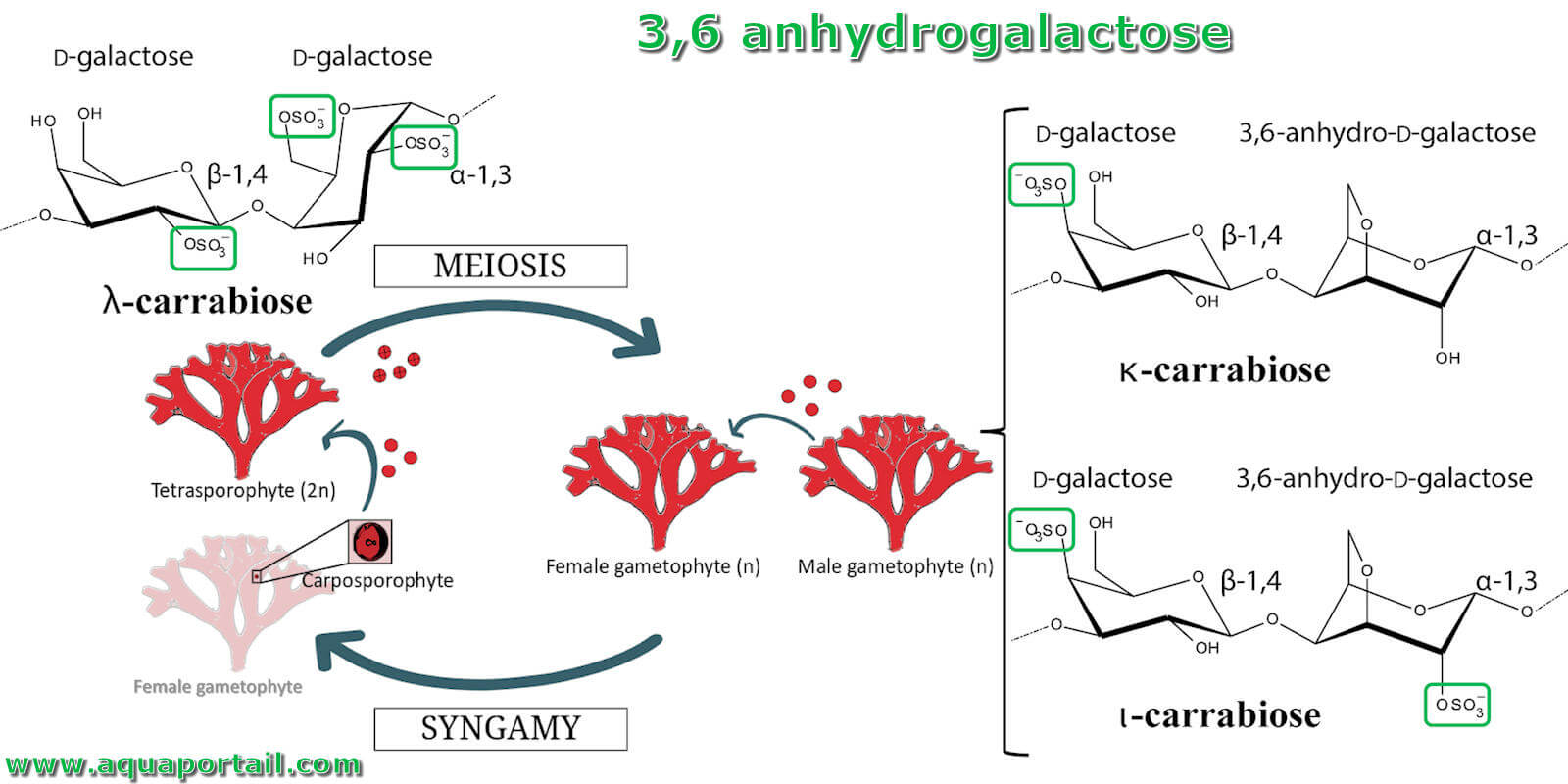
3,6-Anhydrogalactose and carrabiose.
Explanations
3,6-Anhydro-D-galactose (empirical chemical formula C6H10O5) is an aldehyde and an anhydrohexose. It is derived from D-galactose. 3,6-Anhydro-L-galactose is derived from L-galactose.
3,6-Anhydro-L-galactose dehydrogenase
Despite the growing potential of red algal biomass as a feedstock, biological conversion of red algal biomass has been limited by the lack of viable microorganisms capable of converting structured anhydrogalactose, a major carbohydrate component of red algae, into a common metabolite. In the AHG uptake pathway, anhydrogalactose dehydrogenase (AHGD) is known to be a key step; it is therefore important to find an efficient dehydrogenase to break down 3,6-anhydro-L-galactose (AHG), which is required for practical use of red macroalgal biomass in biorefineries.
In one study, a novel high-activity anhydrogalactose dehydrogenase (AHGD) produced by a bacterial strain, Raoultella ornithinolytica (B6–JMP12), was newly isolated. The stability and compatibility of the enzyme were evaluated under various conditions to achieve high enzyme production.
In Chondrus crispus
Chondrus crispus is a marine red alga with sulfated galactans, called carrageenans, in its extracellular matrix. Chondrus has a complex haplodiplontic life cycle, alternating between male and female gametophytes (n) and tetrasporophytes (2n). The life cycle stages of Chondrus are isomorphic; however, a major phenotypic difference is that carrageenan composition varies considerably between tetrasporophytes (predominantly lambda-carrageenan) and gametophytes (predominantly kappa/iota-carrageenans). The disparity in carrageenan structures, which confer different chemical properties, strongly suggests differential regulation of active carrageenan genes between the life-cycle phases of Chondrus.
Carrageenophyte red algae produce carrageenan, a linear sulfated galactan with alternating α-1,3-/β-1,4 linkages, in their ECM (extracellular matrix). Certain carrageenan motifs contain the unique red algal bicyclic sugar 3,6-anhydro-D-galactose produced by the action of galactose-sulfurylase enzymes. The 3,6-anhydro-D-galactose moiety is present in kappa- and iota-carrabiose motifs, -[D-galactose-4-sulfate-(β-1,4)-3,6-anhydro-D-galactose-(α-1,3)]- and -[D-galactose-4-sulfate-(β-1,4)-3,6-anhydro-D-galactose-2-sulfate-(α-1,3)]-, respectively, and absent from the lambda-carrabiose motif, -[D-galactose-4-sulfate-(β-1,4)-D-galactose-2,6-disulfate-(α-1,3)]-.
Sulfate groups further distinguish carrabiose structures: kappa-carrabiose has one sulfate group, iota-carrabiose has two sulfate groups, and lambda-carrabiose has three sulfate groups.
However, not all red algae contain carrageenans. Agarophyte red algae have varying proportions of porphyranobiose, -[D-galactose-(β-1,4)-L-galactose-6-sulfate-(α-1,3)]-, and agarobiose, -[D-galactose-(β-1,4)-3,6-anhydro-L-galactose-(α-1,3)]-, in their ECM. Contradictorily, there appear to be carrageenophyte red algae capable of producing minor to significant amounts of sulfated agar and DL-galactan hybrids, as well as agarophyte red algae possessing DL-galactan hybrid structures.
Overall, it is not fully understood how the structural differences in galactans arose between carrageenophyte and agarophyte red algae.
Synonyms, antonyms
Spanish translation: anhidrogalactosa
2 synonyms (similar meaning) for "anhydrogalactose":
- anhydro-D-galactose
- anhydrohexose
0 antonyms (opposite meaning).
Related words and expressions to ANHYDROGALACTOSE are directly connected by general or specific meaning.
The word ANHYDROGALACTOSE is listed on page 1 of words starting with A in the dictionary glossary.
Related to "anhydrogalactose"
carbonic anhydrase
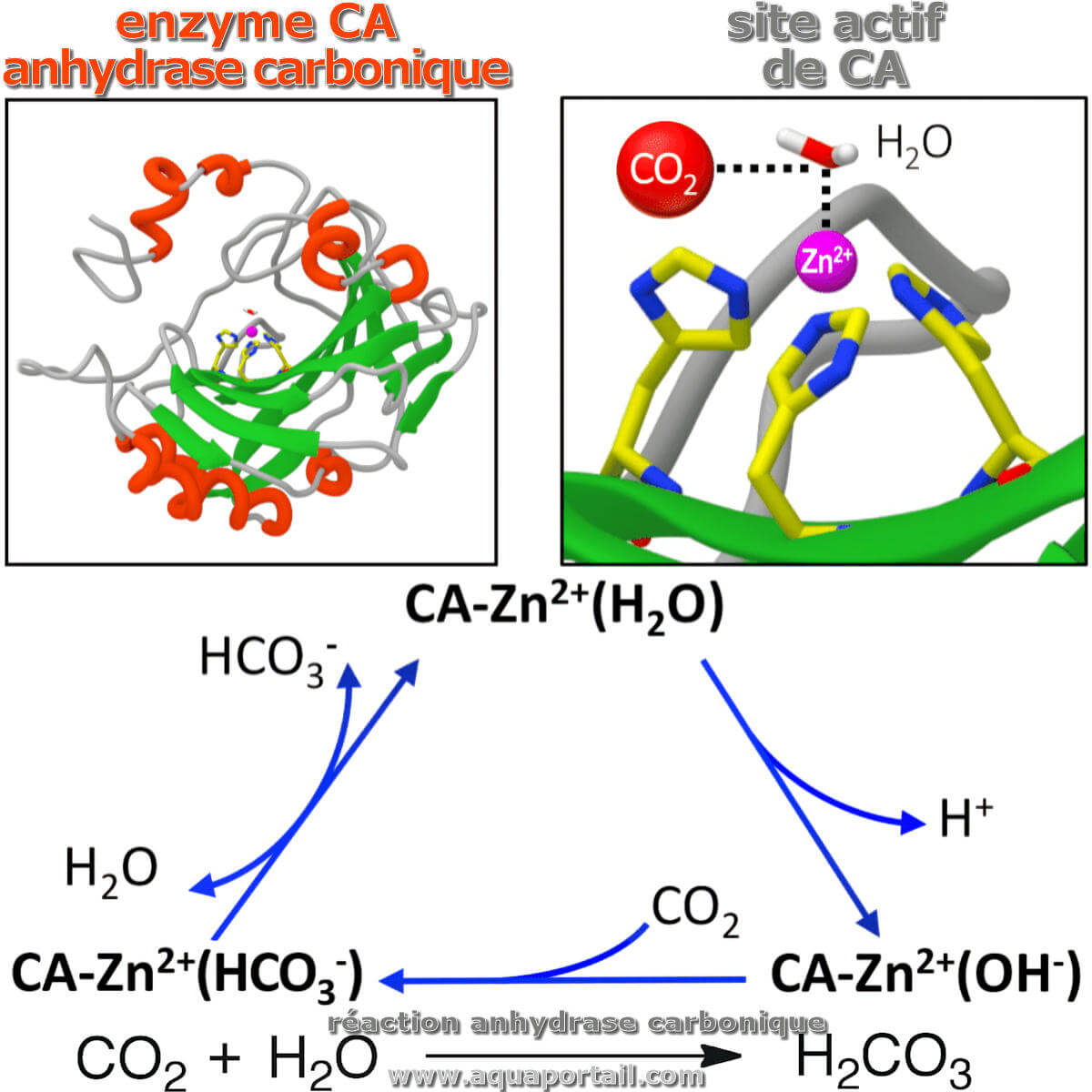
Carbonic anhydrase (CA) catalyzes the reversible hydration and dehydration reactions of CO₂/H₂CO₃.
abiotic

In biology and ecology, abiotic refers to what is not biotic, that is, not part of living beings.
aboral

Aboral refers to what is situated away from or opposite the mouth in zoology, and especially in marine biology.
absence

Absence refers to non-presence at an expected location, or the complete non-existence of something.
