Carbonic anhydrase
noun phrase (n. phr.)
Definition
Carbonic anhydrase (CA) catalyzes the reversible hydration and dehydration reactions of CO2/H2CO3. Carbonic anhydrases are widespread in nature, occurring in animals, plants, and certain bacteria. Sixteen isozymes have been identified and characterized in mammals.In chemistry, an anhydrase is an enzyme that catalyzes the removal of water from a compound. For an anhydride, see carbonic anhydride.
Diagram with reaction of carbonic anhydrase:
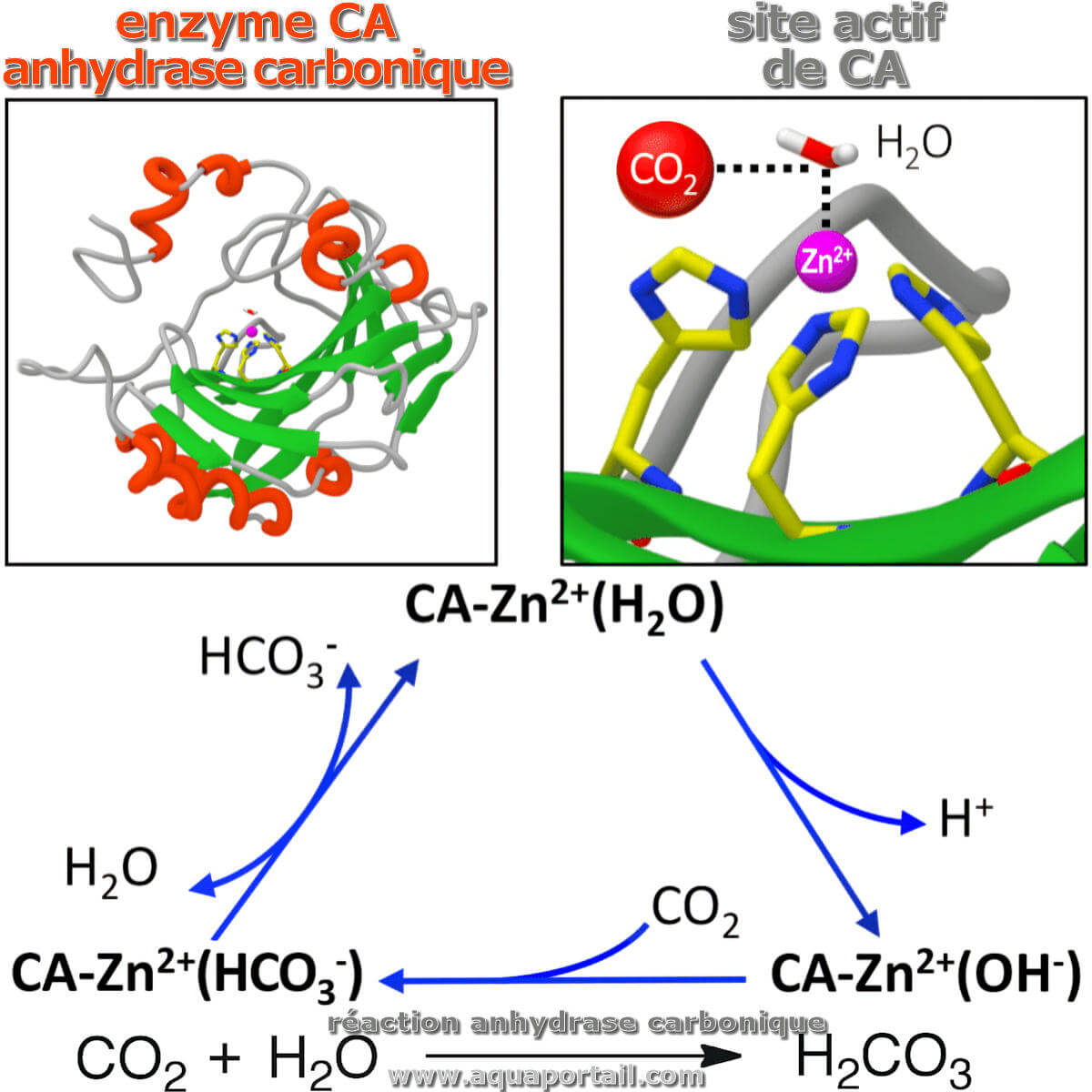
Carbonic anhydrase enzyme and its CO2 capture and regeneration mechanism, with the ribbon representation of the CA enzyme at top left.
Explanations
Because erythrocyte carbonic anhydrases are relatively easy to obtain for experimental purposes, they are the most extensively studied. Since CO2 (carbon dioxide) transport occurs in the blood, its excretion relies heavily on the rapid catalysis of CO2 via reactions inside the erythrocyte mediated by carbonic anhydrases.
Bovine carbonic anhydrase reversibly hydrates alkyl pyruvates and exhibits hydratase activity toward a wide variety of substrates.
Human erythrocytes were used in 1970s studies to isolate and obtain the first amino acid sequences of CA-I and CA-II. John Edsall conducted thorough studies on the kinetics of human erythrocyte CA and also discovered the first competitive inhibitor, imidazole.
Current research on carbonic anhydrase continues to investigate the binding mechanism of inhibitors and the role of CA in inhibiting ectopic cardiovascular calcification.
In algae
Carbonic anhydrase is an enzyme enabling algae to convert bicarbonate ions into carbon dioxide and thus utilize HCO3- as a carbon source. The presence of such an enzyme in algae is difficult to study and often hypothetical. The release of hydroxyl ions driven by the dissociation of HCO3- (H2CO3 being carbonic acid) into CO2 and OH- alkalinizes the medium around bicarbonate-absorbing algae; in some calcified species, bicarbonate uptake and the resulting hydroxyl ion release are linked to calcium carbonate precipitation.
Molecular characteristics
Each erythrocyte isozyme (CA-I and CA-II) consists of a single-chain peptide of 259 or 260 amino acid residues. The low-activity form (CA-I) contains 260 residues, whereas the high-activity form (CA-II) contains 259 residues. High- and low-activity erythrocyte forms within a given species generally display over 50% sequence identity. For example, equine CA-I and CA-II forms share only 55% identity. By contrast, identical forms across different species show much greater homology: human CA-II and bovine CA-II exhibit 77% sequence homology.
The isozymes are encoded by separate genes, yet given their high homology, particularly within the active site, they appear to share a common evolutionary history. Ubiquitin, a 76-residue protein possessing certain enzymatic properties of carbonic anhydrases, displays distinct sequence homology with carbonic anhydrase.
Composition
Sixteen carbonic anhydrase isozymes have been described so far in mammals. The erythrocyte carbonic anhydrases, CA-I and CA-II, are the best known. CA-I, CA-II, CA-III, CA-VII, and CA-XIII are cytosolic. CA-IV, CA-IX, CA-XII, CA-XIV, and CA-XV are membrane-bound. CA-VI is secreted in saliva. CA-VA and CA-VB are mitochondrial. There are also three acatalytic forms called carbonic anhydrase-related proteins (CARPs): CARP-VIII, CARP-X, and CARP-XI.
The metallic zinc is always coordinated to histidines 93, 95, and 118 (mature chain numbering). A hydrogen-bonded network, linked directly or indirectly to the zinc-bound water molecule and these histidines, includes 28-Ser, 91-Glu, 105-Glu, 106-His, 116-His, 193-Tyr, 198-Thr, 208-Trp, and 223-Asn. These residues have been found to be highly conserved. Bovine and human CA-I and CA-II contain a unique C-terminal knot structure, which has proven important for enzymatic and mechanical properties.
Carbonic anhydrase inhibitors
Carbonic anhydrase plays an important role in the blood, lungs, stomach, and kidneys. Its inhibitors, notably sulfonamides (sulfanilamides), are used as diuretics.
History and evolution
Carbonic anhydrase was first discovered in vertebrate erythrocytes. It was deduced that a catalyst was present in blood capable of dehydrating bicarbonate and allowing it to escape as CO2. CA was rapidly isolated from erythrocytes by Meldrum and Roughton in 1933. Following the 1940 discovery that zinc is an intrinsic cofactor, CA became the first recognized metalloenzyme. It was also deduced that sulfanilamide is an inhibitor of the enzyme, leading to pharmacological studies and the major discovery of carbonic anhydrase inhibitors as a treatment for glaucoma.
It took more than twenty years for CA to attract broad interest from the research community, owing to the simple substrates on which it acts. It became known as one of the most efficient acid-base catalysts. Further interest in the enzyme was sparked when Lindskog replaced the zinc ion with cobalt and found that enzyme activity remained unaffected, leading to extensive studies on metal oxidation and theories linking enzyme activity to the ionization of neighboring groups.
Synonyms, antonyms
Spanish translation: anhidrasa carbónica
6 synonyms (similar meaning) for "carbonic anhydrase":
- carbonate dehydratase
- carbonate hydro-lyase
- carbonic acid anhydrase
- carbonic dehydratase
- carboxyanhydrase
- EC 4.2.1.1
0 antonyms (opposite meaning).
Related words and expressions to CARBONIC ANHYDRASE are directly connected by general or specific meaning.
The expression CARBONIC ANHYDRASE is listed on page 1 of words starting with C in the dictionary glossary.
Related to "carbonic anhydrase"
carboxamide
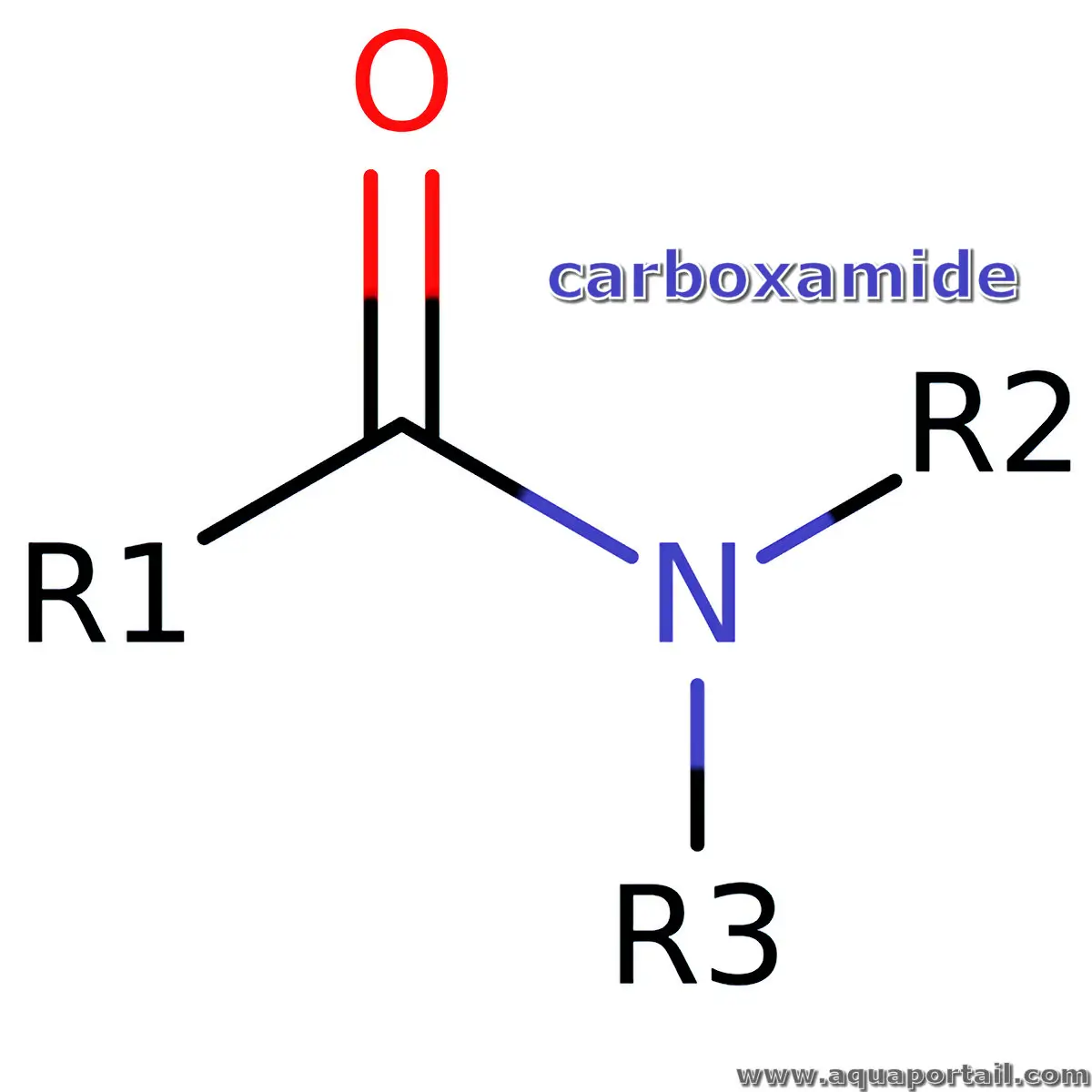
A carboxamide is a carboxylic acid amide having the structure RC(=O)NR₂. The term is used as a suffix in systematic nomenclature to designate the group...
carboxylate

A carboxylate denotes the anionic form of a salt or ester of a carboxylic acid, characterized by the deprotonation of the hydroxyl group (−OH) of the carboxyl...
cactus

A cactus is a thick, fleshy plant that grows in many hot, dry regions of the world. Cacti do not have leaves, and many are covered with spines.
caecilian

A caecilian (gymnophione) is a limbless, burrowing, worm-like amphibian whose legs are vestigial or absent.
Simple summary
Carbonic anhydrase is an enzyme that regulates the body's pH and fluid balance. It catalyzes the reversible reaction between carbon dioxide and water to form bicarbonate ions and hydrogen ions. This process is essential to respiration: it facilitates the transport of carbon dioxide from tissues into the bloodstream, and then from the blood to the lungs for exhalation. In addition, carbonic anhydrase helps maintain acid-base balance and facilitates ion transport in tissues such as the kidneys and eyes.
