Atmosphere
noun (n.)
Definition
An atmosphere is a gaseous envelope surrounding a planet. The presence of an atmosphere around a planet depends on the gravitational pull it exerts on gas molecules, whose velocity is linked to temperature.
The layers of the atmosphere:

Earth's atmosphere is composed of several successive layers. It incorporates the protective ozone layer against UV radiation. The different layers of the atmosphere are: the troposphere, the stratosphere, the mesosphere, the thermosphere, and the exosphere (the outermost layer).
Explanations
The absence of an atmosphere on a planet is due to its low gravitational mass. On a large gas giant, very light gases are retained by gravity, unlike Earth, whose mass is insufficient to retain the lightest gases. Earth's atmosphere has a high nitrogen and oxygen content and therefore oxidizing conditions.
It is difficult to pinpoint the upper boundary of the atmosphere because gases gradually become thinner and thinner. It is within the atmosphere that the greenhouse effect occurs on Earth.
Its vertical structure is due to varying temperatures. Weather (meteorological climate) takes place in the lowest 10 kilometers (6.2 mi), the troposphere. Higher layers no longer exert as much influence.
✅ Atmospheric air, at any scale, refers directly to the ambient air that all living beings breathe within the atmosphere.
See also food preservation under modified atmosphere packaging and controlled atmosphere storage.
Earth's atmosphere
Earth's atmosphere is a layer of gases surrounding planet Earth that is retained by Earth's gravity. The atmosphere protects life on Earth by absorbing solar ultraviolet radiation, warming the surface through heat retention (greenhouse effect), and reducing temperature extremes between day and night (diurnal temperature variation).
The common name given to atmospheric gases used in respiration and photosynthesis is air. By volume, dry air contains 78.09% nitrogen, 20.95% oxygen, 0.93% argon, 0.039% carbon dioxide, and small amounts of other gases.
Air also contains a variable amount of water vapor, on average around 1%. Although air content and atmospheric pressure vary at different altitudes, air suitable for the survival of terrestrial plants and terrestrial animals is currently known only on Earth and within artificial atmospheres.
The atmosphere has a mass of approximately 5.15 × 10¹⁸ kg (1.14 × 10¹⁹ lb), with three-quarters of this mass lying within the first 11 kilometers (6.8 mi) above the surface. The atmosphere becomes progressively thinner with increasing altitude, with no sharp boundary between the atmosphere and outer space.
The Kármán line, at 100 km (62 mi), or 1.57% of Earth's radius, is often used as the boundary between the atmosphere and outer space. Atmospheric effects become noticeable during the atmospheric reentry of a spacecraft at an altitude of around 120 km (75 mi).
Several layers can be distinguished within the atmosphere based on characteristics such as temperature and composition.
The study of Earth's atmosphere and its processes is called atmospheric science or aerology. Pioneers in the field include Léon Teisserenc de Bort and Richard Assmann.
See also primitive atmosphere. The variation of atmospheric pressure with height (altitude) depends on gravity, temperature, and atmospheric density; it is governed by what is known as the barometric formula.
Composition
The strata from ground level up to about 80–100 km (50–62 mi) in altitude (the Kármán line region) have a relatively uniform composition, which is why this zone is called the homosphere. What is termed air essentially ignores variations in water vapor content (that is, expressed as a volume percentage of dry, water-vapor-free air).
The layers near the ground (atmospheric air) have a fairly uniform composition, hence the term homosphere.
What is called air consists primarily of: 78.08% nitrogen (N2), 20.95% oxygen (O2), and 0.93% argon (Ar), when variable water vapor content is ignored (i.e., by volume of dry air), plus aerosols and trace gases, including carbon dioxide (CO2, currently 0.04%, the primary driver of the greenhouse effect after water vapor), methane (CH4), ozone (O3), chlorofluorocarbons, sulfur dioxide (SO2), and nitrogen compounds.
In addition to the energy input from solar radiation and its daily and seasonal fluctuations, water vapor content is primarily responsible for shaping weather conditions.
This process occurs at concentrations varying from 0% by volume to about 4%. In air, see humidity. Regional solar radiation depends on aerosol content as well as atmospheric transparency.
The upper atmosphere is already a very tenuous gas into which even high-energy components of solar radiation can still penetrate. Short-wave UV light partially dissociates and ionizes molecules.
Furthermore, at altitudes above 100 km (62 mi), constituents also separate according to their different molar masses, which is why this region is also called the heterosphere.
Consequently, as altitude increases, the proportions of lighter particles, such as hydrogen atoms and helium, rise. Both elements gradually escape into space for thermal reasons.
Layers (strata)
In terms of vertical temperature profile, particularly temperature gradient, the atmosphere consists of several layers:
- troposphere from the surface to the tropopause at altitudes between 7 km (4.3 mi, polar regions) and 17 km (10.6 mi, tropics)
- stratosphere up to the stratopause at 50 km (31 mi) altitude
- mesosphere up to the mesopause at an altitude of 80 to 85 km (50 to 53 mi)
- thermosphere (see also ionosphere)
- exosphere
The troposphere is also called the lower atmosphere, the stratosphere and mesosphere form the middle atmosphere, and the thermosphere forms the upper atmosphere.
Especially in the troposphere (the weather sphere), temperature stratification and water vapor content are dynamic, which accounts for stratification stability.
Boundary with space
The transition between the exosphere and outer space is continuous, so no sharp upper boundary of the atmosphere can be drawn. In the exosphere (above the exobase at about 600 km or 373 mi altitude), the mean free path is so large that particles can escape if they reach their escape velocity; for individual hydrogen atoms, this is possible through collisions even at average speeds of 3–4 km/s (1.9–2.5 mi/s).
According to the Fédération Aéronautique Internationale, the homopause or an altitude of about 100 km (62 mi, the Kármán line) is considered the boundary. This definition is widely recognized internationally, although it is not absolute. For example, NASA defines the mesopause (about 80 km or 50 mi) as the boundary.
Synonyms, antonyms
Spanish translation: atmósfera
5 synonyms (similar meaning) for "atmosphere":
- aerosphere
- atmospheric air
- gaseous envelope
- homosphere
- magnetosphere
0 antonyms (opposite meaning).
Related words and expressions to ATMOSPHERE are directly connected by general or specific meaning.
The word ATMOSPHERE is listed on page 1 of words starting with A in the dictionary glossary.
Related to "atmosphere"
biosphere

The biosphere encompasses the interconnected system of the lithosphere, atmosphere, and hydrosphere, all inhabited by living organisms.
pedosphere
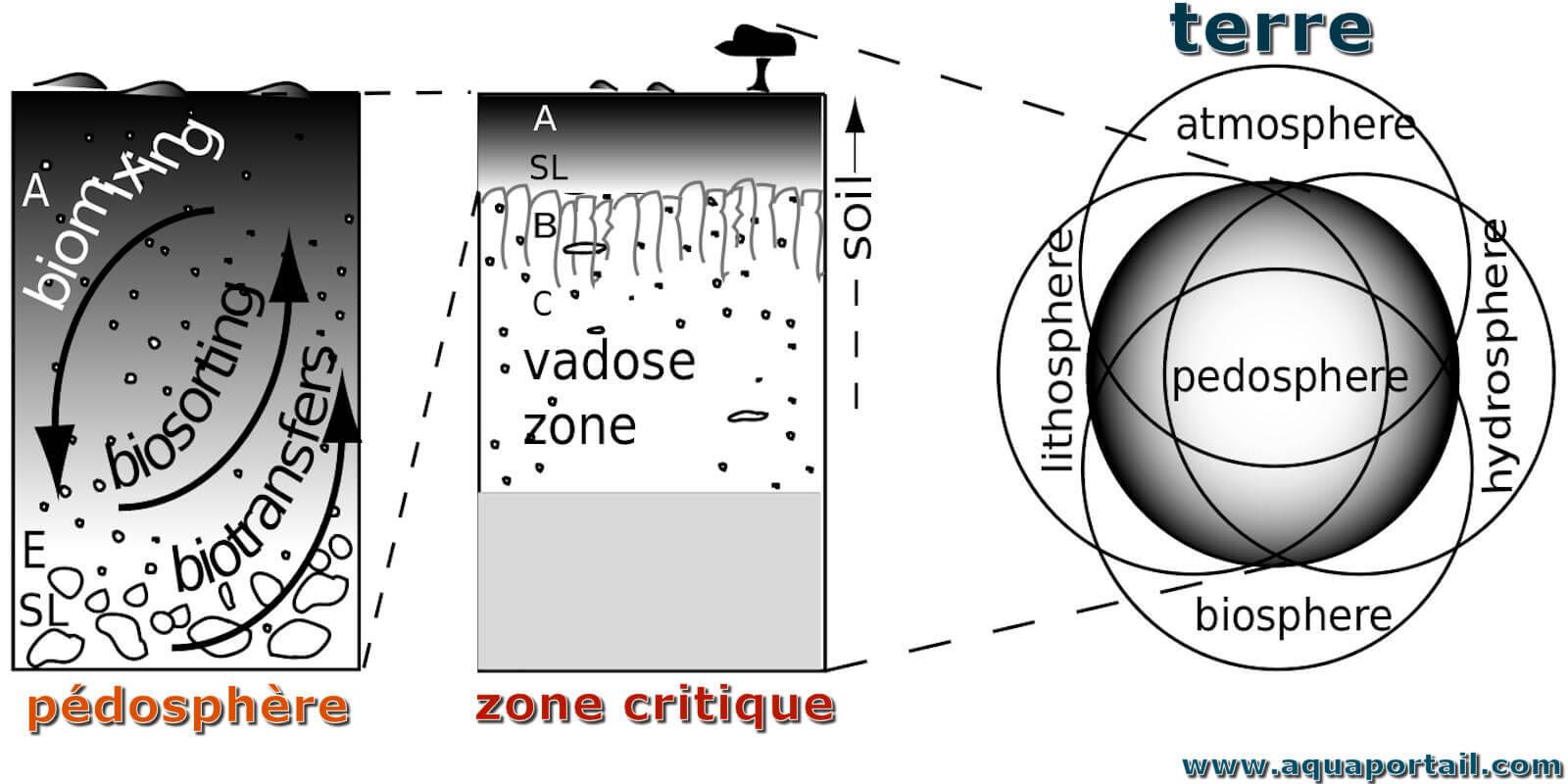
In geology, the pedosphere is the outermost layer of the Earth, composed of continental emerged soils and subject to soil-forming processes.
abiotic

In biology and ecology, abiotic refers to what is not biotic, that is, not part of living beings.
aboral

Aboral refers to what is situated away from or opposite the mouth in zoology, and especially in marine biology.
Simple summary
Atmosphere refers to the layer of gases surrounding a planet or celestial body, such as Earth. This gaseous layer is held in place by gravity and plays a crucial role in sustaining life, regulating temperature, and protecting the surface from harmful solar radiation. It is composed mainly of nitrogen, oxygen, and other trace gases. The atmosphere is also important in weather phenomena and climate regulation.
