Biosphere
noun (n.)
Definition
The biosphere encompasses the interconnected system of the lithosphere, atmosphere, and hydrosphere, all inhabited by living organisms. Living beings on planet Earth and their interrelationships influence the environment. This meaning of Earth's living envelope is the most widely used, though it sometimes designates the space in which life develops.
The biosphere:

The biosphere represents the zone where all life exists on Earth. It consists of three main components: the lithosphere, the atmosphere, and the hydrosphere. The atmosphere designates the layer of air essential for the respiration of living organisms, supporting life up to about 10,000 meters (32,800 ft) above the planet's surface. The hydrosphere encompasses Earth's water systems. Finally, the lithosphere includes emerged lands, excluding the mantle and core, as these inner layers do not allow life to develop.
Explanations
The biosphere is important to living organisms because it is designated as the zone of life on Earth, being its ecological system.
The realization that our planet is a self-sustaining biosphere with sunlight as the primary energy source for life has LED to a long-standing historical fascination with how self-sustaining ecological systems operate.
However, studies of such systems never entered the canon of ecological or evolutionary tools and instead led a marginal existence linked to life-support systems engineering and space travel.
Recent advances in genomics, robotics, and sensor technology make studying closed systems much more manageable than in the past.
By enabling highly replicated long-term studies, particularly on predetermined, simplified systems, microbial biospheres offer the opportunity to test and develop robust hypotheses about ecosystem function and the ecological and evolutionary determinants of long-term system failure or persistence.
Unlike many sciences, ecosystem ecology has never fully adopted a reductionist approach and has remained focused on the natural world in all its complexity.
A reductionist approach to ecosystem ecology, using microbial biospheres (closed-system culture), based on a combination of theory and the replicated study of much simpler self-enclosed microsystems could yield tremendous insights.
Biology and ecology
The biological biosphere groups together all zones where life is possible, where biota live, across the terrestrial globe and in the oceanic environment. The biosphere is unique as a zone encompassing all parts of the atmosphere, lithosphere (such as the oceanic lithosphere), and hydrosphere where life is present.
The ecological biosphere is further defined as a region of the planet that contains all living beings with several types of biodiversity and the global sum of all ecosystems and biomes. The biosphere is the global ecosystem. By extension, it includes all living beings on the planet, whether on land, in the ocean, or in the air.
This concept refers to other terms, which may be considered synonyms, such as the ecosphere or geosphere. It is a collective creation of a variety of organisms and species which, by interacting with one another, form the diversity of ecosystems. It possesses properties that allow it to be spoken of as a large living being, with the capacity to control, within certain limits, its own state and evolution.
The biosphere constitutes a thin layer of irregular dimensions, just as biomass density, diversity, and primary production are irregular.
It extends over the surface and floor of the oceans and seas of the world ocean, where it first developed, across the surface of the continents, and into the surface levels of the Earth's crust, where life develops at low density within rock pores and interstices.
A part of the biosphere:

The biosphere is represented by a beach, waves, and the sky, corresponding to the lithosphere, hydrosphere, and atmosphere components. Early studies on biospheres generally used complex, undefined communities designed to mimic natural environments, but ignorance of species composition and clear measurable parameters limited the interpretation of results.
See also the pedosphere and the ionosphere.
Hydrobios
A hydrobios (aquatic biosphere) designates an assemblage of organisms living in water, encompassing all biotic life in an aquatic environment.
History
The term "biosphere" was coined by geologist Eduard Suess in 1875, but the ecological concept of the biosphere in Earth and life sciences began in the 1920s with Vladimir I. Vernadsky, preceding Arthur Tansley's 1935 introduction of the term ecosystem.
The biosphere is a concept of the utmost importance in astronomy, geology, climatology, paleogeography, biogeography, evolution, and, in general, in all sciences dealing with life on Earth. It includes all ecosystems, whether giant or tiny.
Synonyms, antonyms
Spanish translation: biosfera
3 synonyms (similar meaning) for "biosphere":
- ecosphere
- geosphere
- global ecosystem
2 antonyms (opposite meaning):
Related words and expressions to BIOSPHERE are directly connected by general or specific meaning.
The word BIOSPHERE is listed on page 1 of words starting with B in the dictionary glossary.
Related to "biosphere"
atmosphere

An atmosphere is a gaseous envelope surrounding a planet. The presence of an atmosphere around a planet depends on the gravitational pull it exerts...
pedosphere
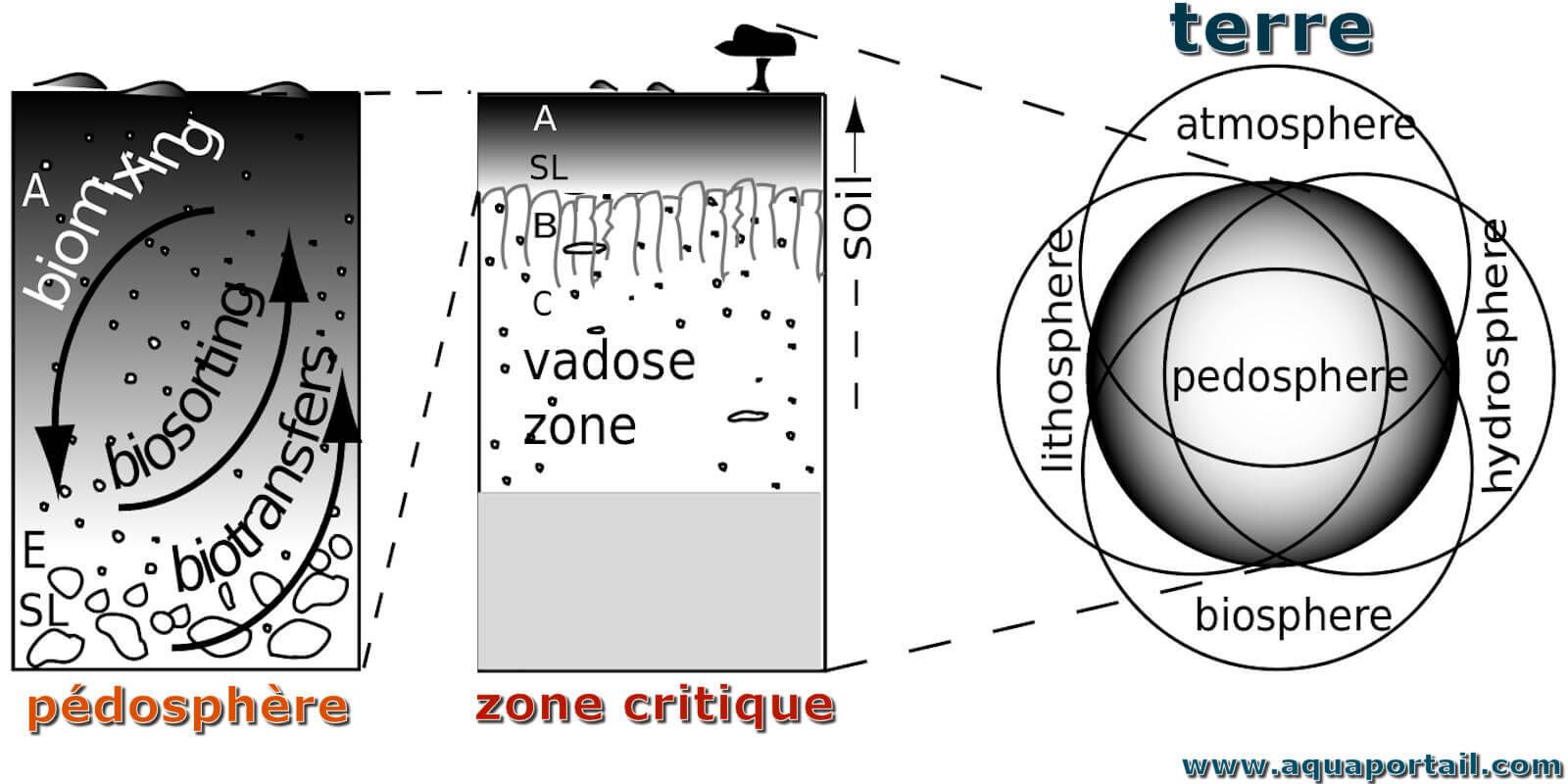
In geology, the pedosphere is the outermost layer of the Earth, composed of continental emerged soils and subject to soil-forming processes.
bacterial artificial chromosome

A bacterial artificial chromosome (BAC) is a DNA construct, based on a functional fertility plasmid or F-factor, used for transformation and bacterial cloning...
bacteriochlorophyll

A bacteriochlorophyll (BChl) is a pigment of photosynthetic eubacteria other than cyanobacteria, yet containing chlorophyll and able to carry...
