Arm
noun (n.)
Definition
The arm is the upper limb of the upper body of primates, consisting of 3 joints (shoulder, elbow, wrist) and 3 parts (upper arm, forearm, hand). Extending from the shoulder to the fingers, it comprises 30 bones, 56 muscles, nerves, and blood vessels. Its nerves are connected to the brachial plexus, one of the major nerve networks of the human body.
The human arm:
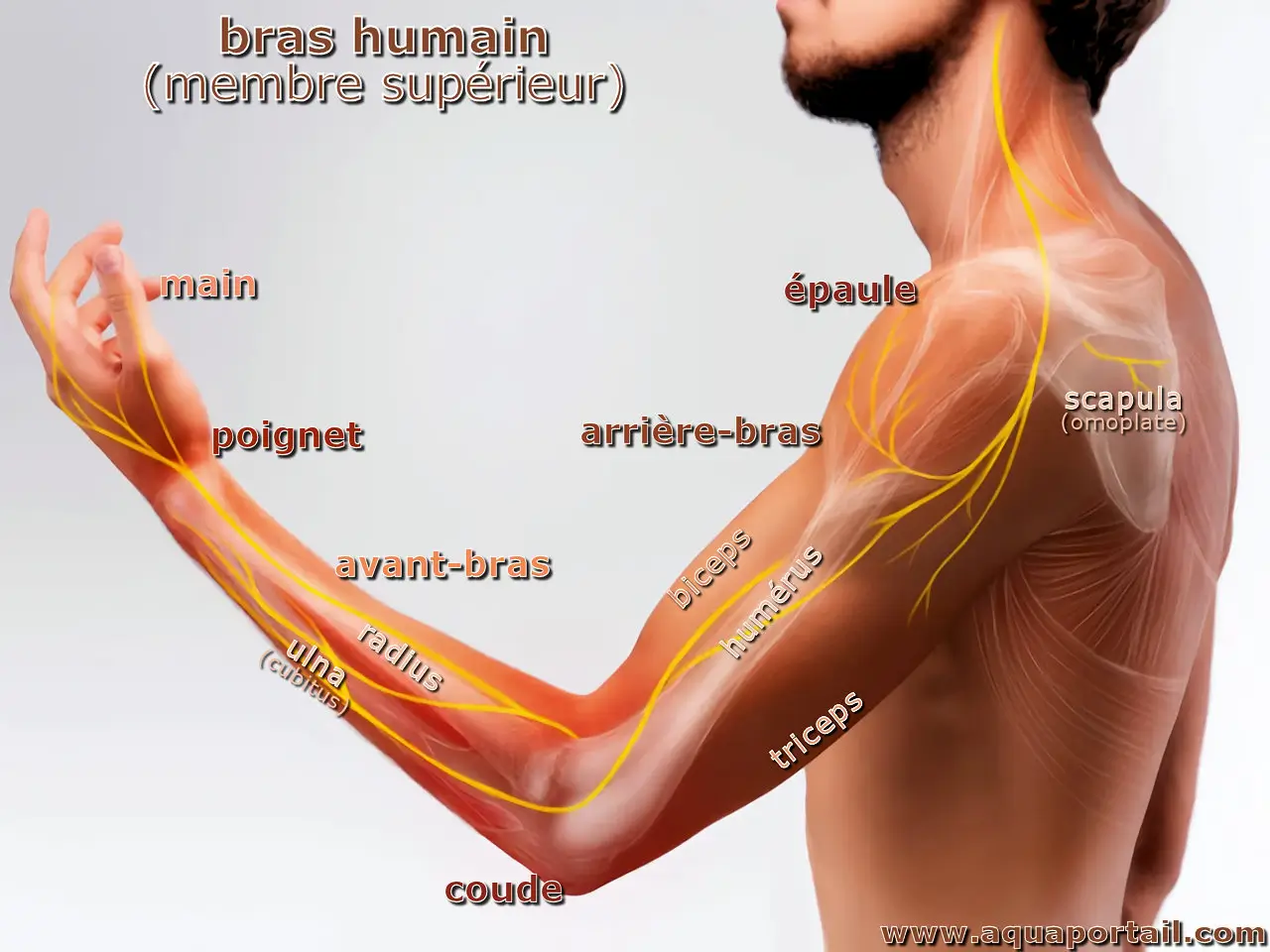
The arm is the tool of manipulation which, with its various parts (from shoulder to hand) working together, enables all possible movements in every anatomical direction.
Explanations
The part of an arm between the shoulder and elbow joints is called the "upper arm" or simply "arm". The part between the elbow and the wrist is called the "forearm". The hand is its distal extremity.
Humans, great apes, and monkeys possess two upper limbs, or arms, attached to the shoulders. Each arm is composed of bones, joints, and muscles allowing it to bend, rotate, swing, and move laterally. Possible movements include pronation and supination, flexion and extension, and adduction and abduction.
The arm consists of three main bones. The humerus, the bone of the upper arm, fits into the glenoid cavity of the shoulder by means of ligaments. This joint permits rotation and swinging. Four primary muscles attach to it: the biceps flexes the arm, the triceps extends it, the coracobrachialis moves it forward and backward (anteversion), and the brachialis muscle (beneath the biceps) contributes to anchoring and flexing the forearm.
At the elbow, the humerus connects to the ulna, while the radius runs parallel to the ulna from the elbow to the wrist, forming the forearm. The muscles of the forearm enable twisting movements leading to the hand.
Arms enable primates (humans and monkeys) to position their hands for various tasks such as pushing, pulling, grasping, carrying, and self-defense. Apes and monkeys use their arms to swing from branches and move along the ground.
Functions
The arm, or upper limb, begins at the shoulder joint, commonly described as a ball-and-socket (spheroidal) joint. Unlike the hip, the body's other ball-and-socket joint, the glenoid cavity of the shoulder is markedly shallower. This structural difference allows a wider range of motion, though at the expense of joint stability.
Further down the arm, the elbow joint is generally considered a hinge (trochlear) joint. Although partially accurate, this description overlooks the forearm's capacity for pronation and supination. This movement is made possible by the articulation between the radial head and the radial notch of the ulna, forming a pivot (trochoid) joint that permits one bone to rotate around the other.
The wrist joint, meanwhile, is classified as an ellipsoidal or condyloid joint. In addition, intercarpal joints connect the carpal bones; although synovial joints, they permit only minimal movement. Finally, the interphalangeal joints are simple hinge joints.
Other animals
In other animals, forelimbs differ from the true arms found only in primates. These animals may possess legs, fins, or wings. Starfish and octopuses possess limb-like structures lacking bones or joints, called arms or tentacles.
Synonyms, antonyms
Spanish translation: brazo
2 synonyms (similar meaning) for "arm":
0 antonyms (opposite meaning).
Related words and expressions to ARM are directly connected by general or specific meaning.
The word ARM is listed on page 1 of words starting with A in the dictionary glossary.
Related to "arm"
forearm
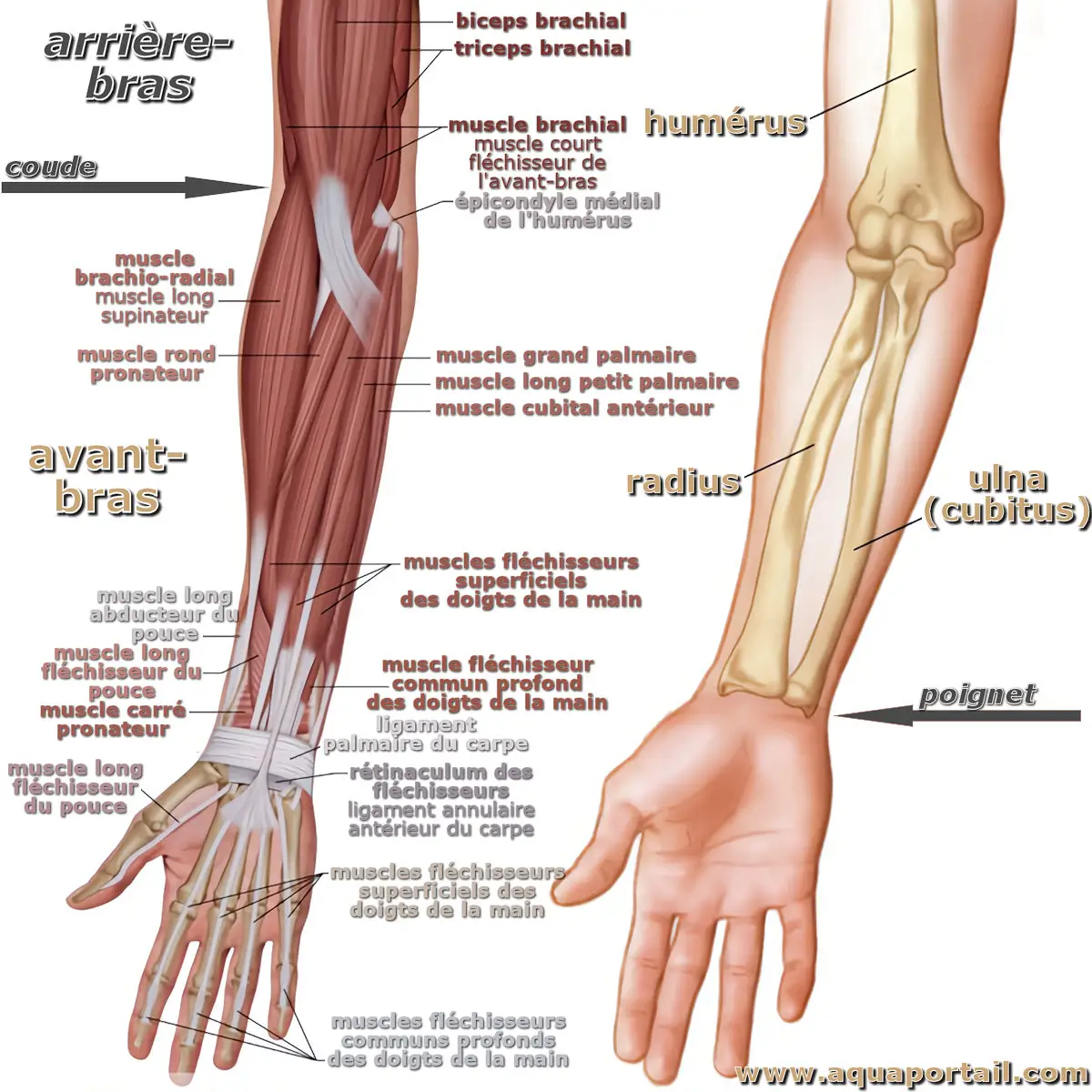
The forearm is the distal region of the human upper limb extending from the elbow to the wrist, composed of two long bones : the radius and the ulna.
armor

In zoology, armor is a protective outer covering formed for defense against predators, generally through hardening of the body, outgrowths, or secretions.
abiotic

In biology and ecology, abiotic refers to what is not biotic, that is, not part of living beings.
aboral

Aboral refers to what is situated away from or opposite the mouth in zoology, and especially in marine biology.
Simple summary
The arm is a limb of the body connecting the shoulder to the hand; it includes the upper arm (strictly speaking), forearm, wrist, and hand. It enables various movements and tasks, such as lifting, pushing, pulling, and performing daily activities. Additionally, the term "arm" can refer to elements or parts whose structure or function resembles that of a human arm, such as the articulated arms of a machine or of cephalopods.
