Fin rot
noun phrase (n. phr.)
Definition
Fin rot in a fish is a common disease symptom in aquariums. This soft rot is a highly fatal disease if not treated promptly. Several expressions describe the same symptom in the literature: fin necrosis, fin ulcer, fin blunting, or fin fraying.A fish affected by fin rot disease:
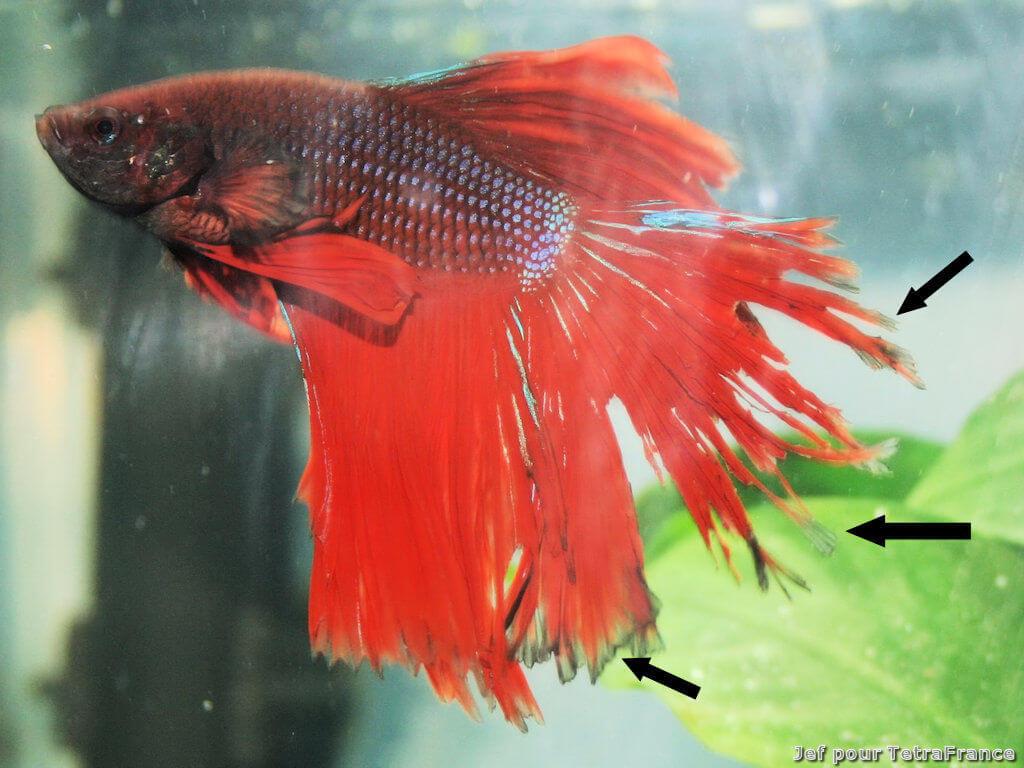
Fin rot has developed on this fish's unpaired fins: dorsal fin, caudal fin, and anal fin. In other cases, rot primarily affects the paired fins, and quite rarely all fins at once. Fin rot is common in bettas due to poor keeping conditions in pet stores. Beware: certain fighting fish such as the Crowntail Betta naturally have deeply cut and fringed fins—this is a normal morphology of their fins. Do not confuse the two!
Explanations
In all cases, the fish disease is caused by a bacterial infection for which three bacteria are primarily responsible: Flexibacter columnaris (Flavobacterium columnare), Pseudomonas sp., and Aeromonas sp.
The emergence and rapid spread of this disease stem largely from the intensive production of farmed fish in aquaculture. Husbandry conditions (high-dose antibiotics, precarious living conditions, overcrowding, reduced genetic diversity) have made this disease common in aquariums.
✅ The onset of soft fin rot is often a water-related disease linked to water quality and a drift in water parameters.
Development
Fin rot may be the result of a bacterial infection (Pseudomonas fluorescens, which causes irregular rotting of the fin), or a fungal infection (which rots the fin more uniformly and is more likely to produce a white edge—the margin). Sometimes, both types of infection are observed together. The infection is often triggered by poor water conditions, injuries, poor diet, stress, or a secondary infection in a fish already stressed by another illness.
Fin rot starts at the edge of the fins and destroys increasingly more tissue until it reaches the base of the fins. If it reaches the fin base, the fish will never be able to regenerate the lost tissue. At this stage, the disease may begin to attack the fish's body; this is known as advanced fin and body rot.
Fin rot is common in fighting bettas due to poor water conditions in pet stores.
Columnaris infection
Infection caused by Flexibacter columnaris or Flavobacterium columnare is responsible for: guppy disease with fin decomposition and skin necrosis, mouth fungus with mouth necrosis and deterioration of surrounding tissue, and in neon tetras, false neon disease in species of Paracheirodon with loss of blue coloration, fin decomposition, and whitish skin patches corresponding to necrotic areas.
The earliest symptom is the appearance of a whitish trim, or a whitish to yellowish coloration starting at the caudal peduncle and/or the base of the other fins, on one fin and then on all fins. Sometimes the fins fray until they become mere shreds of transparent skin. A progressive and significant reduction in fin size follows, leading to atrophy (complete loss of the fin) that prevents the fish from swimming properly.
Other signs of infection may be present or appear: mouth fungus, a sort of white fuzz on the mouth that may be the sole initial symptom; red patches on the skin corresponding to local hemorrhages; whitish patches on the skin corresponding to skin necrosis that may be preceded by hemorrhages; breathing difficulties in the event of gill infection: the fish breathes at the surface, gasps for air, and its respiratory rate accelerates; discoloration and darkening of the livery; weight loss and lethargy.
All internal organs of the fish are affected, and mixed infections are not uncommon.
Treatment is difficult, and maximum effectiveness with a good recovery rate depends largely on reaction time and treatment as soon as the first signs appear. Fish that have lost all of their fins are doomed; it is preferable to remove them from the aquarium before starting treatment for euthanasia. Primary, first-line treatment includes nifurpirinol, furaltadone, and neomycin. As a second-line option or in case of resistance to first-line treatments, penicillin, sulfonamides, or quinolones are advisable. For early-stage infections, baths with copper sulfate, benzalkonium, or salt can aid recovery. Since the bacterium thrives in water between 25 and 35 °C (77 and 95 °F), lowering your tank's temperature to 20 °C (68 °F) can limit its multiplication.
Aeromonas sp. and Pseudomonas sp. infections
As with Columnaris, the infection occurs in fish kept in poor conditions. Fin decomposition is not the main symptom of this infection. Instead, the infection primarily leads to dropsy (ascites) caused by kidney infection, red or whitish skin patches, or even skin ulcerations.
Behavior becomes abnormal and lethargic, showing breathing difficulties and swimming disorders. The fish loses weight and becomes apathetic.
Treating these two bacterial groups, known to exhibit high rates of resistance to broad-spectrum antibiotics, requires potent medications. To treat this form of rot, using neomycin, nifurpirinol, or nitrofurazone as a first-line treatment is suitable; as a second-line treatment, use sulfonamides and/or quinolones.
Prevention in tanks
Since the disease is common among fish in pet stores and the mortality rate of these infections is very high (up to 80%), prevention is better than cure. Effective preventive measures include: quarantine, or even a saltwater disinfectant bath for new arrivals, although the saltwater bath technique must not be practiced on scaleless fish. In all cases, avoid overcrowding, as overpopulation promotes stress and disease outbreaks. Check that the water temperature remains well suited to the fish being kept.
🚩 Fin rot in fish can result from another disease at an advanced stage, such as gyrodactylosis, for example.
⭐ Fin rot can be prevented with good water quality, by feeding fresh foods in small portions, and by maintaining a constant water temperature. Preventing the tank from becoming overcrowded (for domestic fish) will also help prevent fin rot.
Synonyms, antonyms
Spanish translation: podredumbre de las aletas
4 synonyms (similar meaning) for "fin rot":
- Columnaris
- fin fraying
- fin necrosis
- tail rot
0 antonyms (opposite meaning).
Related words and expressions to FIN ROT are directly connected by general or specific meaning.
The expression FIN ROT is listed on page 1 of words starting with F in the dictionary glossary.
Related to "fin rot"
fabrication

Fabrication is the act or process of making, constructing, or inventing something. The manufacturing or fabrication process, whether artisanal or industrial...
fang

A fang is a long, pointed, and curved tooth. All animals equipped with fangs use them to bite. Whereas in mammals the upper-jaw fangs (called canines)...
fatty acids

Fatty acids are molecules possessing a long hydrophobic hydrocarbon chain and a highly hydrophilic carboxyl group at one of its ends.
feeding

Feeding is the ingestion of food aimed at meeting the nutritional or medicinal needs of all organisms for their vital functions, notably growth, movement...
Simple summary
Fin rot is a common fish disease characterized by progressive degradation and fraying of the fins. It is generally caused by bacterial infections, poor water quality, or stress. It occurs primarily in freshwater aquariums but can also appear in saltwater. If left untreated, this condition can lead to more serious health problems for the affected fish. Symptoms include fin discoloration, a ragged appearance, and, in severe cases, total loss of parts of the fin tissue. Treatment generally involves improving water quality, reducing stressors in the fish's environment, and administering appropriate medications to combat the infection.
