Flagellum
noun (n.)
Definition
In biology, a flagellum is a motile cellular appendage equipped with a long, thin whip or tail, present in many unicellular organisms, including flagellates, and in certain cells of multicellular organisms, such as spermatozoa. Flagella have a locomotory function.
Flagellated organisms bear flagella:
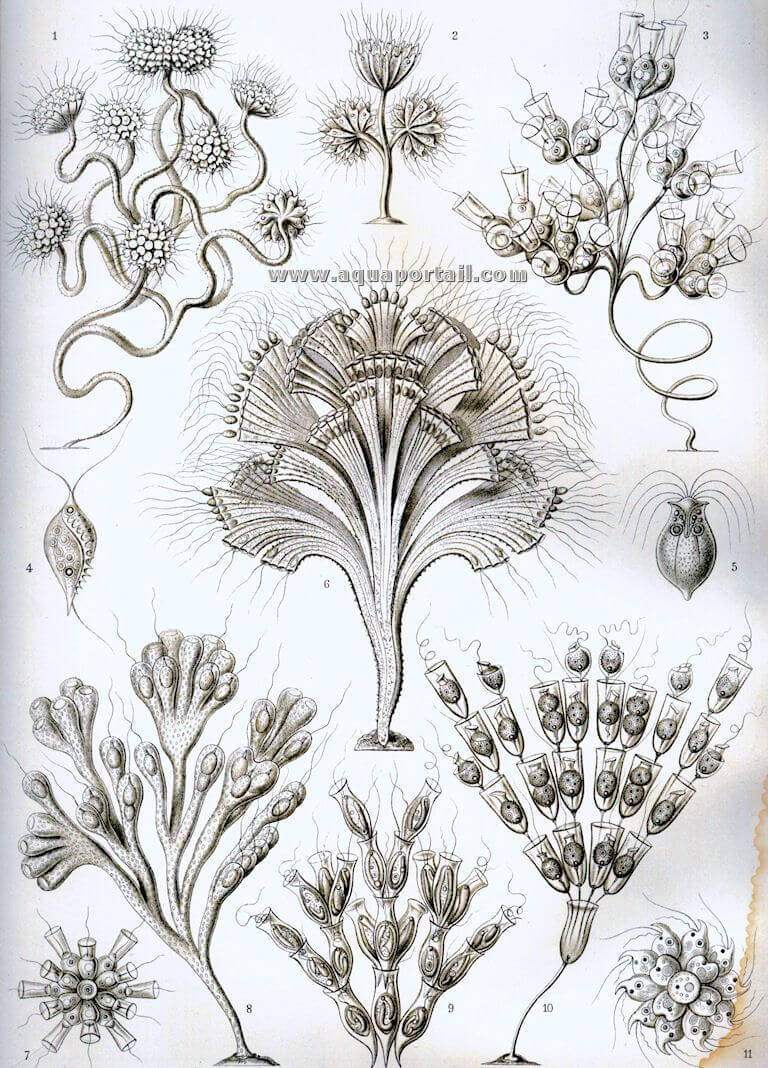
A flagellum is also present in certain multicellular organisms, such as spermatozoa. Flowering plants and higher fungi do not produce flagella, although this occurs in certain green algae and in chytrids. Many protists possess various forms of flagella. Flagella are found in many eukaryotic organisms and were likely present in the common ancestor of eukaryotes.
In flagellate protists, the flagellum is a motile filament serving as a locomotory organ in certain protozoans and spermatozoa. Flagella enable rapid, directed movements of the cell on which they depend.
Generalities and explanations
More completely, it is a slender filamentous appendage on the surface of a cell used for locomotion. It is composed of flagellin in bacterial cells, and consists of a set of two central microtubules surrounded by nine pairs of microtubules (9 + 2 arrangement) in eukaryotic cells. The number and arrangement of flagella vary.
The origin is the Latin word flagellum meaning "whip," like an axial filament. A flagellum, in pseudoscorpion arachnids, designates each of the setae on the outer face of the chelicerae. A pseudoflagellum is an appendage resembling a flagellum or flail.
Flagella are found in various types of organisms: flagellates, dinoflagellates, zooflagellates, phytoflagellates, silicoflagellates...
Structure
Flagella have a helical shape and consist of three distinct parts: filament, hook, and basal body. Here are brief definitions of these parts:
- the filament: is the part extending from the cell into the surrounding medium; it is formed by numerous subunits of a protein called flagellin. Unlike eukaryotic organisms, prokaryotic flagella have no internal microtubules
- the hook: is a protein structure whose function is to connect the filament to the basal body; its name refers to the curved shape that imparts circular motion to the filament. Its presence is fundamental because without it the flagellum would be a straight structure unable to transmit rotary motion
- the basal body or kinetosome: is a complex structure in Gram-negative and Gram-positive bacteria, characterized by the presence of rings embedded in the cytoplasmic membrane and associated with proteins enabling movement via a proton motive force and proteins that reverse the rotation of the shaft.
Types of flagella
Flagellates multiply by longitudinal binary fission, and some species have sexual reproduction. Examples of all modes of nutrition are found among them. A flagellum is stichonematic when it bears only a single row of fine, short hairs or mastigonemes. Put another way, the flagellum is an elongated cytoplasmic extension enabling cell movement. Spermosin designates a protein of sperm flagella.
Indeed, flagella are usually used for movement, although certain organisms may use them for other functions. For example, sponge choanocytes have flagella that generate water currents which these organisms filter to obtain food.
In Eukaryotes (unicellular organisms, gametes, zoospores), the flagellum possesses a central axoneme of microtubules surrounded by the plasma membrane and driven by dynein arms. In Bacteria, the flagellum is a filamentous polymer of flagellins, not surrounded by the plasma membrane but attached to it by a membrane rotary motor that spins on itself, driving the flagellum in its motion.
Thus, there are three types of flagella: eukaryotic, bacterial, and archaeal. Indeed, in each of these three biological domains, flagella are completely different in both structure and evolutionary origin. The only common trait among the three types of flagella is their superficial appearance. Eukarya flagella (those of protist, animal, and plant cells) are cellular projections that beat and generate an undulatory or helical motion.
On the other hand, bacterial flagella are complex mechanisms in which the filament rotates like a propeller driven by a microscopic rotary motor. Finally, archaea flagella are superficially similar to bacterial flagella, yet differ in many details and are considered non-homologous.
Pleuronematic flagellum
A pleuronematic flagellum is a flagellum bearing two lateral rows of very fine, short hairs or mastigonemes. Pleuronematic flagella have hair-like appendages on their surface. These appendages are called mastigonemes.
Pleuronematic flagella with hairs are divided into:
- with fine hairs (= non-tubular or simple hairs), found in euglenids Euglenophyceae, dinoflagellates Dinoflagellata, and some haptophytes Haptophyceae (Pavlovales)
- with stiff hairs (= tubular hairs, retronemes, mastigonemes stricto sensu), divided into:
- bipartite hairs: with two regions, found in cryptophytes Cryptophyceae, prasinophytes Prasinophyceae, and certain heterokonts Heterokonta
- tripartite hairs (= straminipiles): with three regions (a base, a tubular shaft, and one or more terminal hairs), found in most heterokonts Heterokonta / Stramenopiles.
Synonyms, antonyms
Spanish translation: flagelo
7 synonyms (similar meaning) for "flagellum":
- cilium
- flagellates
- flagellum
- mastigoneme
- pseudoflagellum
- spermatozoon
- undulipodium
0 antonyms (opposite meaning).
Related words and expressions to FLAGELLUM are directly connected by general or specific meaning.
The word FLAGELLUM is listed on page 1 of words starting with F in the dictionary glossary.
Related to "flagellum"
biflagellate

In zoology, biflagellate describes what possesses two flagella, referring to a doubly flagellated cell or microorganism equipped with two flagella.
fabrication

Fabrication is the act or process of making, constructing, or inventing something. The manufacturing or fabrication process, whether artisanal or industrial...
fang

A fang is a long, pointed, and curved tooth. All animals equipped with fangs use them to bite. Whereas in mammals the upper-jaw fangs (called canines)...
fatty acids

Fatty acids are molecules possessing a long hydrophobic hydrocarbon chain and a highly hydrophilic carboxyl group at one of its ends.
