Rhizome
noun (n.)
Definition
A rhizome is a perennial, subterranean or subaquatic, elongated horizontal or oblique plant stem typically extending along or beneath the soil surface. The rhizome is often swollen with food reserves and capable of producing new plants from its buds. A rhizophyte (or rhizomatous system) encompasses the entire network of roots, stolons, rhizomes, and tillering crowns.
The rhizome of a plant from a rice paddy:
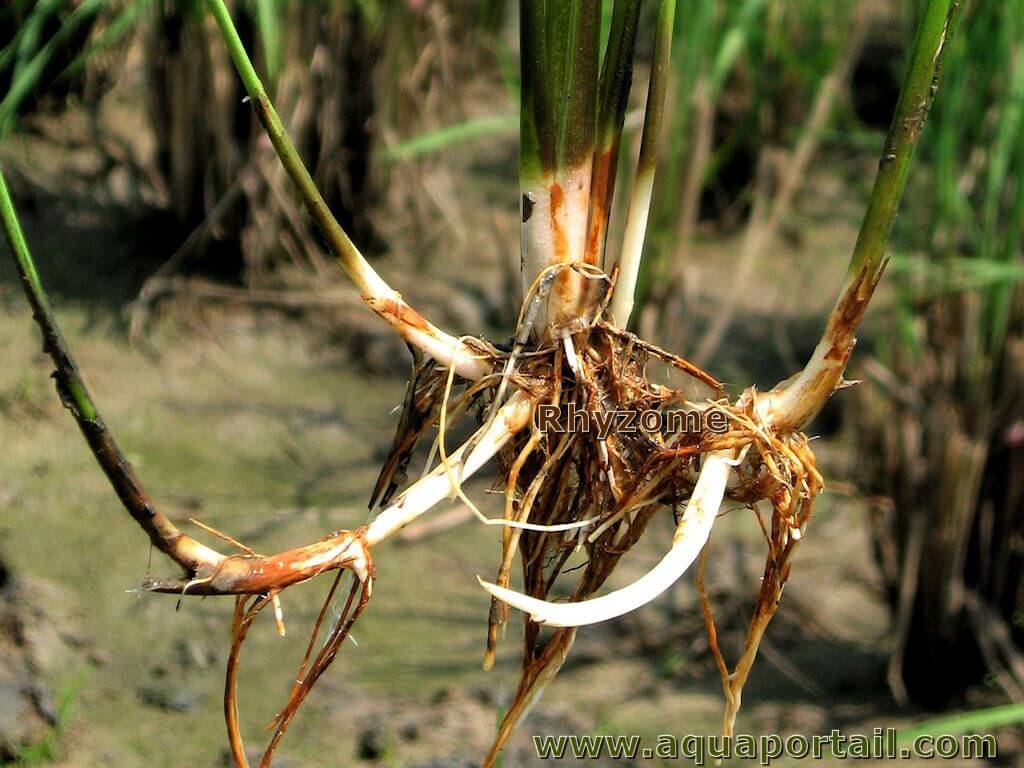
In botany and dendrology, a rhizome is a modified subterranean plant stem typically found underground or subaquatically, frequently sending out roots and shoots from its nodes in multiple directions. Rhizomes may also be referred to as creeping rootstocks in perennial plants.
Explanations
The roots of rhizomatous plants are adventitious. Developing from rhizomes, axillary buds are diageotropic, growing perpendicular to the force of gravity. The rhizome also retains the ability to send new shoots growing upward.
A rhizomatous plant differs from a bulbous plant.
If a rhizome is divided into pieces, each piece may be capable of giving rise to a new plant. The rhizome serves as storage for starches, proteins, and other plant nutrients. These nutrients become useful to the plant when new shoots must be formed or when the plant enters winter dormancy. This is a reproductive process known as vegetative propagation and is used by farmers and gardeners to propagate certain plants. It also enables lateral spread in grasses such as bamboo and turfgrasses.
Examples of plants that propagate in this manner include hops, asparagus, ginger, iris, lily of the valley, cannas, and sympodial orchids.
Examples of rhizomes used directly in cooking include ginger, turmeric, galangal, and asparagus.
Because algae do not possess a true stem in the botanical sense, this terminology is applied to them by analogy with higher plants.
Simply put: a nutrient-rich stem, subterranean or creeping along the soil surface, or an underground portion producing fibrous roots and aerial stems.
In certain perennial plants, the diageotropic underground stem bears adventitious roots, rudimentary leaves (scales), an apical bud, lateral buds, and leafy aerial stems—for example, lily of the valley, Solomon's seal, and polypody fern.
An endomycorrhizome represents a symbiotic association between an endophytic fungus and a rhizome; for example, Psilophytinae and rootless Orchidaceae.
Synonyms, antonyms
Spanish translation: rizoma
2 synonyms (similar meaning) for "rhizome":
- endomycorrhizome
- rhizophyte
0 antonyms (opposite meaning).
Related words and expressions to RHIZOME are directly connected by general or specific meaning.
The word RHIZOME is listed on page 1 of words starting with R in the dictionary glossary.
Related to "rhizome"
ramulus

A ramulus is a small branching of branches or stems of a plant that has undergone a metamorphosis resulting in growth arrest.
reaction rate

The chemical reaction rate corresponds to the change in concentration of a reactant (taken as a positive value) or a product over time, divided...
recessive

In genetics, a recessive trait refers to an allele or character that is expressed in the phenotype only if the organism is homozygous for the allele.
redox

The redox potential (rH) is the standardized abbreviation for oxidation-reduction potential via an oxidation-reduction reaction.
