Bud
noun (n.)
Definition
A bud is an embryonic development of an organ or an outgrowth-shaped structure. In botany, a bud is a plant organ composed of woody, foliar, or floral primordia (e.g., flower bud). In anatomy, a bud corresponds to the globular primordium of an organ.
This rose flower bud will open into a blossom:
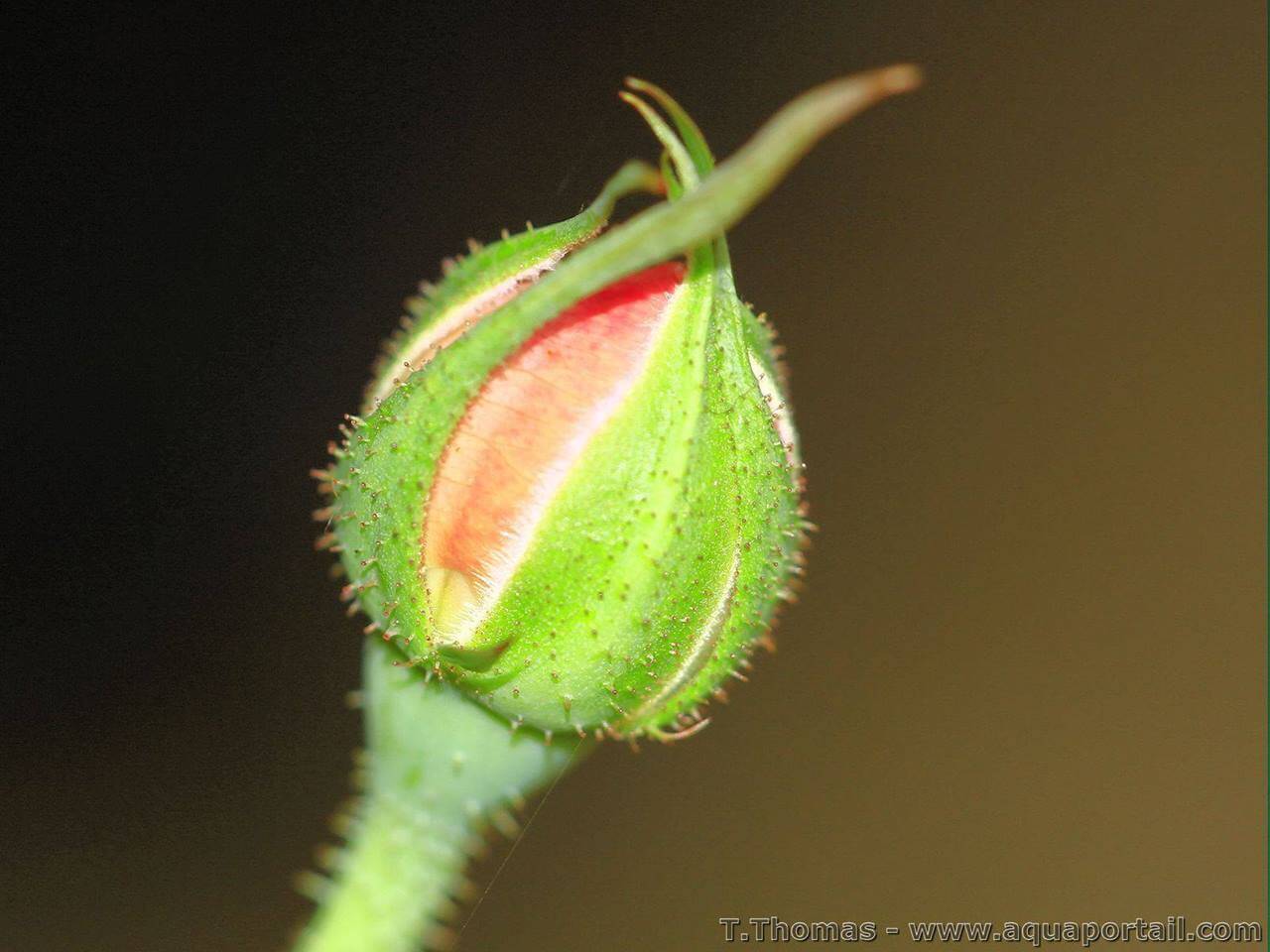
The blooming of a flower occurs after budding, the maturation of a flower bud, here of a rose.
Explanations
In plants, a bud is woody for a leaf/wood bud or floral for a flower bud, enclosed in scales in woody species or naked, at the tip of which lies a dormant meristem until budburst.
A distinction is made between the terminal bud and the apical bud at the tips of axes, as well as lateral or axillary buds in leaf axils, and adventitious buds appearing anywhere. Apical buds generally exert dominance over axillary buds, keeping the latter in dormancy.
✅ A mailleton is the specific French viticultural term for the current year's bud. A mallet cutting (crossette) is a grapevine or fig branch cutting with a heel of older wood. A spur (avantin) is a short-pruned cane retaining a bit of the previous year's wood.
Tree buds.

Around the buds of Carya ovata, after budding, the lenticels of the shagbark hickory are visible: each bud is a distinctive feature of a tree species.
A bud is underdeveloped or in an embryonic state. It normally appears in the axil of a leaf or at the tip of a branch. Once formed, a bud may remain dormant for some time. Buds may be specialized to develop into flowers or short shoots.
Whether an apical bud, axillary bud, taste bud, pelvic bud, vegetative bud, or spheroblast, all share a form of organogenesis.
The term bud is also used in zoology, in morphogenesis, where it refers to a body outgrowth that can develop into a new individual. Thus, in hydrozoans and corals (cnidarians), a bud is an outgrowth enabling asexual reproduction (gemmiparity/budding), whereas large sea anemones multiply primarily by fission.
A bud is mixed (ambiparous) when it contains both leaves and flowers.
Botanical types
Each plant has its own type of bud, specific to each species. Buds originate from meristematic tissue, forming small lateral or terminal protuberances on the stem of a vascular plant capable of developing into a flower, leaf, or shoot.
Types of tree buds:

28 types of tree buds found in France.
Perule (bud scale)
The perule refers to the covering of scales on a bud, serving a protective role. In certain orchids termed perulate, it describes the extension of the base of the gynostemium, forming a swelling beneath the corolla.
A perule is one of the scales of a leaf bud. Together, the perular scales protect the leaf bud.
In camellias, the bracts and outermost sepals become indistinguishable and are called perules.
In certain orchids termed perulate, the perule is the extension of the base of the gynostemium forming a swelling beneath the corolla, a pouch-like part of the perianth. A perule is thus a kind of sac formed by the fused bases of the two lateral sepals.
In anatomy
In animal anatomy, a bud corresponds to the globular primordium of an organ.
Taste buds (or gustatory papillae) consist of clusters of taste receptor cells that respond to sweet, bitter, sour, salty, and umami tastes and transmit this information to higher centers of the brain. Taste buds regenerate roughly every 10 days, meaning injured taste buds usually repair themselves.
Synonyms, antonyms
Spanish translation: yema
5 synonyms (similar meaning) for "bud":
- flower bud
- germ
- offshoot
- shoot
- sucker
0 antonyms (opposite meaning).
Related words and expressions to BUD are directly connected by general or specific meaning.
The word BUD is listed on page 1 of words starting with B in the dictionary glossary.
Related to "bud"
budding
Budding describes asexual reproduction through the formation of propagules, free buds, that is, starting from an outgrowth of the parent cell (mother cell)...
budget aquarium

How to save money for a cheaper aquarium ? With 40 ways to make fishkeeping less expensive, setting up a budget aquarium is easy ! If your aquarium is leaving...
bacterial artificial chromosome

A bacterial artificial chromosome (BAC) is a DNA construct, based on a functional fertility plasmid or F-factor, used for transformation and bacterial cloning...
bacteriochlorophyll

A bacteriochlorophyll (BChl) is a pigment of photosynthetic eubacteria other than cyanobacteria, yet containing chlorophyll and able to carry...
