Coral
noun (n.)
Definition
A coral is a marine polyp animal living inside a rigid cup composed of calcium carbonate that it secretes itself (in stony corals). Along with jellyfish, sea anemones, and sea pens, corals belong to the phylum Cnidaria and exhibit one of the simplest body plans among multicellular animals.
Detail of a Mediterranean red coral branch with extended white polyps:

The origin of the word coral, Corallium rubrum is the iconic red coral of the Mediterranean Sea, extending exquisite pure-white polyps in shaded habitats. See this thread on red coral.
Explanations
A coral polyp has a cylindrical body and a mouth surrounded by a ring of tentacles—essentially resembling a miniature sea anemone that secretes a calcareous skeleton. The calcareous skeleton (calcite or aragonite) secreted by a coral colony is called the corallum (and each individual polyp cup, a corallite).
Corals and reef builders
Corals may be solitary (a single corallite housing a single polyp) or colonial. In colonial forms, individual corallites fuse together to form a colony comprising thousands of polyps that can span several meters. Within this underwater structure, polyps gain major ecological advantages in protection, feeding, reproduction, metabolic sharing, and structural support. Corals are the primary builders of coral reefs.
Hermatypic (reef-building) corals harbor symbiotic unicellular algae, zooxanthellae, at densities on the order of 1 million cells per cm2. These algae require sunlight for photosynthesis, utilizing dissolved carbon dioxide, nitrogen, and inorganic phosphorus from seawater to synthesize organic compounds transferred to the host polyp. By shifting carbonate equilibria, they facilitate calcium carbonate precipitation—the foundation of coral skeletons (calcification).
Highly prized in reef aquariums, the pink coral Acropora millepora:

Keeping live corals in an aquarium creates a miniature reef that has become the hallmark of reef aquariology. See the guide on how to keep stony corals in an aquarium for Acropora millepora.
Zooxanthellae rapidly remove carbon dioxide generated by coral respiration, which would otherwise inhibit calcification; as a result, zooxanthellae boost calcification rates up to tenfold compared with non-symbiotic (azooxanthellate) corals.
Ectodermal cells in the basal region of the polyp (calicoblasts) secrete an organic matrix at the interface between the polyp and skeleton, where aragonite crystals nucleate and grow.
While most stony corals are sessile, many soft corals such as leather corals can slowly creep across the substrate (vagile). Sea anemones, close relatives of corals within Hexacorallia that lack a calcareous skeleton, can likewise move using their pedal disc.
See also sand, coral sand, bioerosion, reef flat.
⭐ Coral rock is a biogenic sedimentary rock derived from coral reefs. When freshly collected from the sea and colonized by microfauna and nitrifying bacteria, it is termed live rock; when dried, it reveals the calcareous skeletal framework of dead corals.
Coralliform describes anything resembling coral in form or structure. In marine zoology, certain corallimorpharians exhibit an intermediate morphology between sea anemones and stony corals.
Live coral
Live coral consists of living coral colonies or fragments transported in water, identifiable to species or genus level (CITES trade regulations frequently list corals at the genus rank).
Dead coral
Dead coral consists of skeletal coral fragments exported dead (though potentially harvested alive) whose corallite structures remain intact, allowing identification to species or genus level.
Mass spawning of corals
On the Great Barrier Reef, a few nights after the full moon in November, one of nature's most extraordinary spectacles unfolds: mass coral spawning along the entire 2,300 km (1,430 mi) reef system. Shortly after nightfall, the water teems with tiny bundles packed with eggs and sperm resembling miniature colored beads.
Anchored to the substrate, corals cannot move in search of mates and must therefore synchronize their spawning with remarkable precision.
Eggs, which develop more slowly than sperm, begin maturing inside coral polyps as early as April, shifting gradually from white to pink, orange, red, purple, green, or blue as the seasons progress toward austral spring. In some corals, colonies are separate sexes (gonochoric), whereas in most species polyps are simultaneous hermaphrodites producing both eggs and sperm.
Season, water temperature, and the lunar cycle are the three primary cues governing synchronized reproduction. Once optimal conditions align, spawning occurs between the second and seventh nights after the full moon, with each species typically spawning once a year. Shortly after dusk, egg-sperm bundles become visible just beneath the polyp mouths before being released simultaneously at dusk or night. Spawning at night helps corals evade daytime predators, while synchronous mass release overwhelms nocturnal planktivores; weak tidal currents further maximize fertilization success.
Hermaphroditic corals release buoyant egg-sperm bundles that float to the surface and break apart, allowing sperm to swim in search of eggs from another colony of the same species for cross-fertilization within roughly 30 minutes.
Bundle release may last from a few seconds to around thirty minutes. Massive corals of the genus Porites, by contrast, are typically gonochoric: in certain Porites species, males release sperm clouds that enter female polyps of neighboring conspecific colonies to fertilize mature eggs internally, with planula larvae brooded before release into the water column.
From this surface slick of gametes arises the next generation of corals; after drifting in the plankton for several days, most coral planula larvae settle onto the reef.
Synonyms, antonyms
Spanish translation: coral
1 synonym (similar meaning) for "coral":
0 antonyms (opposite meaning).
Related words and expressions to CORAL are directly connected by general or specific meaning.
The word CORAL is listed on page 1 of words starting with C in the dictionary glossary.
Related to "coral"
hexacorallian
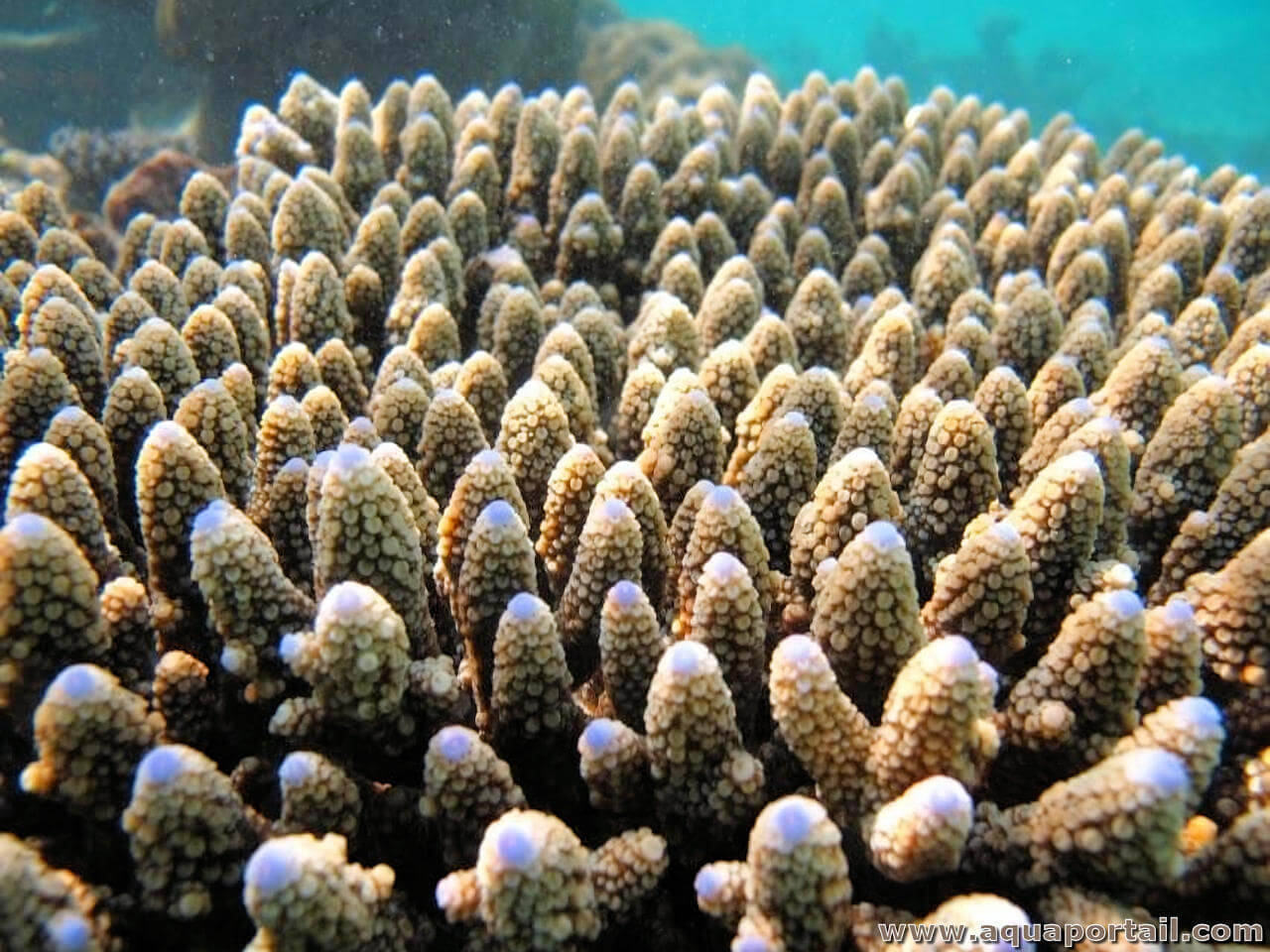
A hexacorallian is a cnidarian belonging to the anthozoan subclass Hexacorallia, in which each polyp is characterized by 6 tentacles (or a multiple...
octocorallian

An octocorallian is a member of the phylum Cnidaria and the anthozoan subclass Octocorallia, characterized by 8 pinnate tentacles surrounding the polyp's...
cactus

A cactus is a thick, fleshy plant that grows in many hot, dry regions of the world. Cacti do not have leaves, and many are covered with spines.
caecilian

A caecilian (gymnophione) is a limbless, burrowing, worm-like amphibian whose legs are vestigial or absent.
