Cloud
noun (n.)
Definition
A cloud is a visible collection of water droplets or ice crystals in the atmosphere at a certain height above the Earth's surface.
Atmospheric clouds are created because water vapor in saturated air condenses around condensation nuclei. Water vapor may develop into ice crystals and form ice clouds. In mixed-phase clouds, water droplets and ice crystals coexist.
Clouds:

A cloud is a visible aggregate of tiny particles of ice or liquid water, or both at once (mixed), suspended in the atmosphere after condensing or liquefying due to atmospheric phenomena. A cloud may also contain larger particles of liquid water or ice, as well as particles originating, for example, from industrial vapors, smoke, or dust.
Explanations
✅ A cloud is a mass of water droplets or ice crystals suspended in the atmosphere. Clouds form when water condenses in the sky. Condensation makes water vapor visible. Water on land or in the ocean evaporates, changing from a liquid into a gas called water vapor. Water vapor rises, cools, and then turns back into a liquid, forming tiny droplets. Enough of these droplets form a cloud.
Clouds have different shapes, which vary essentially according to the nature, size, number, and spatial distribution of their constituent particles and atmospheric wind currents. The shape and color of a cloud depend on the intensity and color of the light it receives, as well as the relative positions of the observer and the light source (sun, moon, rays) in relation to the cloud.
⭐ The study of clouds is called nephology, and its classification catalog is defined by the International Cloud Atlas, currently regulated by the World Meteorological Organization.
Clouds have major effects on Earth's temperature; they can trap heat in the atmosphere or block the sun's rays. Clouds are divided into types based on several factors, including size, color, elevation, and composition. Each cloud type has a Latin name and may belong to one of the four basic cloud groups. Since cloud formations and movements signal different weather patterns, you can predict the weather forecast if you know which types of clouds are in the sky.
Cloud types
Depending on the atmospheric layers occupied and their shape, different types of clouds are distinguished. Here are the cloud types ranked in ascending order of altitude (from lowest to highest):
- stratus;
- nimbostratus;
- stratocumulus;
- altocumulus;
- cumulus;
- altostratus;
- cumulonimbus;
- cirrus;
- cirrocumulus;
- cirrostratus.
The prefix "strato-" indicates a low altitude (from ground level up to 2 km / 1.2 mi), the prefix "alto-" is for middle-altitude clouds (from 2 to 5–7 km / 1.2 to 3.1–4.3 mi), and the prefix "cirro-" is for the highest ones (above 5–7 km / 3.1–4.3 mi altitude).
The main types of clouds:
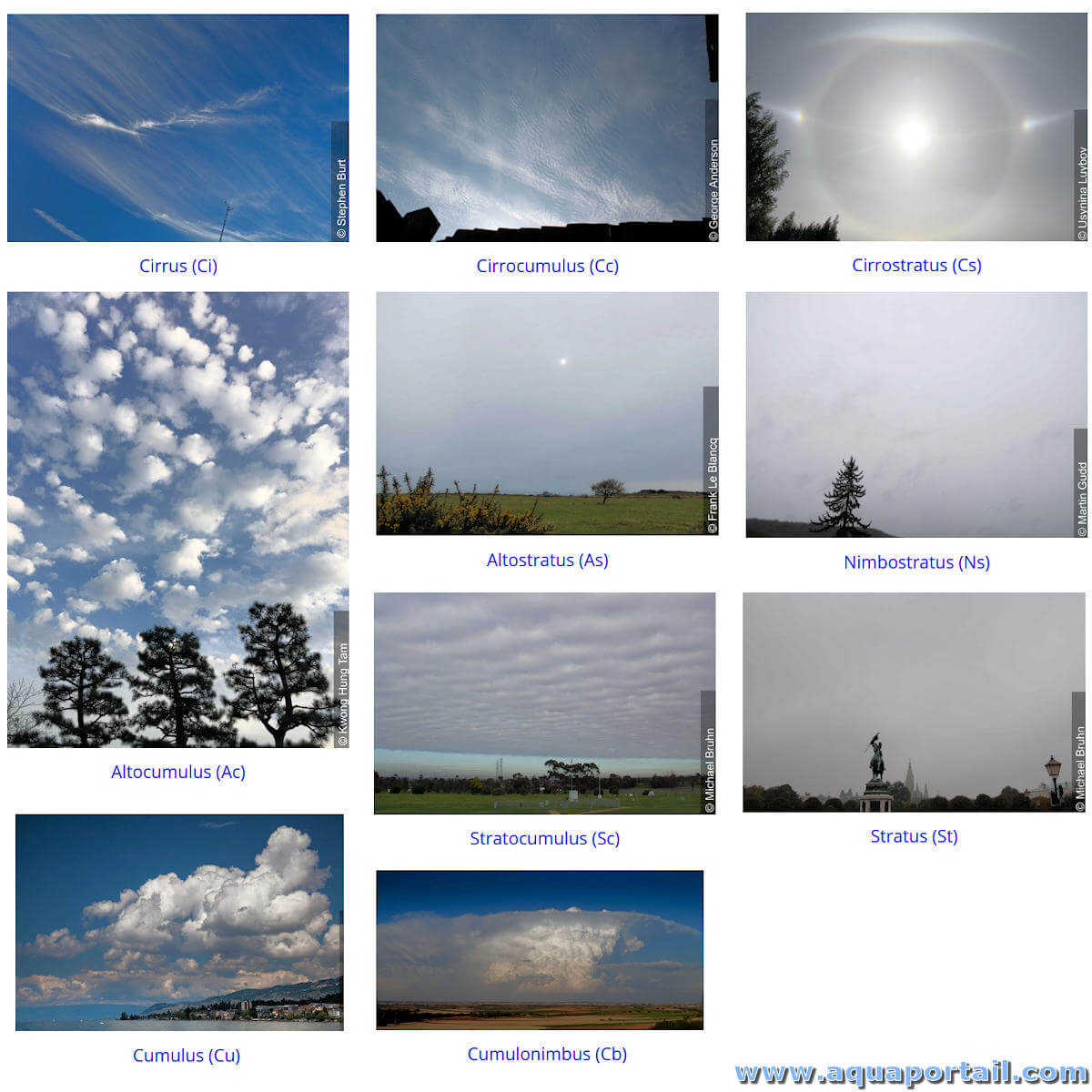
Photographic representation of 11 cloud types.
Cirrus clouds are high-altitude ice clouds ranging from 6 to 12 km (3.7 to 7.5 mi) up in the sky. Cirrus are detached white bands or streaks of cloud lining a clear sky. They generally look wispy, silky, and hair-like and are sometimes called "mares' tails," "cobwebs," or "painters' brushes." These clouds are associated with pleasant or fair weather. Cirrocumulus is a type of cirrus that appears as sheets or layers of small, rounded white puffs in the sky. Cirrocumulus clouds can resemble fish scales and give the appearance of a "mackerel sky." Cirrostratus is another type of cirrus. These clouds are transparent, thin, sheet-like clouds that can cover the entire sky. The transparency of the clouds still allows the sun or moon to be seen through them.
Alto clouds are mid-altitude clouds that can range from 2 to 6 km (1.2 to 3.7 mi) in the sky. One type of alto cloud is altocumulus. If these clouds appear on a warm, humid summer morning, they generally tend to portend late-afternoon thunderstorms. Altocumulus clouds are white or gray in color and composed of water droplets. The clouds may appear as puffy masses, flattened layers, or parallel bands or waves across the sky. Another type of alto cloud is altostratus. Altostratus clouds are gray or blue-gray in color and tend to appear ahead of rainy weather.
Stratus clouds are gray clouds that hang below 2 km (1.2 mi) and may accompany precipitation. Stratus clouds resemble fog and can cover the whole sky. One type of stratus is nimbostratus. This cloud indicates a wet weather front. The clouds are dark gray in appearance and produce rain or snow. Another type of stratus is stratocumulus. Stratocumulus are generally low, lumpy cloud layers ranging from dark gray to light gray. They may occur as rounded masses or rolls and can produce light precipitation.
Cumulus clouds appear as detached, puffy white "heaps" of cloud in the sky. These clouds can develop vertically and form cloud domes or mountains. The cloud tops have rounded towers and the cloud bases are flat and may hover 100 m (330 ft) above the ground. One type of cumulus is cumulonimbus. Cumulonimbus clouds can reach high altitudes of over 12 km (7.5 mi) and indicate very stormy weather. These clouds can produce threatening thunderstorms with lightning, thunder, or tornadoes.
Synonyms, antonyms
French translation:
nuageSpanish translation: nube
0 synonyms (similar meaning) for "cloud".
0 antonyms (opposite meaning).
Related words and expressions to CLOUD are directly connected by general or specific meaning.
The word CLOUD is listed on page 1 of words starting with C in the dictionary glossary.
Related to "cloud"
cumulonimbus

A cumulonimbus is a cloud of great vertical development, internally formed by a column of warm, moist air rising in a rotating spiral.
cactus

A cactus is a thick, fleshy plant that grows in many hot, dry regions of the world. Cacti do not have leaves, and many are covered with spines.
caecilian

A caecilian (gymnophione) is a limbless, burrowing, worm-like amphibian whose legs are vestigial or absent.
cancer

Cancer is a disease in which certain cells of the body grow uncontrollably and spread to other parts of the body.
