Cresyl blue
noun phrase (n. phr.)
Definition
Cresyl blue is a (vital) dye used to highlight the physodes of brown algae and the reticulocytes of bone marrow. Staining occurs via the binding of dye molecules to positive charges in the tissue or to cellular organelles such as ribosomes.Close to Nile blue, it is less toxic. It is used in phycology and hematology as a dye allowing vital or supravital staining of cells.
Brilliant cresyl blue is a supravital stain used to count reticulocytes. It is classified as an oxazine dye. Dust masks, protective goggles, and N95 gloves must all be worn when handling the chemical.
Brilliant cresyl blue molecules:
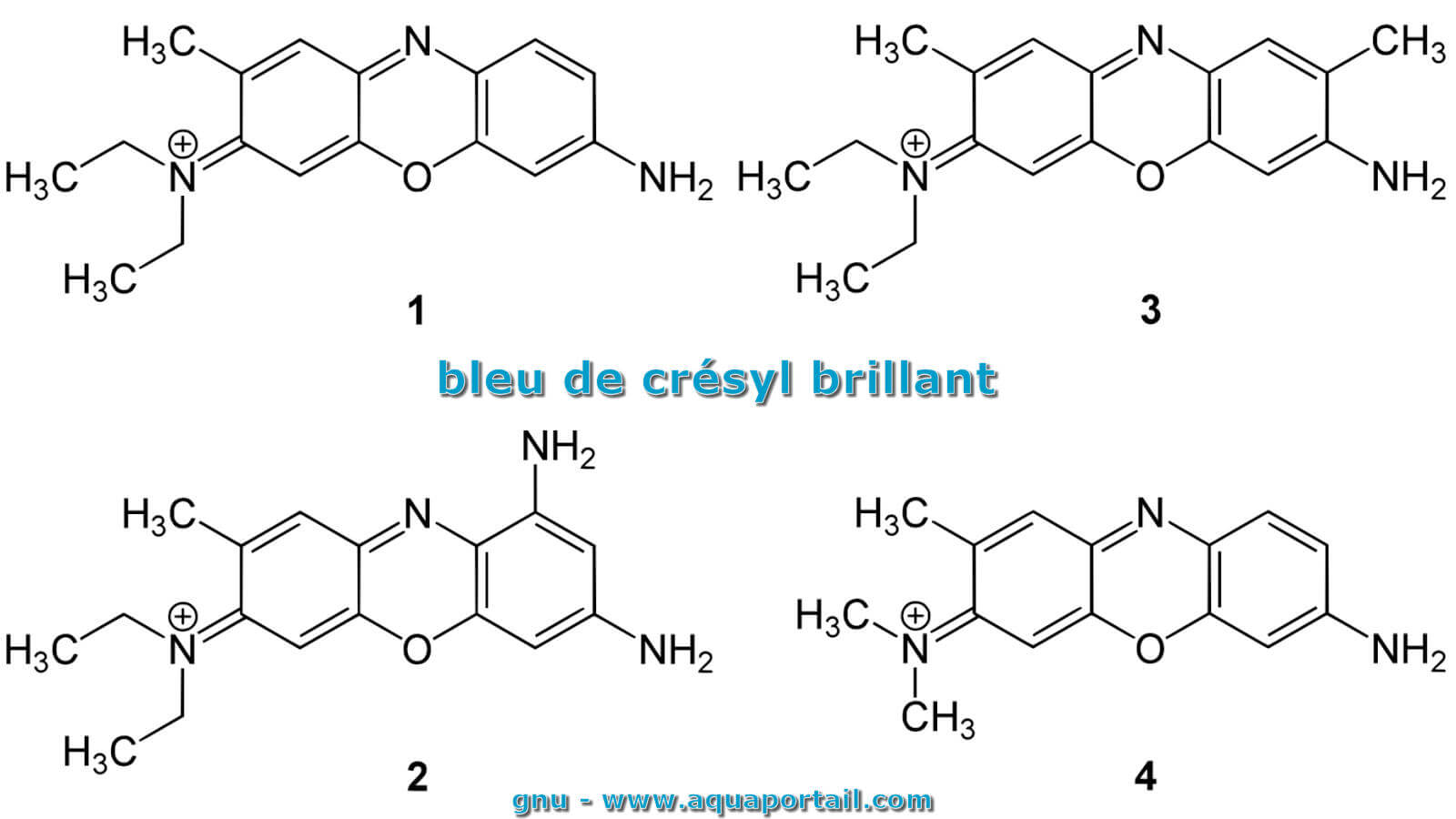
Different structures of brilliant cresyl blue. Only the cations are shown; the corresponding chloride ions have been omitted.
Chemistry
Brilliant cresyl blue belongs to the diaminobenzooxazines. Over time, there have been several structures in circulation called brilliant cresyl blue (see illustration). Even related oxazines were sometimes listed as brilliant cresyl blue. Finally, it was also partially declared as new methylene blue.
⭐ In the illustration above, structure (1) was produced in the German Reich before the outbreak of World War II, as well as shortly after 1980. Structure (2) is the preferred structure of Color Index International, though it was probably never commercially available. The third structure (3) has been manufactured in the United States since the 1950s. In some cases, it is listed under the name brilliant cresyl blue ALD. The last illustrated structure (4) was also produced in the United States after World War II.
The maximum absorption of the dye in a 50% ethanolic solution is λ max = 622 nm. It is sold either as a hemi-zinc chloride or as a chloride. The cation itself (see figure) is weakly hydrophobic. Brilliant cresyl blue may be stored in a dark, locked place.
Applications
Brilliant cresyl blue has a long history of application in cell biology. A weakly alcoholic solution of the dye is used to stain samples, or the dye is dissolved in distilled water. The method was described by Lavaditi around 1901 and was initially used to stain blood platelets (thrombocytes) in patients with leukemia. Supravital staining using brilliant cresyl blue was also introduced for reticulocytes at that time. The method was developed based on the knowledge of Nakanishi, who had performed bacterial staining with methylene blue. Sperm penetration into oocytes could be observed through brilliant cresyl blue. It is also useful for testing red blood cells for proper glucose-6-phosphate dehydrogenase activity.
Finally, the dye can also be used to check how Blastocystis hominis, a eukaryotic parasitic pathogen causing diarrhea, responds in humans after drug treatment.
Brilliant cresyl blue can also be used for counting reticulocytes in blood or bone marrow or for examining pathological erythroblasts.
In addition to staining animal specimens, it is also possible to stain various plant tissues, for example to observe nuclear division. Vital preparations and permanent preparations stained with brilliant cresyl blue can be produced. This allows, for example, the comparison of fixed and "living" chromosomes. The stain can also be used to examine other cellular organelles. In this context, Harold Joel Conn also described a delay in tumor cell growth due to the dye.
More recently, studies have been conducted on the use of brilliant cresyl blue in in vitro fertilization. With the help of the dye, it is possible to select ova with good developmental potential. Corresponding studies have been conducted on mouse and dog ova.
Synonyms, antonyms
Spanish translation: azul de cresilo
0 synonyms (similar meaning) for "cresyl blue".
0 antonyms (opposite meaning).
Related words and expressions to CRESYL BLUE are directly connected by general or specific meaning.
The expression CRESYL BLUE is listed on page 1 of words starting with C in the dictionary glossary.
Related to "cresyl blue"
toluidine blue
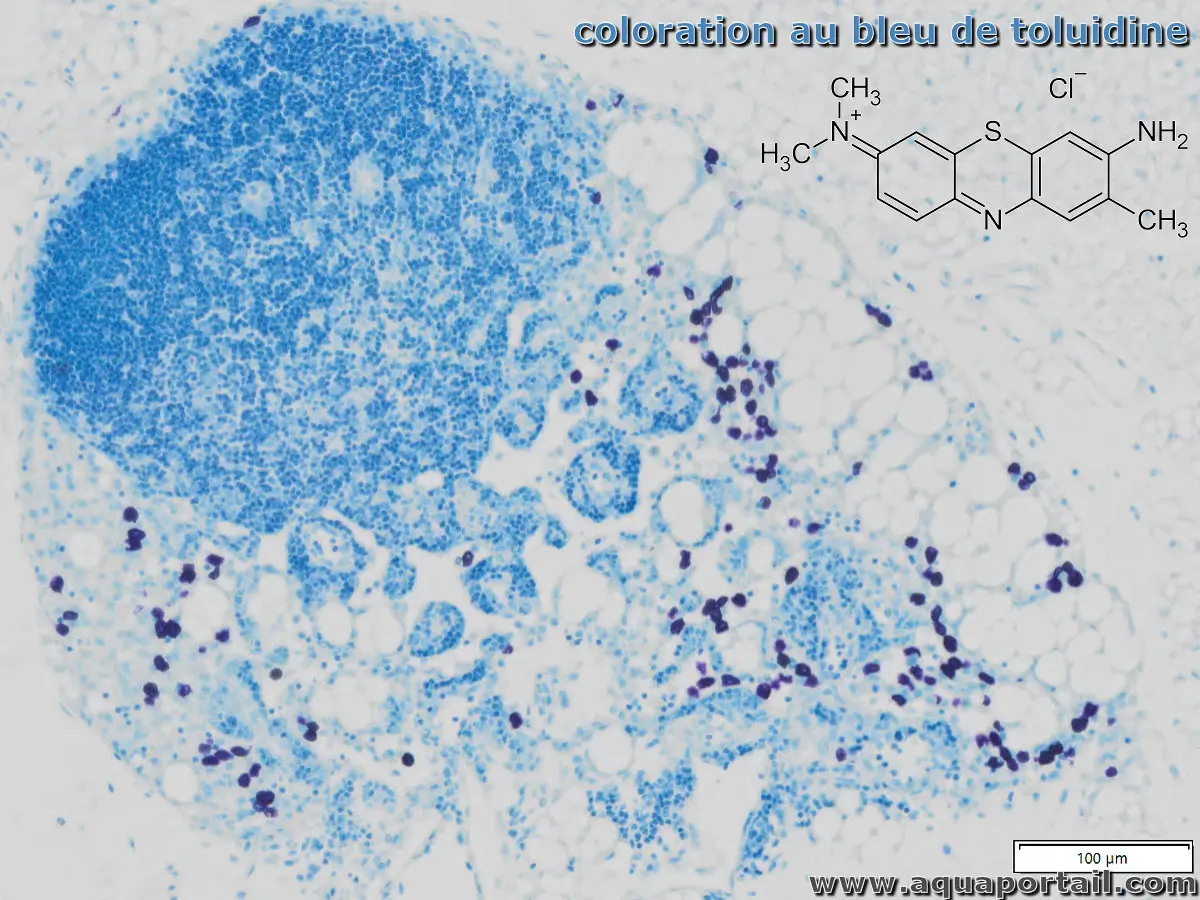
Toluidine blue is a dye very closely related to methylene blue, which imparts a red color to certain elements and blue to others.
cactus

A cactus is a thick, fleshy plant that grows in many hot, dry regions of the world. Cacti do not have leaves, and many are covered with spines.
caecilian

A caecilian (gymnophione) is a limbless, burrowing, worm-like amphibian whose legs are vestigial or absent.
cancer

Cancer is a disease in which certain cells of the body grow uncontrollably and spread to other parts of the body.
