Concrete
noun (n.)
Definition
Concrete is a composite construction material consisting of a binding paste and aggregates. The paste, composed of cement and water, coats the surfaces of fine aggregates (sand) and coarse aggregates (gravel or crushed stone); through a chemical reaction called hydration, the paste hardens and gains strength to form a rock-like mass known as concrete.Concrete is one of the strongest and most durable surface materials on Earth, yet under certain loads it is insufficient on its own: unreinforced concrete exhibits high compressive strength but low tensile strength, making reinforced concrete its essential structural counterpart.
Freshly poured liquid concrete:
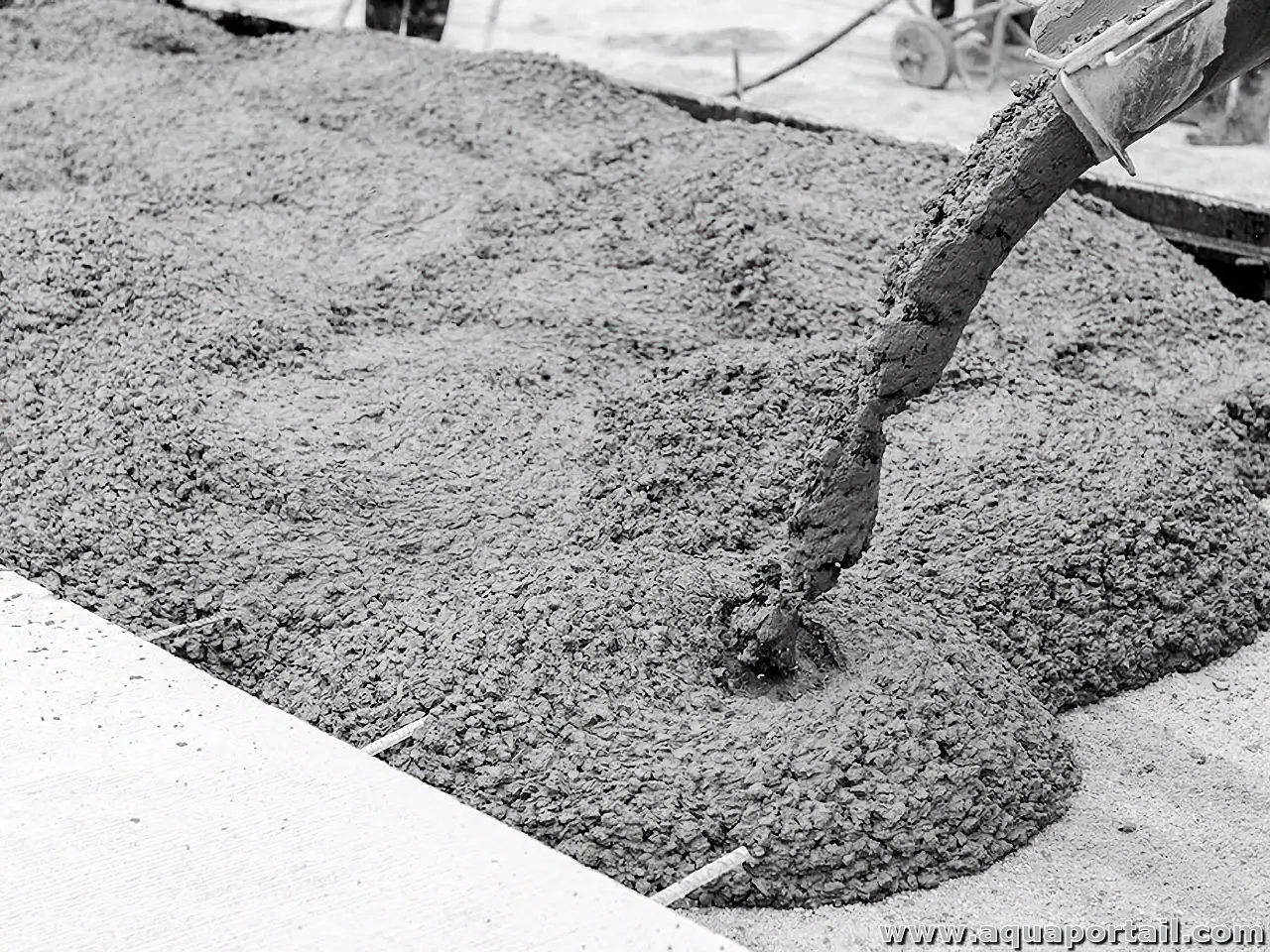
For structural applications, textured steel reinforcements called "rebar" or "reinforcing mesh" are embedded in concrete to increase its overall tensile strength.
Explanations
It may seem surprising to imagine a scenario in which concrete is not strong enough for a task, yet this occurs whenever a structural element experiences bending or tension, which is why reinforced concrete is used in a vast array of structures worldwide.
Concrete grade is defined by the minimum characteristic compressive strength of a mix 28 days after pouring. Cement is the most expensive ingredient in concrete, so increasing cement content—or adding specialized chemical admixtures—naturally raises mix cost.
Under European standards (EN 206), common strength classes include C8/10, C12/15, C16/20, C20/25, C25/30, C30/37, C35/45, and C40/50. A 10 mm aggregate mix uses fine gravel to ease placement around dense reinforcement.
Different construction projects require concrete of specific strength classes, making it essential to understand mix grades to match structural and environmental demands.
Whether a project demands enhanced strength, improved workability, or placement on a site with challenging geographic or climatic conditions, specialized concrete mixes exist to meet those needs.
Traditional uses
Concrete—plain or reinforced—is widely used in large-scale civil engineering projects as well as residential foundations and structural elements.
Key applications of concrete include:
- High-rise and commercial buildings: reinforced concrete is standard for floors, roof slabs, columns, and beams in multi-story buildings owing to its strength, fire resistance, durability, and cost-effectiveness.
- Bridges: reinforced and prestressed concrete are widely favored in bridge engineering for structural versatility, durability, and economy.
- Roads and pavements: concrete's rigidity and load-bearing capacity make it ideal for heavy-traffic highways and airport runways carrying aircraft and heavy vehicles.
- Marine and water-retaining structures: durable marine-grade reinforced concrete is suited for quays, seawalls, caissons, floating docks, sewer pipelines, and dams.
- Foundations: reinforced concrete is used in nearly all foundations, including footings, piles, and mat (raft) foundations for houses, buildings, and bridges.
Foundations of a reinforced concrete raft slab:

Raft foundation construction is carried out using concrete reinforced with steel rebar.
Mixes and specialty concretes
Concrete formulations span a wide spectrum of mixes tailored to both commercial infrastructure and residential projects, where high-quality concrete significantly improves structural longevity and surface finish.
Cellular and foamed concrete
Cellular concrete (aerated foamed concrete) is lightweight, non-toxic, and low in chemical additives, making it ideal for void filling, sinkhole remediation, and geotechnical stabilization. Flowable foamed concrete is also widely used to backfill utility pipeline trenches in roadways because it self-levels without mechanical compaction yet remains easily excavatable later if needed.
Another advantage of cellular concrete is its low density and reduced labor demand; with air contents up to 80%, foamed concrete also delivers excellent thermal insulation, soundproofing, and fire resistance.
Rapid-setting concrete
Rapid-setting concrete is a formulation that sets and hardens much faster than standard mixes, ideal for time-critical repairs or rapid turnaround work.
Rapid-setting concrete is a practical choice for small-scale, non-structural DIY jobs such as setting fence posts or quick patching.
✅ Whereas conventional concrete typically requires 24 to 48 hours before formwork removal (and 28 days to reach full design strength), rapid-setting concrete hardens within an hour—making it invaluable for urgent anchoring but unsuitable for large pours.
Every concrete mix rests on three core ingredients—water, cement, and aggregates—whose proportions and chemical admixtures govern performance. Rapid-setting concrete contains higher cement dosages (or specialized calcium aluminate/sulfoaluminate cements) along with accelerating admixtures to speed hydration.
Waterproof (watertight) concrete
Designed to keep water in or out, waterproof concrete is a dense, durable mix formulated with a low water-to-cement ratio, superplasticizers for workability, and pore-blocking waterproofing admixtures to minimize capillary permeability.
✅ Standard concrete is not completely watertight; waterproof concrete resists both ground dampness and liquid water penetration under hydrostatic pressure (basements, tanks, pools, and foundations below the water table).
Ordinary concrete is naturally porous because excess mixing water evaporates during curing, leaving behind a network of microscopic capillary pores.
As a result, untreated concrete can absorb significant water by capillary action—up to several tens of liters per cubic meter—leading to dampness, freeze-thaw scaling, and rebar corrosion.
Over time, water ingress causes cracking that accelerates further water penetration and internal deterioration; investing in properly specified, durable concrete upfront avoids costly structural repairs later.
Self-compacting concrete
Self-compacting concrete (SCC) is a highly flowable mix that consolidates under its own weight without mechanical vibration while achieving strength comparable to conventionally vibrated concrete.
Self-compacting concrete lowers labor and equipment costs, speeds construction schedules, fills intricate formwork cleanly, and reduces jobsite noise and vibration hazards.
Power-floated concrete
Power-floated concrete is a smooth, dense floor-slab finish produced using a rotary power trowel machine whose rotating blades compact and burnish the concrete surface, enhancing abrasion resistance and reducing surface cracking.
Hydraulically bound material
"Hydraulically bound material" (HBM) refers to soil or aggregates stabilized with hydraulic binders such as cement, lime, slag, gypsum, or fly ash that harden through reaction with water.
Hydraulically bound materials are widely used in road sub-bases and base courses, offering lower environmental impact and substantial energy savings through cold in-place mixing compared with hot-mix methods.
Synonyms, antonyms
French translation:
bétonSpanish translation: hormigón, concreto
3 synonyms (similar meaning) for "concrete":
- aggregate material
- cement
- mortar
0 antonyms (opposite meaning).
Related words and expressions to CONCRETE are directly connected by general or specific meaning.
The word CONCRETE is listed on page 1 of words starting with C in the dictionary glossary.
Related to "concrete"
cactus

A cactus is a thick, fleshy plant that grows in many hot, dry regions of the world. Cacti do not have leaves, and many are covered with spines.
caecilian

A caecilian (gymnophione) is a limbless, burrowing, worm-like amphibian whose legs are vestigial or absent.
cancer

Cancer is a disease in which certain cells of the body grow uncontrollably and spread to other parts of the body.
capsule

A hard capsule (gelcap) is a small, hollow, hard-shelled capsule made of two interlocking halves containing a medication, nutraceutical, or dietary...
