Brittle star
noun phrase (n. phr.)
Definition
A brittle star is a marine echinoderm of the class Ophiuroidea. Ophiuroids have pentaradial symmetry and resemble starfish, with five arms radiating from a central disc.
The superb, large brittle star Ophiolepis superba:

Brittle stars, such as Ophiolepis superba, generally have five long, thin, whip-like arms that can reach up to 60 cm (23.6 in) in length in the largest specimens.
A brittle star is an animal belonging to the taxonomic class Ophiuroidea, equipped with five arms and closely related to starfish. The brittle star is thus a small echinoderm resembling a starfish with a small round body and 5 thin, highly mobile arms, crawling across the bottom using these flexible arms.
Brittle stars and ophiuroids are benthic invertebrates with the specific qualifiers: epibenthic, zoobenthic, and macrobenthic.
Characteristics
The class Ophiuroidea contains two major clades: Ophiurida (true brittle stars) and Euryalida (basket stars). Many brittle stars are rarely encountered in the relatively shallow depths normally visited by humans, yet they form a diverse group. More than 2,000 species of brittle stars (in about 230 genera) live today. Over 1,200 of these species are found in deep waters, below 200 m (656 ft) depth, some in abyssal or even hadal environments.
Mostly detritivorous in diet, brittle stars are light-avoiding (photophobic) and live sheltered under stones and rocks.
Brittle stars (and relatives) have a small flattened body formed by a rounded disc extended by five very thin, long, jointed arms that emerge abruptly from the central disc and may be branched. Each arm consists of a column of ossicles (called vertebrae), articulated with one another, connected by muscles, and covered with plates. They have closed ambulacral grooves, with pores through which tube feet emerge; these are smooth, lacking ampullae or suckers, but with well-developed musculature.
The mouth is composed of five movable plates acting as jaws. An anus is absent, so their digestive tract is incomplete; undigested material is expelled through the mouth. The skeleton is very similar to that of starfish, except for the presence of skeletal vertebrae in the arms, which reduce or completely obliterate the coelomic cavity (coelomate).
They may possess, among other traits, a curious asexual reproduction system. In this type of reproduction, a brittle star can be completely regenerated from a single arm that, for some reason, detached (possibly through autotomy). They are generally separate-sexed, although a few species are hermaphroditic. Some brood their young (ovoviviparous); in such cases, these juvenile brittle stars exit through the genital slits or by rupturing the disc on its aboral side.
In the upper part of the body, there is a kind of armor covered with microscopic lenses functioning like a large compound eye. Within the protective plates lies an array of crystalline protuberances thinner than a human hair. These tiny structures, made of calcite (calcium carbonate), turn out to be high-quality microlenses that focus light onto a set of apparently photosensitive nerves beneath the plates, shaped precisely to produce a clear image.
Feeding and diet
There is great diversity in the feeding habits of brittle stars. There are predatory species, such as Ophioderma, that hunt with their arms using a row of flat spines they bear. Suspension-feeding species, such as Ophiothrix, capture food through a mucus net formed between the arms; they have long spines to help support this network.
They then form a food bolus that travels along the aboral side of the arm to the mouth. Detritivores may be selective (capturing food with their podia and transporting it to the mouth) or non-selective (eating whatever reaches the mouth, with selection occurring in the stomach).
Habitat
Different types of brittle stars inhabit all of the world's oceans, notably the tropical belt of the Atlantic Ocean, from the gulf of Mexico to the Mediterranean and up to certain regions of northern Europe. It should be noted that brittle stars have various species radiations and their geographic distribution varies by species; in addition to their size ranging from about 5 to 60 cm (2 to 23.6 in), the depth of their natural habitat also varies, from 1 meter (3.3 ft) to around 350 meters (1,148 ft) (and far deeper for abyssal species).
They are often found associated with coral reefs in all their forms; they can also be found in damp beach sands or in mid-depth regions, in algal zones, all varying according to their level of activity, as several species move very little, others are very active, and another considerable proportion are even hunters.
The closest marine animals are sea cucumbers and sea urchins, in addition to starfish, all of these animals possessing pentamerism in their radial symmetry.
Synonyms, antonyms
Spanish translation: ofiura
3 synonyms (similar meaning) for "brittle star":
0 antonyms (opposite meaning).
Related words and expressions to BRITTLE STAR are directly connected by general or specific meaning.
The expression BRITTLE STAR is listed on page 1 of words starting with B in the dictionary glossary.
Related to "brittle star"
starch

Starch, with the chemical formula (C₆H₁₀O₅)n, is a reserve carbohydrate substance in various organisms, composed of more or less branched glucan molecules.
echinoderm
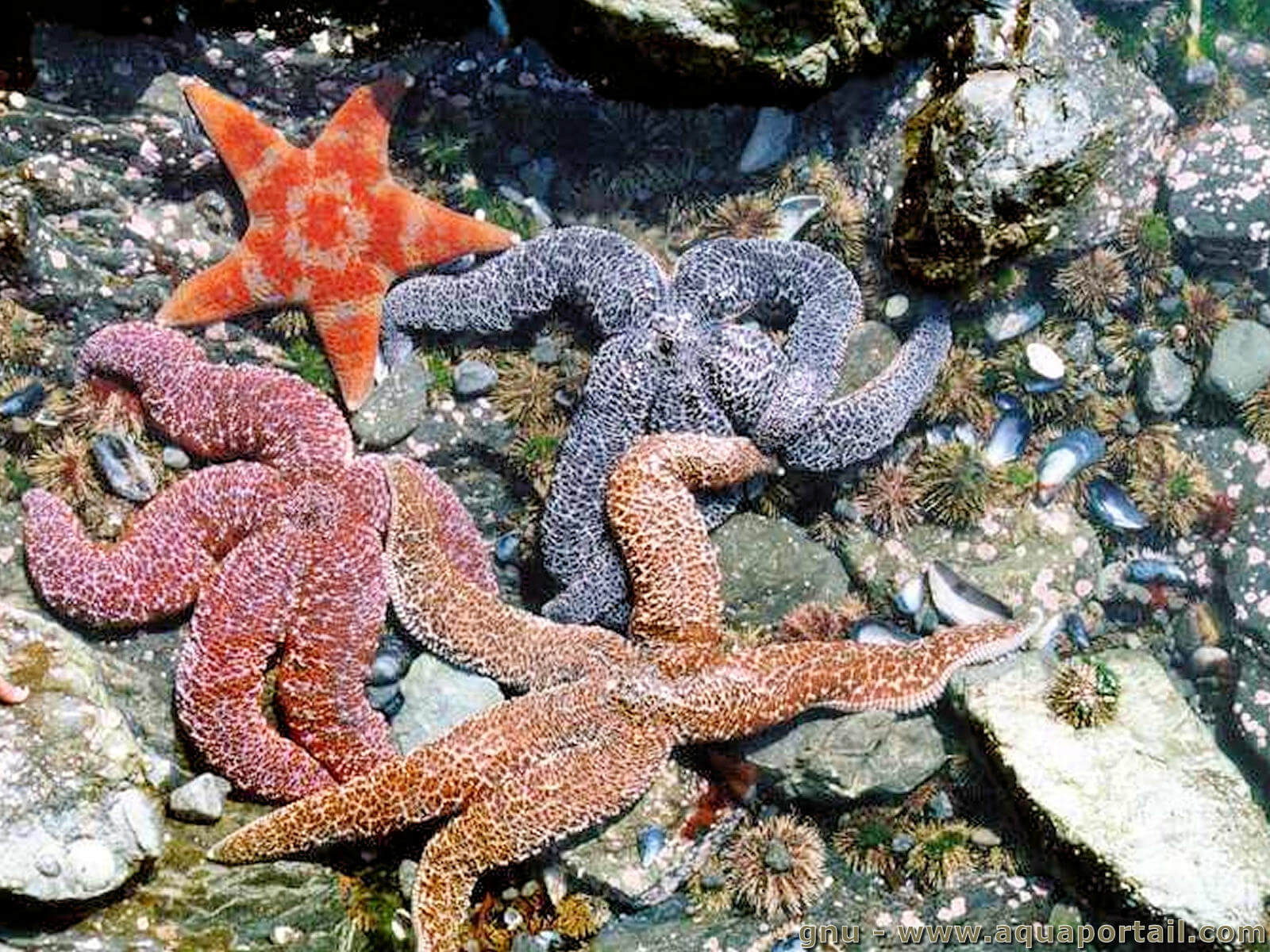
An echinoderm belongs to a lineage of invertebrates, the phylum Echinodermata, found exclusively in the world's oceans : starfish, brittle stars, sea urchins...
bacterial artificial chromosome

A bacterial artificial chromosome (BAC) is a DNA construct, based on a functional fertility plasmid or F-factor, used for transformation and bacterial cloning...
bacteriochlorophyll

A bacteriochlorophyll (BChl) is a pigment of photosynthetic eubacteria other than cyanobacteria, yet containing chlorophyll and able to carry...
Simple summary
The brittle star is an echinoderm of the class Ophiuroidea, closely related to the starfish. These marine creatures are characterized by thin, flexible arms radiating from a small central disc. They are capable of moving rapidly through coordinated, undulating movements of their arms. Their ability to regenerate lost arms gives them great resilience, although their English name ("brittle star") derives from their tendency to easily shed these limbs as a defense mechanism (autotomy).
