Selection
noun (n.)
Definition
Selection, in breeding or cultivation, is a selective breeding (or planting) program in which only individuals or families meeting predetermined phenotypic criteria for quantitative phenotypes, or individuals exhibiting the desired qualitative phenotype, are retained.Giraffes undergo (natural) selection for their height:

Selection for a giraffe's height is proportional to the length of its neck.
Explanations
Selection in animal breeding falls under animal husbandry (zootechnics), while selection in plant cultivation falls under plant breeding (phytotechnics).
⭐ See also selective cultivation (plants, plant breeding) and selective breeding (animal breeding, bacteria).
In biology
In biology, selection may be artificial or natural. A GMO (genetically modified organism) results from genetic selection. Natural selection is the most frequently cited type of selection. However, breeding dogs, cats, birds, cattle, or horses (and domestic animals in general) also constitutes "artificial selection." Subcategories of natural selection may also be noted, including ritual selection, ecological selection, balancing selection, disruptive selection, and directional selection.
Adults, young (chicks, fry, larvae, juveniles), embryos, and even eggs and sperm can be exposed to selection. The primary factors (climatic, edaphic, biological...) driving selection are limited resources (food, host, mate) and the presence of threats (predators, disease, harsh weather conditions). Biologists often refer to such factors as selective pressures.
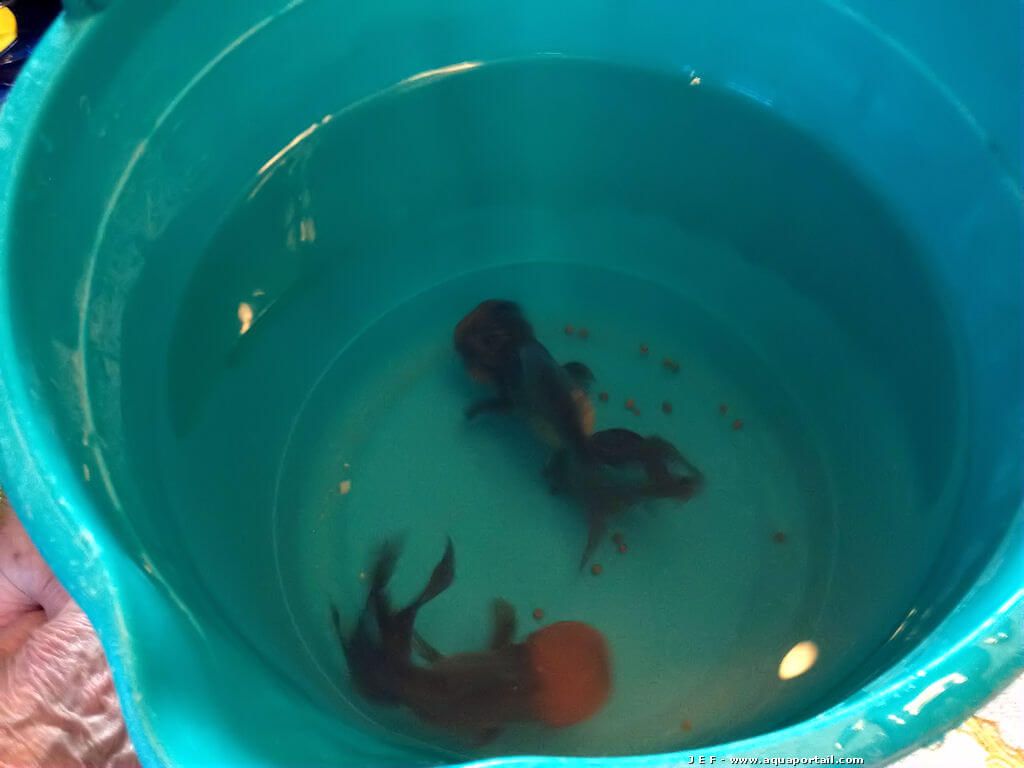
The veiltail is a selective breed of goldfish:

Selective breeding of goldfish creates diverse varieties: this veiltail originates from a lineage or population sorted for centuries to maintain the exact desired form and associated genetic traits. It is an artificial selection.
Selection can act in a positive or negative direction. Negative selection reduces the frequency of traits that lower an individual's ability to reproduce successfully. Positive selection increases the frequency of adaptive functions. For instance, desert conditions select against poorly adapted root structures.
Selection can be categorized by phenotypic effect and by cause. The effects are termed selection, though they do not necessarily stem from the same mechanisms; each form can emerge from several different mechanisms. Stabilizing selection favors individuals with intermediate traits; disruptive selection favors individuals with extreme traits. In directional selection, when traits are arranged along a phenotypic spectrum, individuals closer to one end of that spectrum achieve greater success. Multiple traits can be advantageous in balancing selection, whether natural or artificial.
In aquaculture and fish farming, fish that do not meet these criteria are culled.
Types of selection
Various genetic and/or phenotypic selection methods are applied according to a selection differential and a selection index, yielding a specific selected population, sometimes for selective harvesting:
- natural selection;
- artificial selection;
- genetic selection (for genetic improvement);
- tandem selection;
- family selection;
- indirect selection;
- individual selection;
- within-family selection;
- between-family selection;
- sexual selection;
- in vitro selection (aptamer selection) or clonal selection;
- thymic selection...
The selectivity of each species or group of species leads to choices that are sometimes "mathematical" and sometimes purely anthropic. Natural evolutionary principles leading to breeds, varieties, subspecies, etc., due to dominant or recessive traits in genetics must also be taken into account.
✅ In aquaculture (and across a wide range of organisms), a selected population is characterized by having been created through genetic selection.
Fitness for selection
The concept of biological fitness is central to natural selection. Broadly speaking, the fittest individuals have greater survival potential, akin to the popular phrase "survival of the fittest." However, as with natural selection itself, the precise meaning is more subtle. Richard Dawkins avoids it altogether in his later books, though he devotes a chapter of The Extended Phenotype to discussing the various senses in which the term is used. Modern evolutionary theory defines fitness not based on an organism's lifespan, but on reproductive success. If an organism lives half as long as others, yet twice as many of its offspring reach adulthood, then its genes survive and spread to the next generation.
Although natural selection acts on individuals, random effects mean that fitness can be defined only as an average for individuals within a population. The fitness of a given genotype corresponds to the average effect across all individuals carrying that genotype. Genotypes with very low fitness result in their carriers having very few or no offspring on average. Many human genetic diseases, such as cystic fibrosis, serve as examples.
Because fitness is an average value, it is also possible for a favorable mutation arising in an individual not to spread through the group if that individual dies before adulthood for other reasons. Fitness depends entirely on the environment. Conditions such as sickle cell disease are highly deleterious in the general human population; however, sickle cell trait confers relative immunity to malaria, giving it high fitness in environments with high malaria infection rates.
Synonyms, antonyms
Spanish translation: selección
4 synonyms (similar meaning) for "selection":
- artificial selection
- genetic selection
- GMO
- natural selection
0 antonyms (opposite meaning).
Related words and expressions to SELECTION are directly connected by general or specific meaning.
The word SELECTION is listed on page 1 of words starting with S in the dictionary glossary.
Related to "selection"
contraction

A contraction is the process of becoming smaller. A contraction is the process by which a contractile muscle becomes or is shortened and tightened.
saccharide

A saccharide is a carbohydrate, a biomolecule composed of carbon, hydrogen, and oxygen atoms, usually with a hydrogen-to-oxygen atomic ratio of 2 :1.
sagittocyst

A sagittocyst is a capsule containing a spindle-shaped needle produced by epidermal cells of certain flatworms (acoels).
saltwater treatment
The saltwater bath method, or aquarium salt treatment, helps halt potential external infections via osmotic shock.
