Filament
noun (n.)
Definition
A filament is a long, slender, thread-like structure. Some authors reserve this word for uniseriate filaments and speak of a filamentous appearance for others; in that case, filamentous becomes synonymous with haplostichous. Pseudofilaments and myofilaments also exist.
A flower anther filament:

In this cross-sectional diagram of an anther, the following parts are shown: the filament, the thecae, the connective tissue (vascular bundles are shown in red), and the pollen-bearing region (pollen sac, also called a sporangium).
Types of filaments by field
More generally, the term filament may refer to:
- the filament in electricity is a coiled wire that generates light through heat in incandescent lamps. The function of the filament in thermionic tubes is to heat the cathode for the agitation and subsequent acceleration of electrons toward its anode; in a triode, between the electrodes lies a control grid whose purpose is to increase or decrease the electron flux depending on its bias. In incandescent lamps, the filament's function is to emit visible light as a result of the heat generated by the passage of electric current. In fluorescent lamps, the filament heats and agitates the gas molecules enclosed inside, ensuring ionization and subsequent emission of visible light through the bulb
- the filament in botany is the sterile basal part of a stamen. As a rule, the botanical filament is thread-like, located beneath the anther, which it supports. It varies greatly in shape (polymorphic) and size: depending on the family, it may be laminar, as in certain primitive families (for example Degeneriaceae), divided (for example in certain species of the genus Allium), or bear variable appendages. The filament has a fibrovascular bundle running along its entire length, surrounded by parenchyma and covered by epidermis. If the filament is imperceptible or absent, the anther is said to be sessile
- the intermediate filament in cell biology is a component of the cytoskeleton formed by bundles of fibrous proteins
- the myofilament in histology groups protein fibers (actin and myosin) that together form a myofibril
- the pseudofilament is a developing filament formed during the multiplication of microorganisms
- the filament in physical cosmology designates a long, thin, thread-like structure of galaxies. Filaments remain bound together by the gravity of galaxies; regions where large numbers of galaxies are closely packed are called superclusters
- the barbule denotes each of the numerous very fine filaments inserted on the barbs of feathers that hook adjacent barbs together
In biology
In biology, a filament defines protein fibers found in the cytoplasm. These filaments are responsible for arranging organelles within the cell. They include:
- microfilaments, or thin filaments, made of actin, which are responsible for cytoplasmic streaming, changes in cell shape, and cell movement via pseudopodia and endocytosis. They consist of intertwined actin chains (a protein responsible for muscle contraction present in myofibrils) and are located just beneath the cell membrane
- intermediate filaments, which are composed of various proteins, primarily keratin in epithelia. They provide mechanical strength
- microtubules, which are crucial during cell division and are built from the protein tubulin, whose polymerization begins at the centrosome. They serve as transport tracks for motor proteins (dyneins and kinesins) and form cilia, flagella, and centrioles. Centrioles organize karyokinetic (mitotic, division) spindles, also constructed from microtubules
- a connecting filament is a long tube emitted by the zygote of certain red algae, allowing a daughter nucleus of that zygote nucleus to reach a so-called auxiliary cell. An auxiliary cell, having received a daughter nucleus from the zygote nucleus, can in turn emit one or more connecting filaments toward one or more other auxiliary cells
- a capture filament is a filament emitted by certain dinophyte algae to capture their prey before deploying a pseudopodium that enables them to engulf it
The word filament comes from the Latin filamentum.
Synonyms, antonyms
Spanish translation: filamento
6 synonyms (similar meaning) for "filament":
- barbule
- haplostichous
- intermediate filament
- microfilament
- myofilament
- pseudofilament
0 antonyms (opposite meaning).
Related words and expressions to FILAMENT are directly connected by general or specific meaning.
The word FILAMENT is listed on page 1 of words starting with F in the dictionary glossary.
Related to "filament"
haplostichous
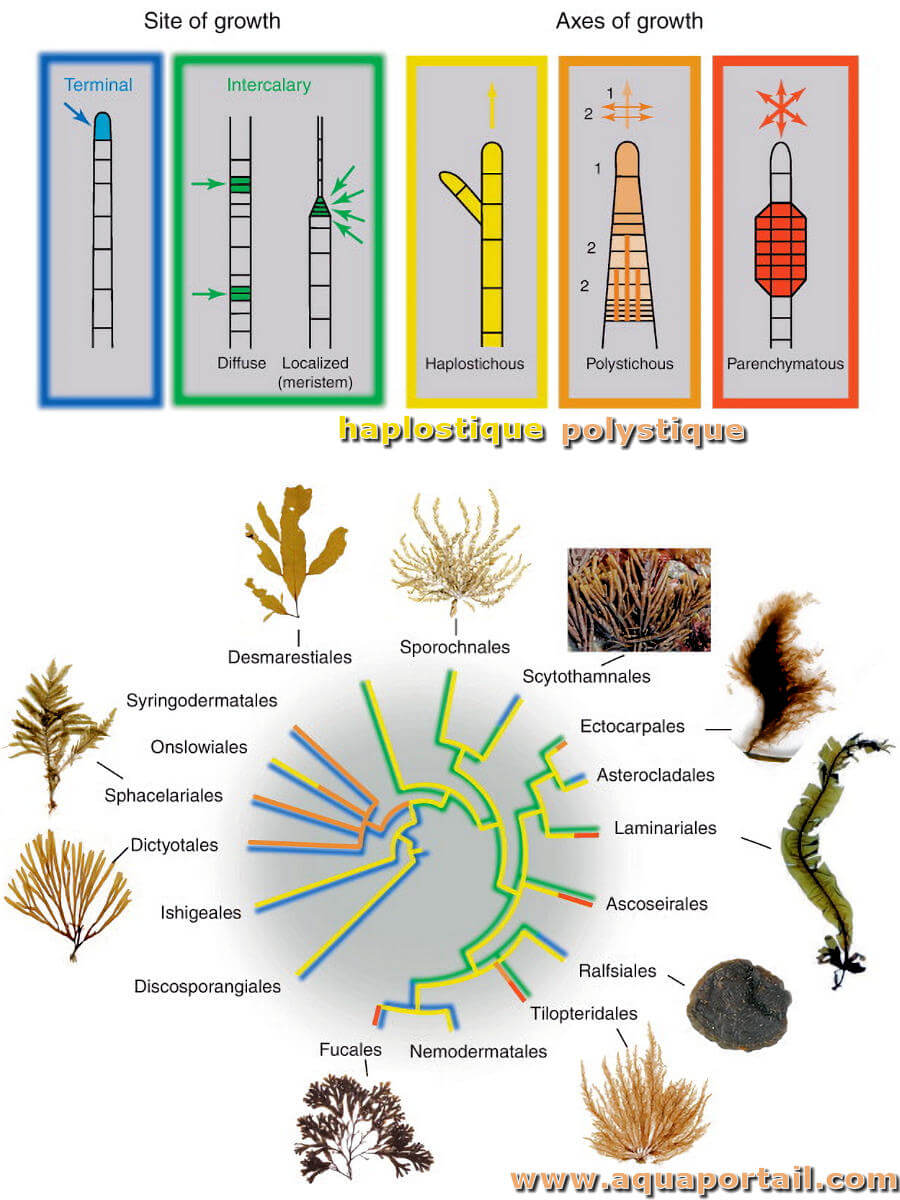
Haplostichous describes an algal thallus structure whose cells never divide longitudinally, in contrast to polystichous algae.
fabrication

Fabrication is the act or process of making, constructing, or inventing something. The manufacturing or fabrication process, whether artisanal or industrial...
famine

Famine is prolonged hunger with acute undernutrition or malnutrition of a population in a region (country).
fang

A fang is a long, pointed, and curved tooth. All animals equipped with fangs use them to bite. Whereas in mammals the upper-jaw fangs (called canines)...
