Actin
noun (n.)
Definition
Actin is a protein that, in polymer form (as a tight helix), constitutes filaments forming a major component of the cytoskeleton and also present in muscles. This motor protein is involved in muscle contraction.Actin is a cytoplasmic protein existing in two forms: globular, monomeric G-actin, and filamentous, polymeric F-actin resulting from actin polymerization of G-actin. These two forms exist in dynamic equilibrium within the cell. Actin filaments are part of the cytoskeleton and have a diameter of 5–7 nm.
The microfilaments of actin:

Actin is a family of globular proteins that form microfilaments, one of the three fundamental components of the cytoskeleton in cells of eukaryotic organisms.
Explanations
Actin can be found in free monomeric form, called G-actin, or as linear polymers called microfilaments or F-actin, essential for cellular functions as critical as cell motility and contraction during cell division.
The fact that a cell's protein content always accounts for a high percentage and that its sequence is highly conserved - meaning it has changed very little throughout evolution - is explained by the importance of actin. For both reasons, its structure can be said to have been optimized. In this regard, two special characteristics can be highlighted: it is an enzyme that hydrolyzes ATP, the "universal energy currency" of biological processes, doing so very slowly.
At the same time, however, it requires this molecule to maintain its structural integrity and acquire its functional shape in a nearly dedicated folding process. It is also the protein that establishes the greatest number of interactions with other proteins, enabling it to carry out the most varied functions spanning nearly every aspect of cellular life.
An actin filament with troponin and tropomyosin:
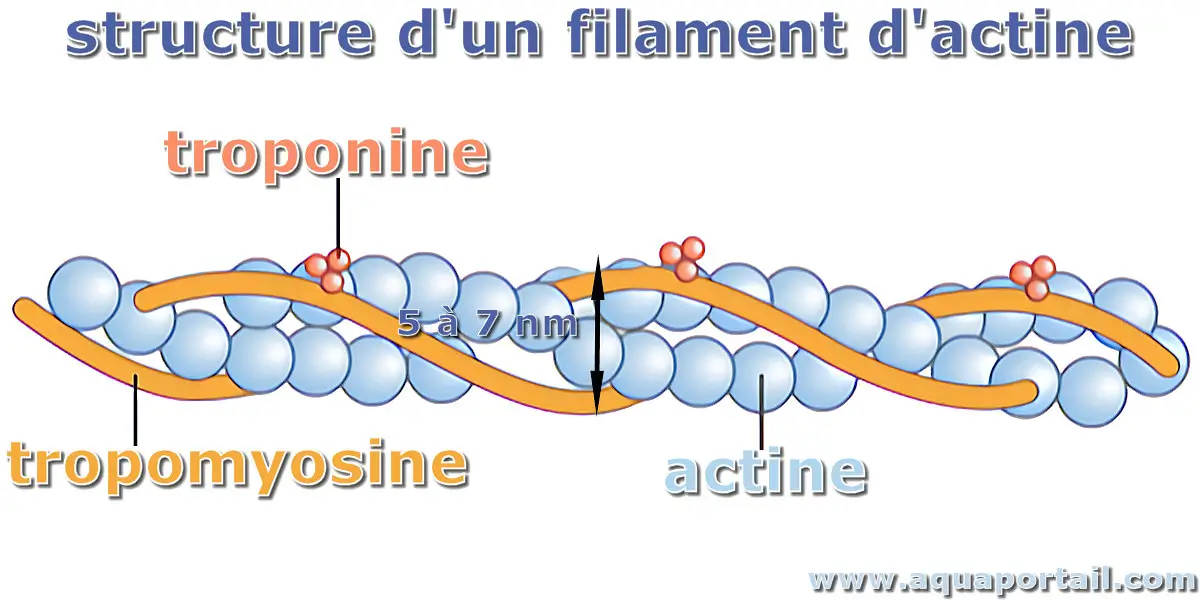
Structure of an actin filament (typical of the cytoskeleton of eukaryotic cells) with troponin and tropomyosin.
Myosin (and tropomyosin) is an example of an actin-binding protein. Another example is villin, which can cross-link actin into bundles or sever actin filaments, depending on the calcium cation concentration in its environment.
A substantial number of diseases stem from genetic alterations in the alleles of genes governing the production of actin or its associated proteins, which are also essential in the infection process of certain pathogenic microorganisms. Mutations in the different actin genes present in humans cause myopathies, variations in cardiac size and function, and deafness.
Cytoskeletal components are also linked to the pathogenicity of intracellular bacteria and viruses, particularly in processes associated with evading the immune system response.
Roles
The formation of microfilaments in a dynamic process provides a scaffold that gives the cell shape along with the ability to rapidly remodel in response to its environment or signals from the organism, for instance increasing cell surface area for absorption or supporting cell adhesion to form tissues.
Onto this scaffold other enzymes can be anchored, and organelles such as the cellular cilium direct deformation of the outer cell membrane enabling cellular ingestion or cytokinesis. It can also generate movement, either alone or assisted by molecular motors.
In this way, it contributes to processes such as intracellular transport of vesicles and organelles and muscle contraction, or cell migration, important in embryonic development, wound repair, or invasive cancer. The evolutionary origin of this protein can be traced back to prokaryotic cells, where equivalents exist. Finally, it is important in regulating gene expression.
F-actin has numerous roles:
- movement and locomotion: in the presence of Ca2+, thick myosin filaments bind to thin actin filaments, allowing each filament to slide past the other and consequently producing muscle contraction. It also forms filopodia and pseudopodia
- cell shape: actin is anchored to plasma membrane proteins via anchoring proteins such as spectrin, ankyrin, filamin, and dystrophin
- structure: actin forms the cytoskeleton of microvilli and stereocilia
- interaction: actin is linked to the extracellular matrix or other cells via integrins.
ABP is the acronym for Actin-binding protein (in botany, ABP also stands for Auxin-binding protein, a protein receptor for auxin present mainly in the tonoplast, plasmalemma, and endoplasmic reticulum lumen of several cell types such as coleoptile and root cells... Binding of auxin to its receptor induces activation of adenylate cyclase via G protein).
F-Actin and G-Actin
Actin is a protein that functions in the contractile system of skeletal muscle, where it is found in thin filaments. In muscle, fibrous actin (F-actin) is a helical polymer of a globular polypeptide chain, G-actin. Actin is present in all eukaryotes and has a highly conserved protein sequence.
Actins in non-muscle cells are encoded by genes distinct from those in muscle and have been shown to be involved in platelet shape, endocytosis, cell motility, cell division, metastasis, and cell signaling.
Actin is generally isolated as G-actin, which can be reversibly converted into a viscous polymerized fibrous form, F-actin, by adding neutral salts at a neutral or slightly alkaline pH. The reaction, which involves a bound nucleotide, is: G-actin-ATP → F-actin-ADP + Pi.
Characteristics
Actin consists of 376 amino acids. The high proportion of proline and glycine residues (4.9% and 7.5%, respectively) contributes to the globular shape of G-actin. Six actin genes are expressed in mammals and birds, and these sequences all share high homology.
The structure contains four domains. Two of these domains are similar alpha/beta domains, containing the ATPase catalytic site. The F-actin helix consists of 13 G-actin molecules in six turns of the helix, repeating every 360 angstroms (36 nm). Each actin molecule contains five sulfhydryl groups. Actin is associated with tropomyosin and the troponin complex in muscle. Actin also contains a myosin-binding site, where it forms temporary complexes with myosin during muscle contraction, and permanently during rigor mortis.
History
Although there has been debate regarding the official discoverer of actin, it is believed that in 1887 Halliburton was the first to prepare an extract containing crude actin, and it was not until 1942 that Straub first isolated pure actin. Straub's original method for isolating actin is relatively similar to procedures used today. At that time, however, little was known about muscle structure at the submicroscopic level.
The 1950s brought a better understanding of the filamentous structure of actin. The sliding filament model was developed and has remained essentially unchanged since then. This theory explains that thick and thin filaments inside the sarcomere slide past one another, shortening the entire length of the sarcomere. In order to slide past one another, myosin heads interact with actin filaments and, using ATP, swivel to pull actin past (Huxley, 2004).
During the 1960s and 1970s, two-dimensional X-ray diffraction patterns of actin structure were obtained and studied (Huxley, 2004). In the 1980s, the first interpretable electron density maps of the actin molecule were acquired, and ATP hydrolysis and phosphate release were characterized.
The involvement of actin and its associated proteins in metastasis was studied in the 1990s, and the crystal structure was solved. Recent research has focused on the functions of actin in endocytosis, and actin has been proposed as a component of chromatin-remodeling complexes in RNA biogenesis.
Synonyms, antonyms
Spanish translation: actina
0 synonyms (similar meaning) for "actin".
0 antonyms (opposite meaning).
Related words and expressions to ACTIN are directly connected by general or specific meaning.
The word ACTIN is listed on page 1 of words starting with A in the dictionary glossary.
Related to "actin"
abiotic

In biology and ecology, abiotic refers to what is not biotic, that is, not part of living beings.
aboral

Aboral refers to what is situated away from or opposite the mouth in zoology, and especially in marine biology.
absence

Absence refers to non-presence at an expected location, or the complete non-existence of something.
acetyltransferase
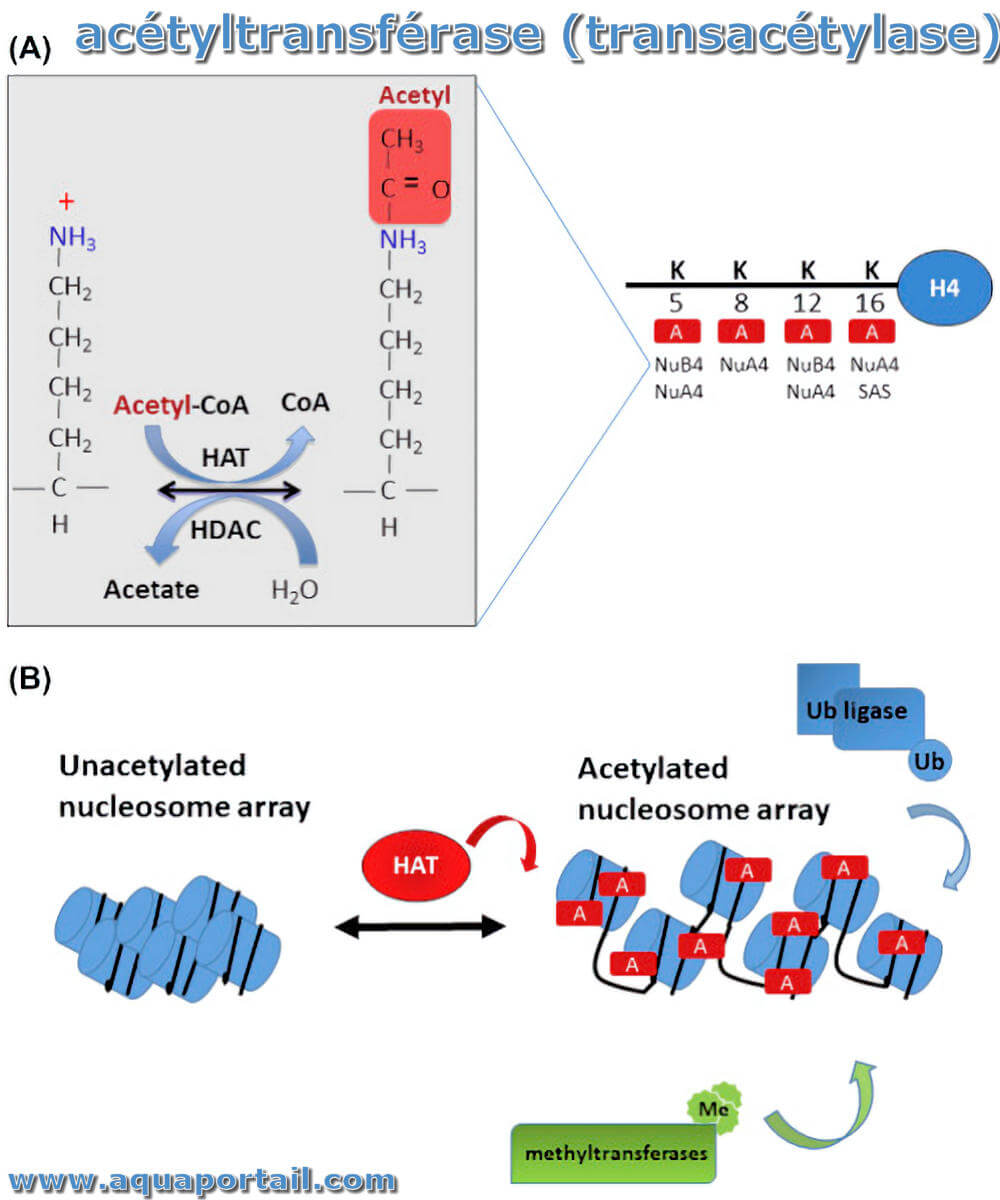
An acetyltransferase is an enzyme that transfers an acetyl group from acetyl-CoA to lysine amino acids.
