Acyl
noun (n.)
Definition
An acyl is a radical with the general formula –C(O)R, where R is an organyl radical (alkyl, aryl, etc.) derived from a carboxylic acid. In organic chemistry, an acyl denotes a moiety formed by a carbonyl group and an aliphatic tail. The best-known acyl group is the acetyl group with a methyl group as its aliphatic tail.
Various types of acyls :
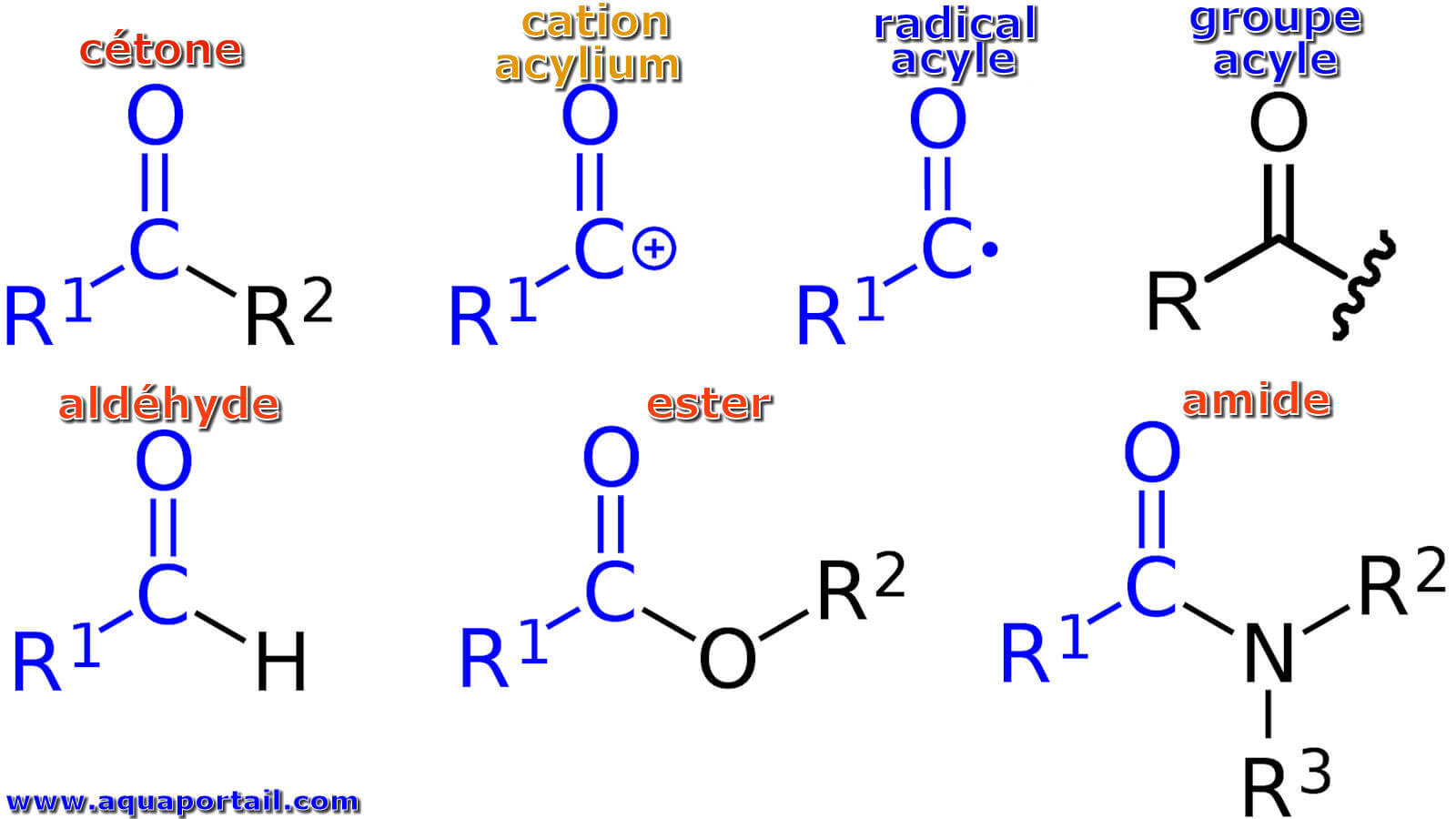
Various acyl compounds: ketone, acylium cation, acyl radical, acyl group, aldehyde, ester, and amide. The R1, R2, and R3 groups are organyl substituents or hydrogen.
Explanations
An acyl group is a group of atoms consisting of a carbonyl group bonded to a carbon group. An acetyl group is an acyl group derived from acetic acid.
Acyl groups transferred to the acceptor molecule can be divided into aromatic acids such as p-coumaric, caffeic, ferulic, sinapic, gallic, or p-hydroxybenzoic acids, or aliphatic acids such as malonic acid, acetic acid, malic acid, succinic acid, or oxalic acid.
An acyl group attached to a benzene ring can be converted into an alkyl group by reduction with zinc-mercury amalgam in HCl. Since an acyl group has a carbonyl carbon atom directly attached to the ring, it is a deactivating, meta-directing substituent. However, an alkyl group is an activating, ortho-directing, para-directing group.
Carbanion, the acyl anion equivalent
Carbanion reaction, acyl anion equivalent:
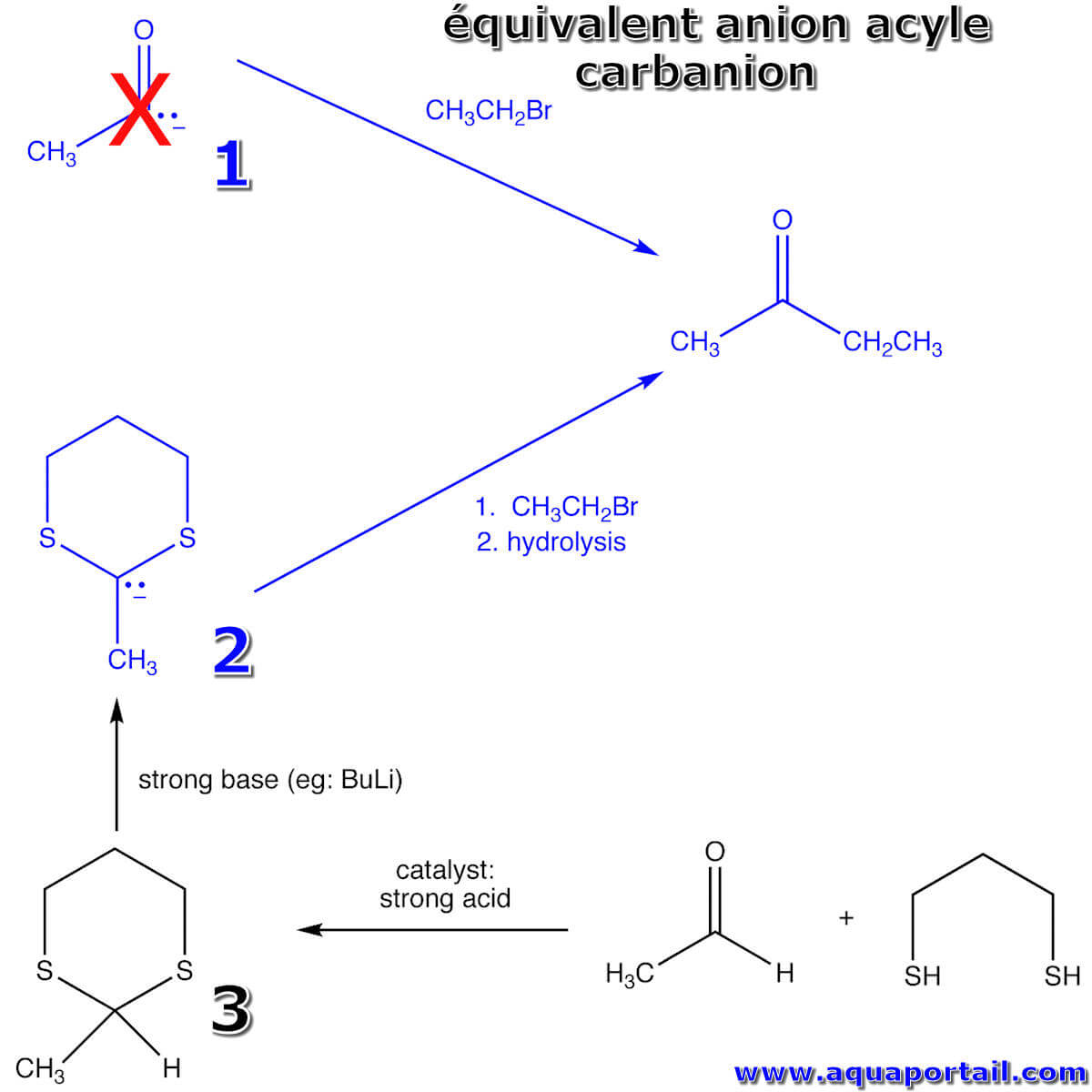
An acyl anion equivalent is a carbanion that functions in a reaction or reaction sequence as an acyl anion would, which is not directly available for synthetic purposes. Carbanion 2, derived from 1,3-dithiane 3, is an equivalent of acyl anion 1, which cannot be generated in a synthetically useful manner.
Acyl halide
An acyl halide (also called an acid halide) is a chemical compound derived from a carboxylic acid by replacing a hydroxyl group with a halogen. The general formula for such an acyl halide can be written RCOX, where R may be, for example, an alkyl group, CO is the carbonyl group, and X represents the halide, such as chloride.
Acyl halide:
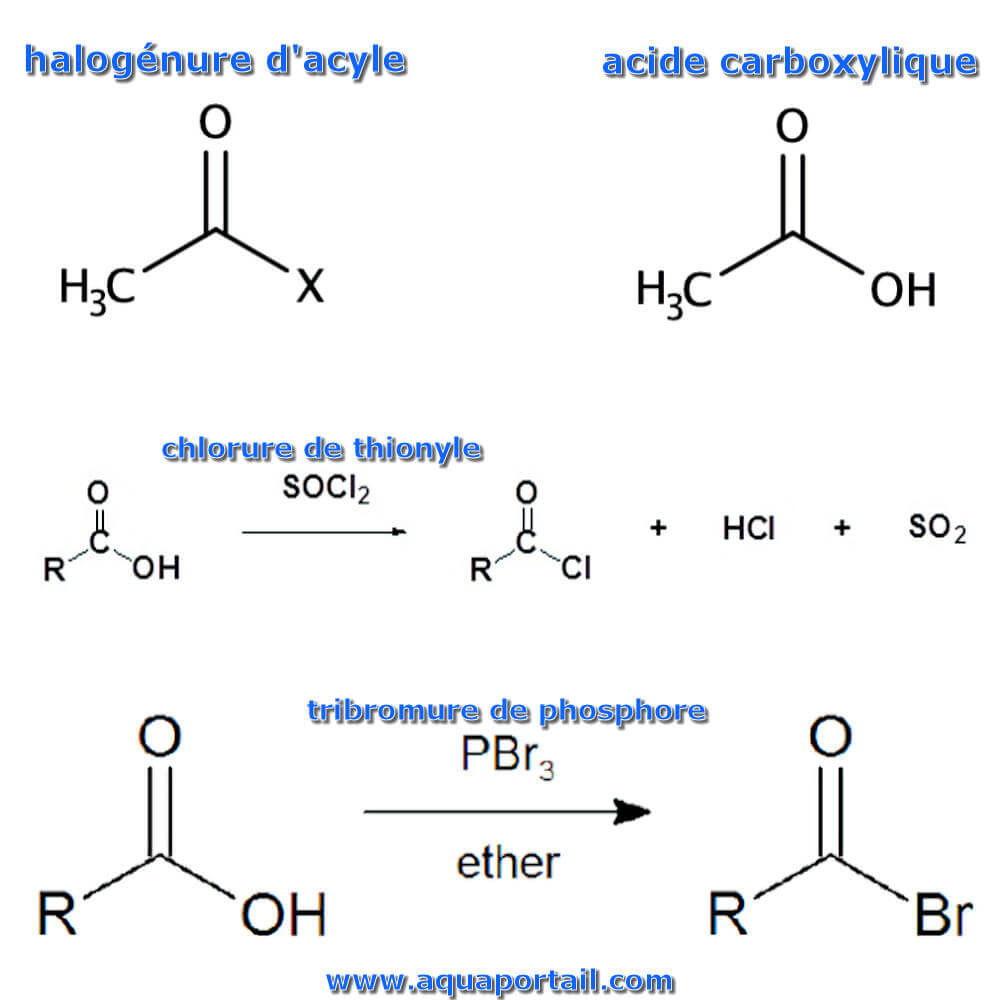
If the X group in an acyl halide is OH, it is called a carboxylic acid.
Carboxylic acids react with thionyl chloride (SOCl2) or oxalyl chloride (C2O2Cl2) to form acid chlorides. Typically, reactions take place in the presence of a proton scavenger such as pyridine to minimize unwanted side reactions. During the reaction, the hydroxyl group of the carboxylic acid is converted into a chlorosulfite intermediate, making it a better leaving group. The chloride anion produced during the reaction acts as a nucleophile.
Analogous to the reactions of primary and secondary alcohols with PBr3 to produce the corresponding alkyl bromide, acid bromides can be formed from the reaction of phosphorus tribromide with carboxylic acids.
Acid halides are quite reactive and therefore very unstable. They react with water (even moisture) in a hydrolysis reaction. For example: the hydrolysis of butanoyl chloride. Because of this reaction, it is very important to work with glassware that has been dried, as well as moisture-free solvents. Volatile acyl halides are lachrymatory because they can react with water on the surface of the eye to produce hydrohalic and organic acids that irritate the eye. Similar problems can arise if acyl halide vapors are inhaled.
Acyl chloride
Acid chlorides react with alcohols to form esters. The advantage of using acyl chlorides instead of carboxylic acids is that the reaction becomes irreversible. For example, the synthesis of ethyl benzoate from benzoyl chloride and ethanol.
An acyl chloride (also called an acid chloride) is an organic compound consisting of a chlorine atom bonded to an acyl group. Typically, their formula is written R–C(O)Cl, where R is a side chain. There are a number of related compounds that replace the -OH group in the acid with something else. Such compounds are described as acid derivatives. A specific example of an acyl chloride is acetyl chloride, CH3COCl. The most important subset of acyl halides consists of acyl chlorides.
An acyl chloride such as ethanoyl chloride is a colorless fuming liquid. The strong odor of ethanoyl chloride is a mixture of the smell of vinegar (ethanoic acid) and the pungent odor of hydrogen chloride gas. Functional groups are parts of a molecule recognized as a distinct group of bonded atoms. When the acyl chloride moiety takes priority, acyl chlorides are named by taking the name of the parent carboxylic acid and substituting -yl chloride for -ic acid. Thus: acetyl chloride = CH3COCl and benzoyl chloride = C6H5COCl.
When other functional groups take priority, acyl chlorides are designated by the prefix chlorocarbonyl: (chlorocarbonyl)acetic acid ClOCCH2COOH.
The inability of an acid chloride to form hydrogen bonds with other compounds is a characteristic property. The odor and fumes are due to the interaction of ethanoyl chloride in the air with water vapor. Acetic acid, for example, boils at 118 °C (244.4 °F), whereas acetyl chloride boils at 51 °C (123.8 °F). Infrared spectroscopy, as for most carbonyl compounds, shows a band near 1,750 cm-1.
A hydrogen bond is a chemical bond created by attracting a hydrogen atom in one molecule to an electronegative atom on another molecule. Electronegative simply refers to an atom that tends to attract electrons to form a chemical bond. Ethanoyl chloride or acetyl chloride is the simplest stable acyl chloride; methanoyl chloride (formyl chloride) is unstable at room temperature, though it can be prepared at or below -60 °C (-76 °F). Acyl chloride is not soluble in water, as it decomposes through hydrolysis.
Acyl chlorides cannot be said to dissolve in water, because they react with it (often violently). This vigorous reaction means a simple aqueous solution of an acyl chloride cannot be obtained. Acyl chlorides are generally prepared in the laboratory in the same manner as alkyl chlorides, by replacing the corresponding hydroxy substituents with chlorides. Acyl chlorides are very reactive, and the chlorine atom is replaced by other elements in their reactions. To yield primary alcohols, acyl chlorides are reduced with lithium aluminum hydride and diisobutylaluminum hydride.
Acyl phosphates
Acyl phosphates, because they are so reactive toward acyl substitutions, are generally regarded as reaction intermediates rather than stable metabolites in biochemical pathways. Acyl phosphates generally take one of two forms: a simple acyl monophosphate or an acyl-adenosine monophosphate.
Acyl phosphate (monophosphate) and reactions:
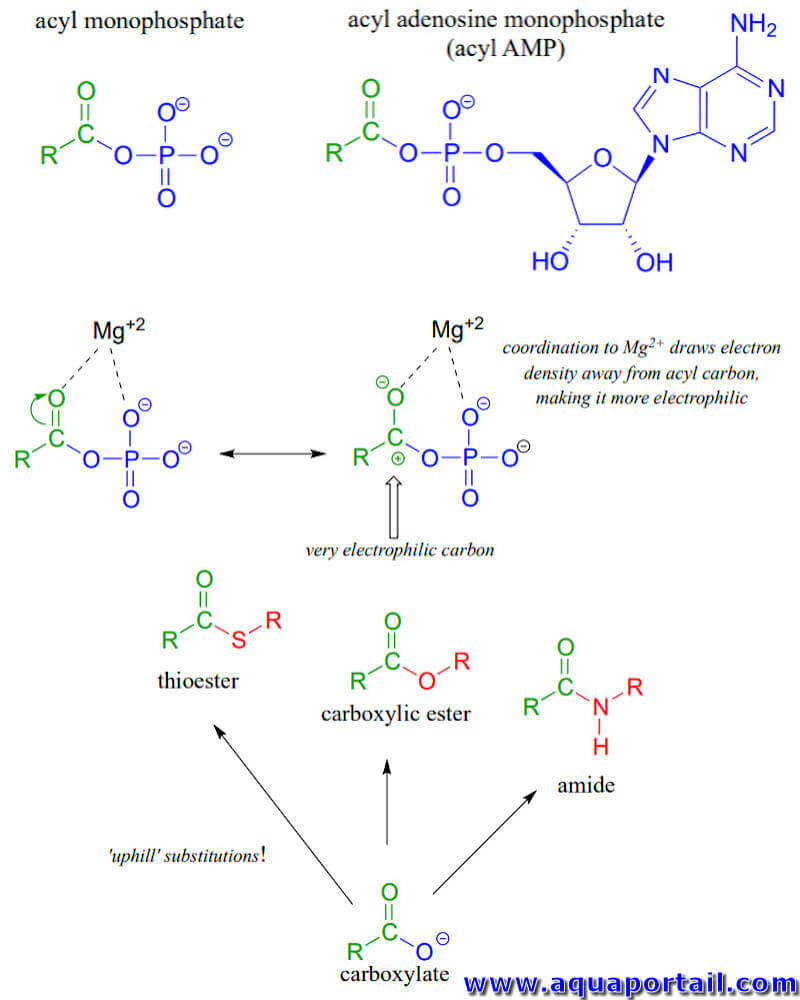
Both acyl monophosphate and acyl-AMP forms are highly reactive in acyl substitution reactions and are often referred to as activated acyl groups or activated carboxylic acids.
The tendency of phosphates to form stabilizing complexes with one or more magnesium ions in an enzyme's active site contributes greatly to the reactivity of acyl phosphates.
A magnesium ion acts as a Lewis acid, accepting electron density from the oxygen end of the acyl carbonyl bond, which substantially increases the degree of partial positive charge—and hence electrophilicity—of the carbonyl carbon. The magnesium ion also balances the negative charge on the phosphate, making it a weak base and an excellent leaving group.
The carboxylate functional group is the least reactive substrate for enzyme-catalyzed acyl substitution reactions. In biology, however, carboxylates are frequently converted into thioesters, carboxylic esters, and amides, all of which are higher in energy, meaning these transformations are thermodynamically "uphill".
Diacyl, alkylacyl, and alkenylacyl
A diacyl compound has two acyl groups.
The phospholipid composition and the acyl, alkyl, and aryl group compositions of diacyl, alkylacyl, and alkenylacyl phosphoglycerides of Meloidogyne javanica were studied. The phospholipid consisted of 61.7% choline phosphoglyceride, 22.0% ethanolamine phosphoglyceride, and smaller amounts of six other lipids. The phospholipid fatty acid was more unsaturated than the neutral lipid fatty acid and contained 61.3% octadecenoic acid (18:1). The fatty acid at position 1 of diacyl-phospholipids was shorter and more saturated than that at position 2. Compared with choline phosphoglyceride, ethanolamine phosphoglyceride contained less 18:1 and 20:5 and more 18:0 and 20:0 acid.
Alkenylacyl and alkylacyl compounds comprised 34.6% and 9.3%, respectively, of ethanolamine phosphoglyceride but only 0.5% and 0.6% of choline phosphoglyceride. Alkenylacyl and alkylacyl ethanolamine phosphoglycerides contained a lower percentage of 20-carbon polyunsaturated acid at position 2 than their diacyl analog. At least 95% of the aryl and alkyl groups were 18:0 compounds. Tomato roots did not contain alkenylacyl- or alkylacyl-phosphoglycerides; their presence in Meloidogyne javanica is a significant biochemical difference between the nematode and its host.
Synonyms, antonyms
French translation:
acyleSpanish translation: acilo
0 synonyms (similar meaning) for "acyl".
0 antonyms (opposite meaning).
Related words and expressions to ACYL are directly connected by general or specific meaning.
The word ACYL is listed on page 1 of words starting with A in the dictionary glossary.
Related to "acyl"
abiotic

In biology and ecology, abiotic refers to what is not biotic, that is, not part of living beings.
aboral

Aboral refers to what is situated away from or opposite the mouth in zoology, and especially in marine biology.
absence

Absence refers to non-presence at an expected location, or the complete non-existence of something.
acetyltransferase
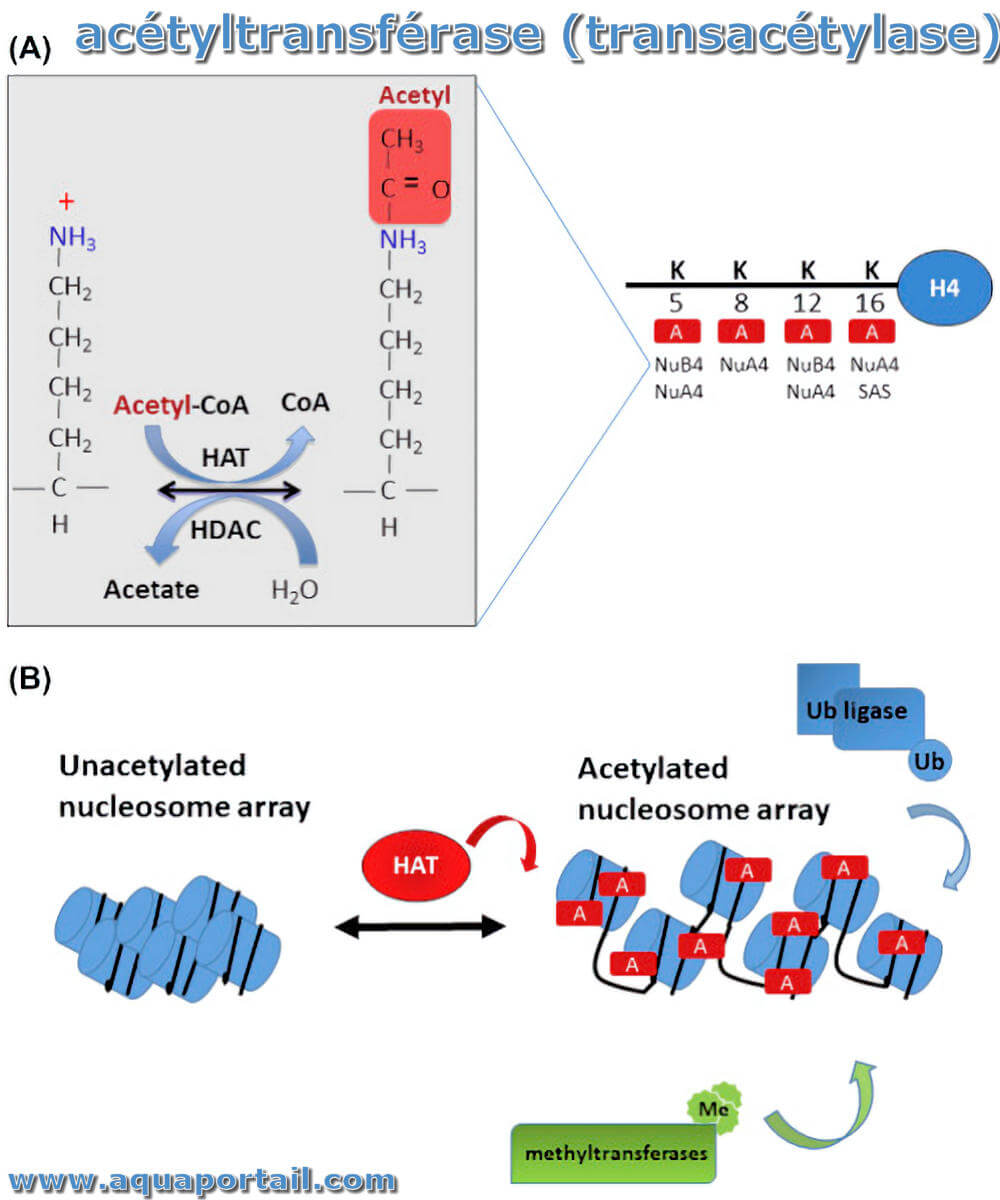
An acetyltransferase is an enzyme that transfers an acetyl group from acetyl-CoA to lysine amino acids.
