Feulgen stain
proper noun
Definition
A Feulgen stain is a staining technique for nucleic acids, following mild acid hydrolysis, based on the Schiff reaction, namely the violet coloration produced by aldehydes in the presence of fuchsin decolorized by sulfurous anhydride.
This reaction is more or less intense depending on the degree of chromatin coiling and is therefore particularly suitable for highlighting chromosomes in the nucleus during mitosis.
A Feulgen stain:
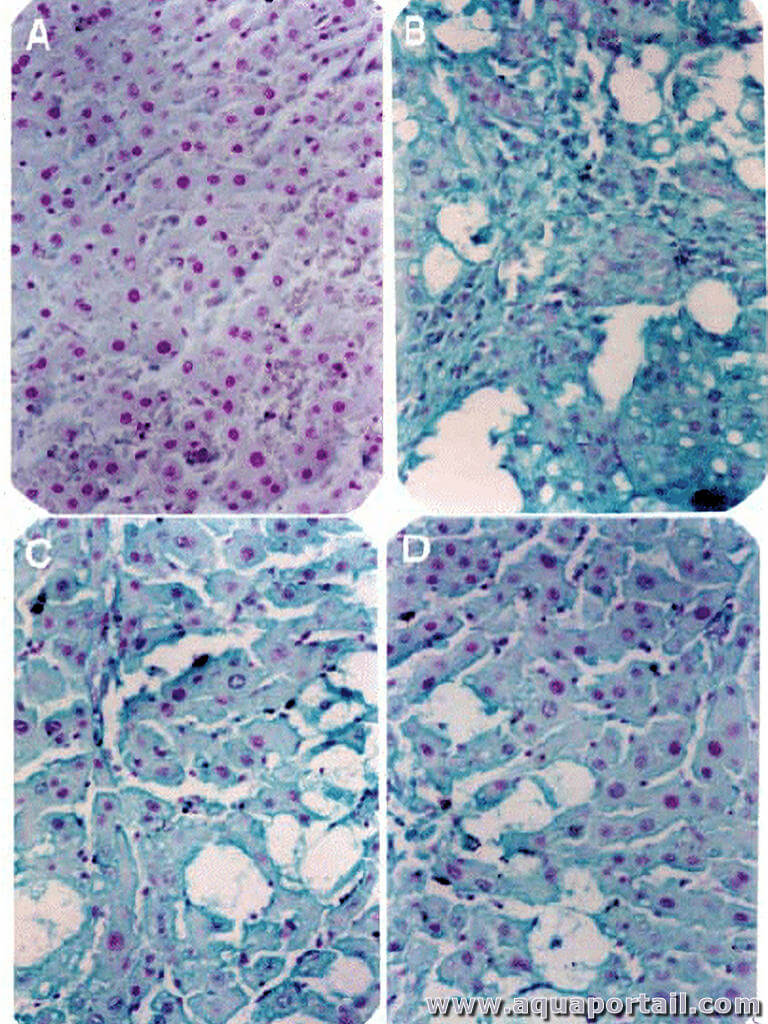
Liver section stained with a Feulgen stain showing DNA in hepatocytes (A) of a control (normal) rat.
Explanations
The Feulgen technique selectively stains DNA and, under controlled conditions, can be used for the photometric determination of DNA content. The reaction comprises two steps. The aldehyde groups then react with Schiff's reagent, resulting in a violet coloration.
The Feulgen reaction is based on the acid-catalyzed removal of purine bases from deoxyribose, resulting in the formation of an aldehyde that can be detected with Schiff's reagent.
The Feulgen reaction is based on the Schiff reaction for aldehydes in which, through acid hydrolysis, aldehydes released from deoxy sugar are allowed to react with fuchsin-sulfurous acid to yield a characteristic magenta color reaction.
The Feulgen reaction, proposed by Feulgen and Rossenbeck in the 1920s, is generally regarded as one of the oldest and most specific reactions in histochemistry. Today, one of the most important applications of the Feulgen reaction is the quantification of DNA amounts. Another field is the study of the structural organization of DNA in situ.
When DNA is exposed to a mildly acidic environment, purine bases detach from the deoxyribose sugar, exposing free aldehyde groups while leaving the DNA backbone intact. The DNA molecule becomes "apurinic". In this form, the free aldehyde groups can bind to a dye such as Schiff's reagent and acquire a magenta color. Staining intensity (color development) is proportional to DNA concentration. DNA ploidy can be measured with the Feulgen reaction in nuclear or cellular suspensions smeared on a slide, in cell culture plates, in biological fluids, and in histological sections. Isolated intact single cells are by far the most commonly used targets for determining DNA ploidy with the Feulgen reaction.
Quantification of the colored Feulgen reaction was originally carried out using cytophotometry. Later, it was discovered that DNA ploidy could also be measured using a microscopic cytofluorometer. This method measures the fluorescence emitted by a nucleus stained with Schiff or Schiff-type reagents. Today, DNA amounts are generally measured using an electronic image cytometer.
For the Feulgen reaction to be specific, tissue fixation must be appropriate. Plant tannins can interfere with the Feulgen reaction to some extent, rendering it useless as a quantitative method. Formaldehyde is the preferred fixative, as it binds to cellular tannins and prevents them from reacting with nuclear chromatin.
Synonyms, antonyms
Spanish translation: tinción de Feulgen
0 synonyms (similar meaning) for "feulgen stain".
0 antonyms (opposite meaning).
Related words and expressions to FEULGEN STAIN are directly connected by general or specific meaning.
The expression FEULGEN STAIN is listed on page 1 of words starting with F in the dictionary glossary.
Related to "Feulgen stain"
Gram stain

Gram staining refers to a crystal violet staining technique retained by the outer cell wall of certain bacteria, called Gram-positive, and not retained...
fabrication

Fabrication is the act or process of making, constructing, or inventing something. The manufacturing or fabrication process, whether artisanal or industrial...
famine

Famine is prolonged hunger with acute undernutrition or malnutrition of a population in a region (country).
fang

A fang is a long, pointed, and curved tooth. All animals equipped with fangs use them to bite. Whereas in mammals the upper-jaw fangs (called canines)...
