Microsporogenesis
noun (n.)
Definition
Microsporogenesis is the meiotic formation of haploid microspores from a diploid microspore mother cell. The arrangement of microspores in a tetrad is generally tetrahedral. All four microspores of the tetrad are functional. Microsporogenesis is a type of male meiosis and pollen morphogenesis. If the spores are macrospores, it is termed macrosporogenesis. In contrast, megasporogenesis is female meiosis.Process of microsporogenesis:

While the arrangement of microspores resulting from microsporogenesis is organized in a tetrahedral tetrad, with all eventually functional, the arrangement of megaspores in the tetrad is generally linear, and only one megaspore in the spore tetrad remains functional, while the other three degenerate.
Explanations
angiosperms are heterosporous. The microsporophyll (stamen) bears microsporangia that produce microspores. These are haploid cells produced following meiosis. Microspores germinate to produce the microgametophyte, which bears microgametangia in which male gametes are produced.
Similarly, on the female side, the sequence is megasporophyll (carpel), whose megasporangia produce haploid megaspores. This is megasporogenesis. During fertilization, male and female gametes fuse to form the diploid zygote, which develops into an embryo. The embryo develops into an adult sporophyte.
Formation process
The main stages of microsporogenesis are:
- diploid mother cell surrounded by a callose wall
- the cell undergoes nuclear divisions
- the cytoplasms are progressively separated by walls formed of callose
- cytoplasmic division is completed, yielding four haploid microspores separated by callose. This assembly is called a tetrad
- the callose dissolves, and the microspores mature into four pollen grains.
Variation in the main determinants of microsporogenesis is governed by:
- type of cytokinesis (two states: successive or simultaneous)
- direction of callose deposition (four states: CpT, centripetal to the tetrad; CpP, centripetal to the cleavage plane; CfT, centrifugal to the tetrad; CfP, centrifugal to the cleavage plane). Asterisks show that callose is deposited to separate daughter cells. Arrows indicate the direction of callose progression
- tetrad shape (mainly four states: tetrahedral, rhomboidal, tetragonal, and linear). Linear tetrads are not shown here for clarity.
Main determinants of microsporogenesis:

These three traits of microsporogenesis determine the patterns of callose deposition along the wall separating the microspores.
Callose is essential for producing pollen wall elements at the cell membrane, and variation in its deposition pattern can generate variation in pollen wall morphology.
Research on pollen morphogenesis
The contribution of developmental constraints and selective forces in determining evolutionary patterns is an important, unresolved question. Tests were conducted to determine whether the long-term evolutionary stasis observed in pollen morphogenesis (microsporogenesis) in dicotyledons is due to developmental constraints or selection on a morphological trait shaped by microsporogenesis: the equatorial aperture pattern.
Most dicotyledons have three equatorial apertures, but several taxa have independently lost the equatorial pattern and exhibit microsporogenesis decoupled from aperture pattern determination. If selection on the equatorial pattern constrains variation, increased variation in microsporogenesis is expected in non-equatorial clades.
Variation in microsporogenesis was investigated using phylogenetic comparative analyses across 83 species dispersed throughout the dicotyledons, including species with and without equatorial apertures.
Species that lost the equatorial pattern exhibit highly variable microsporogenesis at both intra-individual and interspecific levels regardless of pollen morphology, whereas microsporogenesis remains stable in species with the equatorial pattern.
The burst of variation observed upon loss of equatorial apertures demonstrates that there are no strong developmental constraints preventing variation in microsporogenesis, and that stasis is likely due primarily to selective pressure acting on pollen morphogenesis because of its role in determining the aperture pattern.
Interactions between microsporogenesis, microgametogenesis, and pollen grain
Successful interaction of pollen with the environment is essential in agricultural systems because most crop species are cultivated to produce seeds and/or fruits and thus require fertilization to occur.
Considering that in higher plants, each pollen grain is a haploid gametophyte of only two (at most three) cells generated by the diploid sporophyte during meiosis (microsporogenesis), the ephemeral life of pollen is limited to producing two gametes (microgametogenesis), potentially after being transferred to a different plant from the one that produced it (cross-pollination).
Despite its small size and brief lifespan, pollen grains of any species are autonomous organisms, genetically distinct from others and subject to interaction with the environment. Pollen grains are exposed to natural selection and can influence the genetic makeup of the resulting sporophytic generation.
The ability to screen individuals best adapted to specific environmental conditions is the concept on which gametophytic selection is based and proposed as an alternative to the much more widely used sporophytic selection for cultivated species. Although studies on the effects of external factors on pollen biology focus mainly on mature and/or germinated grains, environmental conditions affect pollen at all developmental stages, including microsporogenesis.
Problems with high temperatures
High temperatures during microsporogenesis fatally shorten pollen lifespan. Elevated temperature, outside the optimum temperature range, can impair pollen functionality even if heat treatment is applied only during microsporogenesis. Experimental data on Solanum lycopersicum 'Micro-Tom' confirmed this hypothesis.
Many plant species are cultivated to produce seeds and/or fruits and thus require reproductive success to persist. Previous studies have shown that high temperature on mature pollen at anther dehiscence reduces viability and germination, thereby lowering crop productivity.
Microsporogenesis proceeds successfully at high (30 °C / 86 °F) and optimum (22 °C / 71.6 °F) temperatures. After anthesis, the viability and germinability of pollen developed at an optimum temperature gradually declined, and the reduction was slightly greater when pollen was incubated at 30 °C (86 °F). Conversely, the temperature effect was strongly amplified in pollen developed at high temperature. In this case, a drastic reduction in viability and a drop to zero in germinability occurred not only when pollen was incubated at 30 °C (86 °F) but also at 22 °C (71.6 °F).
Further ontogenetic analyses revealed that high temperature markedly accelerated microsporogenesis and early microgametogenesis (from the vacuolated stage to bicellular pollen); consequently, gametophytes are already senescent at floral anthesis. The effects of heat stress on pollen reveal that high-temperature conditions during microsporogenesis lead to a fatal shortening of male gametophyte lifespan.
Synonyms, antonyms
Spanish translation: microsporogénesis
2 synonyms (similar meaning) for "microsporogenesis":
1 antonym (opposite meaning):
Related words and expressions to MICROSPOROGENESIS are directly connected by general or specific meaning.
The word MICROSPOROGENESIS is listed on page 1 of words starting with M in the dictionary glossary.
Related to "microsporogenesis"
gametogenesis

Gametogenesis is the process by which cells undergo meiosis to form haploid gametes. It takes place in the gonads (female ovaries or male testes).
megasporogenesis
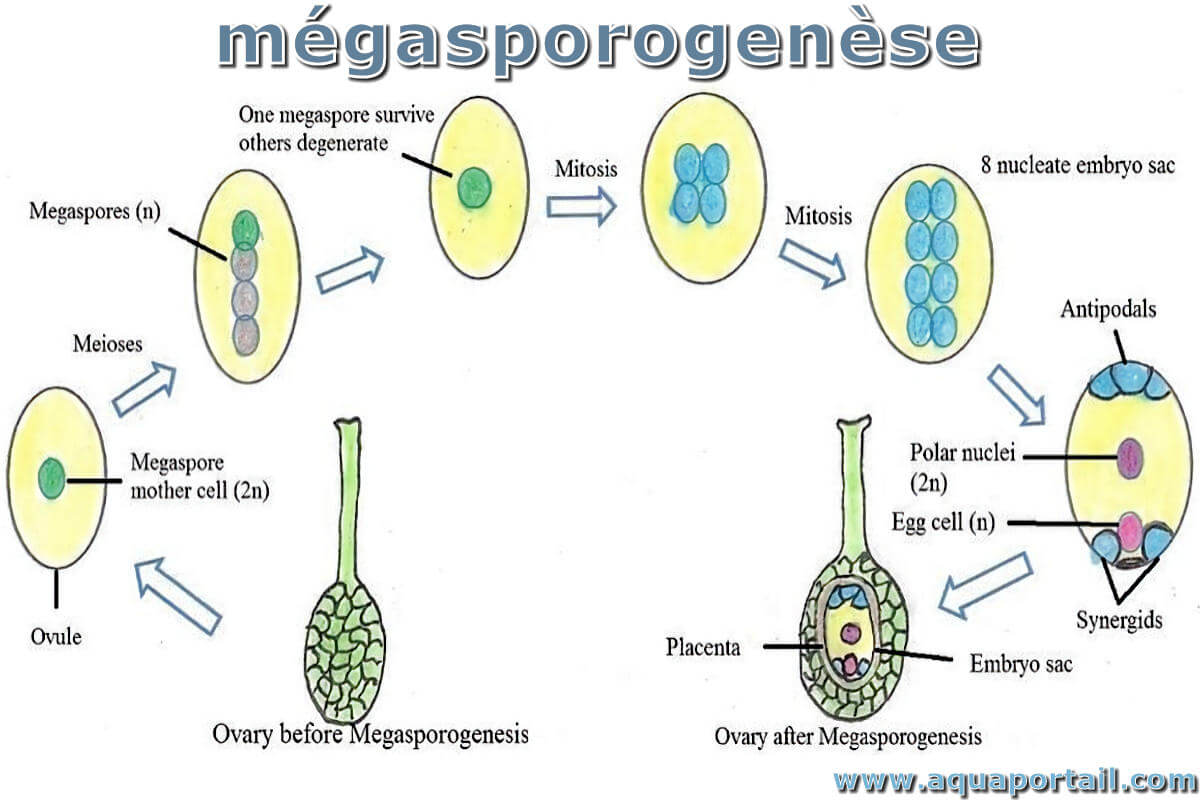
Megasporogenesis is the process of development of a megaspore from a megasporocyte mother cell.
microbe

A microbe is a unicellular microorganism that can act as a vector for transmitting disease or induce fermentation.
madrepore

A madrepore (Madrepora) is a marine animal of the group of scleractinian corals possessing an external skeleton, typically an acropora and encompassing...
