Gamete
noun (n.)
Definition
A gamete is a male or female reproductive cell. This sexual cell is produced in the sex glands, or gonads. The male gamete is the spermatozoon, produced in the testis; the female gamete is the ovum (in animals) or oosphere (in plants), produced in the ovary.
A spermatozoon is a male gamete:

A gamete is a haploid cell enabling sexual reproduction; classically, gametes are the ovum (female gamete, large, non-motile, and rich in reserves) and the spermatozoon (male gamete, small, motile, and produced in large numbers).
Explanations
A gamete is a reproductive cell of an animal or plant. In animals, female gametes are called ova (eggs), and male gametes are called spermatozoa (sperm). Ova and spermatozoa are haploid cells, with each cell carrying only a single copy of each chromosome. During fertilization, a spermatozoon and an ovum unite to form a new diploid organism.
The organs in which gametes are produced are called gonads. The process of gamete production is called gametogenesis.
In animals, such as humans:
- the male gamete is a spermatozoon, a sex cell produced by the testes via spermatogenesis
- the male counterpart contrasts with the female gamete, an ovum produced by the ovaries via oogenesis
For the fertilized egg to possess the correct diploid chromosome number ("2n"), spermatozoa and ova must be produced so that each carries only one chromosome from every pair. In other words, human gametes contain only 23 chromosomes (haploid number "1n").
Non-functional (sterile) gametes render an organism infertile. Gamete fertility (or sterility) is one of the leading causes of infertility in human couples. Inbreeding increases the rate of infertility (or sterility).
Characteristics
The full scientific definition is: a gamete is a haploid cell that fuses with another haploid cell during fertilization (conception) in organisms that reproduce sexually.
A sex cell with a haploid nucleus (n chromosomes) is destined to fuse with a gamete of the opposite sex to form a fertilized egg, or zygote. In algae, male and female gametes may be similar or markedly dissimilar depending on the species.
Haploid male (spermatozoon) and female (ovum) gametes:

A gamete is a mature haploid germ cell, male (spermatozoon) or female (ovum), capable of uniting with another cell of the opposite sex during sexual reproduction to form a diploid zygote (fertilized egg).
Gametes receive different names depending on the sex of the carrier and the kingdom (animal, plant) to which they belong. In animals, gametes arise from a specialized cell lineage called the germline, differentiated during early development, and are called ovum in the female and spermatozoon in the male; once fused, they produce a cell called a zygote or fertilized egg containing two sets of chromosomes, making it diploid. In plants, the female gamete is called an oosphere, and pollen is the male gametophyte within which male gametes form to fertilize the oosphere.
Gametes are cells composed of a single set of chromosomes (possessing one copy of the genetic information that will determine the individual's physical traits) which, upon fertilization, fuse with another gamete of the opposite sex to form the zygote. Gamete formation is called gametogenesis. The organs producing gametes are termed gonads in animals and gametangia in plant organisms.
The cell resulting from gamete fusion combines the chromosomes of both, so gametes are generally haploid cells. In diploid organisms, such as animals, gamete formation involves meiosis with its corresponding chromosome reduction. In haplodiplontic organisms, such as plants, gametes are produced by the haploid phase (gametophyte), whereas the diploid phase (sporophyte), generated from fertilization, produces spores through meiosis.
Disparity
In certain protists and fungi, gametes are morphologically and physiologically identical, although a distinct genetic difference may exist. Over the course of evolution, however, there is a clear trend toward increasingly distinguishing a large, non-motile female gamete from a small, motile male gamete.
In plants and algae, three cases correspond to varying degrees of this trend:
- isogamy: gametes are identical in size and shape, generally motile
- anisogamy: one gamete is non-motile and larger
- oogamy: the non-motile female gamete is rich in nutrient reserves passed on to the zygote after fertilization, supporting the early development of a new multicellular organism until it can sustain its own nutrition
The mating structure of flagellated green algal gametes is a specialized region of the plasmalemma located at the apex of flagellated gametes in certain green algae that enables pairing. It accompanies the copulatory mating system.
Size of gametes
Reproductive cell size varies substantially depending on the individual's genetic traits. In humans, maximum length is 64 thousandths of a millimeter (64 μm) for the spermatozoon, whereas for the oocyte, the minimum diameter is 92 and the maximum is 124 thousandths of a millimeter (92 to 124 μm).
Male or female gamete
Normally, the individual or structure producing male gametes is called male, and the one producing female gametes is called female. In indeterminate or dual cases, the individual is hermaphroditic because it produces both types of gametes.
Gametes occur in morphologically distinct types, and the organ or individual producing the larger gamete, the secondary oocyte, is designated female, whereas the one producing smaller, typically motile gametes is designated male.
In animals, the male gamete is called a spermatozoon. In plants, it is called an antherozoid.
In spermatophytes, the male gamete resides inside the pollen grain.
In pteridophytes and bryophytes, female gametes are called oospheres and are produced in gametangia or archegonia, while male gametes are produced in antheridia.
Agamete
An agamete is a non-gamete cell designating an asexual reproductive cell, generally an agamic spore.
See also agamy, agamogony, agamospermy, agamogenesis, and agamonoecious plants.
Synonyms, antonyms
Spanish translation: gameto
7 synonyms (similar meaning) for "gamete":
1 antonym (opposite meaning):
Related words and expressions to GAMETE are directly connected by general or specific meaning.
The word GAMETE is listed on page 1 of words starting with G in the dictionary glossary.
Related to "gamete"
gonad

A gonad is a reproductive sex gland. It is the ovary in the female, the testis in the male, or the ovotestis as a hermaphroditic gland. Gonad is a general...
isogamous

In biology, isogamous describes a condition where the gametes of both sexes are identical, when the male reproductive cell is indistinguishable from...
zoogamete
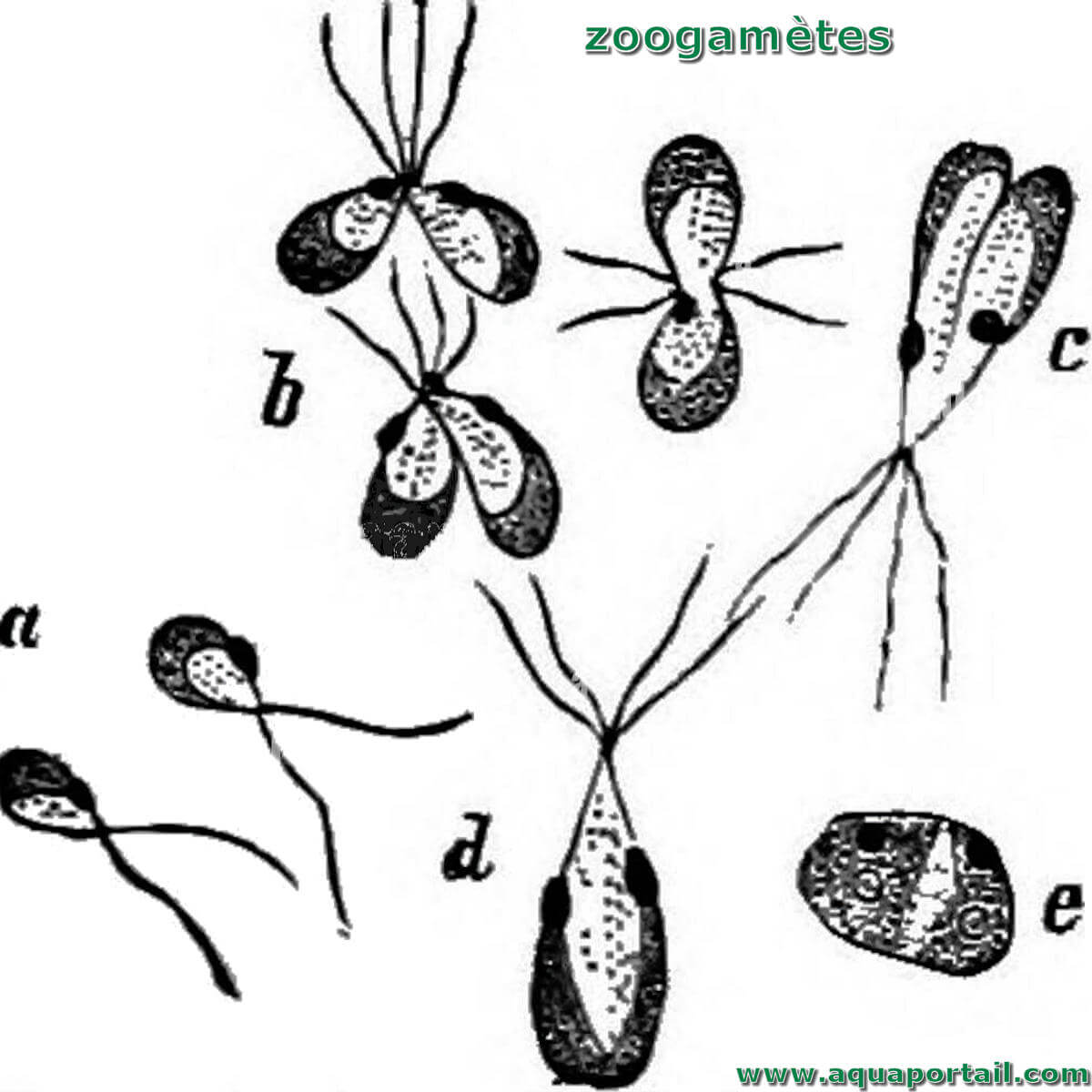
A zoogamete is a ciliated gamete, independently motile by means of one or more eukaryotic flagella.
gametangium

In botany, a gametangium is an organ or cell structure in which gametes are produced, as seen in mosses and liverworts.
Simple summary
A gamete is a specialized reproductive cell found in sexually reproducing organisms that carries a single set of unpaired chromosomes. In humans and many other organisms, gametes take the form of sperm in males and eggs (ova) in females. During fertilization, these cells fuse to form a zygote containing a complete set of chromosomes, initiating the development of a new organism. Gametes enable genetic diversity through sexual reproduction.
