Flagellate
noun and adjective (n. / adj.)
Definition
Flagellates, or mastigophorans, are a heterogeneous group of protozoans characterized by the presence of one or more long flagella during one or all stages of their life cycle. Flagella are used for locomotion and food capture and may serve as sensory receptors.
Anatomy of a flagellate:

A flagellate is an organism or cell equipped with a whip-like appendage called a flagellum, which it uses for locomotion. If two flagella are present, the organism is a biflagellate.
Explanations
Flagellates are unicellular organisms that move using one or more flagella. Some flagellates carry out photosynthesis and are classified among algae, whereas others behave like protozoans. Dinoflagellates, which make up a significant portion of plankton, belong to this group.
Various flagellates of the group Flagellata by Ernst Haeckel in 1904:
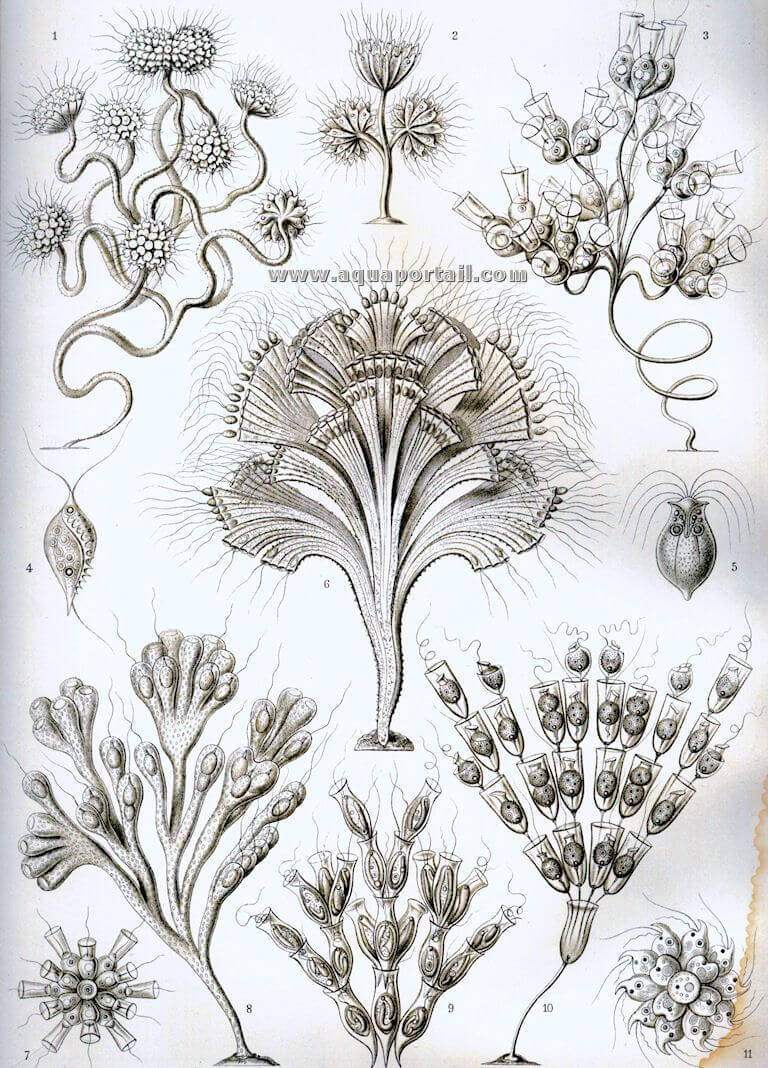
Flagellates do not form a natural (monophyletic) group and have no standing in modern classifications, though the group is still cited in introductory texts as a phylum-level category called protozoans. They are also known as mastigophorans (Mastigophora).
The plate (above) of flagellates depicts several species, ordered by number:
- Anthophysa vegetans (Stein) = Anthophysa vegetans (O.F.Müller) Stein / Anthophysis vegetans (O.F.Müller) Stein
- Cephalothamnium cyclopum (Stein) = Cephalothamnium cyclopum Stein, 1878
- Codonocladium candelabrum (Haeckel) = Codonocladium candelabrum Haeckel / Codonosiga sp.?
- Trichomonas intestinalis (Dujardin) = Trichomonas intestinalis Leuckart
- Tetramitus rostratus (Perty) = Tetramitus rostratus Perty
- Rhipidodendron splendidum (Stein) = Rhipidodendron splendidum F.Stein
- Codonosiga botrytis (Stein) = Codonosiga botrytis (Ehrenberg) Stein
- Phalansterium digitatum (Stein) = Phalansterium digitatum Stein
- Dinobryon sertularia (Ehrenberg) = Dinobryon sertularia Ehrenberg
- Poteriodendron petiolatum (Stein) = Bicoeca petiolata (Stein) Pringsheim
- Uvella glaucoma (Ehrenberg) = Uvella glaucoma (C.G.Ehrenberg) C.G.Ehrenberg
Description and explanations
A flagellate is an organism possessing one or more whip-like organelles called flagella. Certain cells within animal bodies may be flagellated, such as the spermatozoa of most phyla. Flowering plants do not produce flagellated cells, whereas ferns, liverworts, green algae, certain gymnosperms, and closely related plants do. Similarly, most fungi do not produce flagellated cells, though primitive chytrid fungi do. Many protists take the form of unicellular flagellates, such as choanoflagellates and certain euglenids.
The word flagellate describes a particular cellular organization of a eukaryotic organism and its means of locomotion. The term does not imply a specific evolutionary relationship or classification among organisms possessing flagella. However, the term "flagellate" is incorporated into other designations such as dinoflagellates and zooflagellates, which are often more formally defined. Plant-like forms are phytoflagellates, including silicoflagellates.
Flagella are supported by microtubules in a characteristic arrangement, with nine fused outer doublets surrounding two central singlets. These arise from a basal body or kinetosome, with microtubule roots forming an important part of the cell's cytoskeleton. In some cases, flagella support a cytostome where food is ingested. Flagella often bear hair-like appendages called mastigonemes or contain paraflagellar rods. Their ultrastructure plays an important role in eukaryotic classification.
Mastigophorans
Mastigophorans were formerly regarded as a type of protozoan. Because certain rhizopods also possess flagella during some stages of their lives, and some mastigophorans pass through amoeboid stages, these two classes were thought to be closely related and were therefore grouped in the subphylum Sarcomastigophora. The class Mastigophora was subdivided into two subclasses: Phytomastigophorea (plant-like protozoans, or phytoflagellates) and Zoomastigophorea (zooflagellates). This classification is no longer valid today.
Lifestyle, feeding, and reproduction
In protists and microscopic animals, the flagella of flagellates are generally used for propulsion. They may also generate a current or flow that draws food toward the oral opening. In most cases, one or more flagella are positioned near the anterior end of the cell, as in euglenids. Often, one flagellum is directed forward while another trails behind. Among animals, fungi, and Choanozoa, which form a group called opisthokonts, there is a single posterior flagellum, formerly placed within the phylum Mastigophora. They can cause diseases or synthesize their own food, and they reproduce by fission.
Most flagellates spend their lives moving or feeding. Many parasites affecting human health or the economy are flagellates. Flagellates are major consumers of primary and secondary production in aquatic ecosystems, consuming bacteria and other protists.
Many flagellates lead free-living, solitary lives, some are sedentary, and others form colonies ranging from a few to thousands of individuals. They abound in fresh and salt waters, where, together with diatoms, they make up a large portion of the food for small planktonic aquatic animals (zooplankton). Several species inhabit soil. Many species contain plastids with colored pigments; those with chlorophyll inclusions, because they resemble algae, are often classified among plants (phytoflagellates). Free-living flagellates can often encyst to survive unfavorable conditions.
Synonyms, antonyms
Spanish translation: flagelado
5 synonyms (similar meaning) for "flagellate":
- dinoflagellates
- mastigophoran
- phytoflagellates
- silicoflagellates
- zooflagellates
0 antonyms (opposite meaning).
Related words and expressions to FLAGELLATE are directly connected by general or specific meaning.
The word FLAGELLATE is listed on page 1 of words starting with F in the dictionary glossary.
Related to "flagellate"
biflagellate

In zoology, biflagellate describes what possesses two flagella, referring to a doubly flagellated cell or microorganism equipped with two flagella.
bacterial flagellum

A bacterial flagellum is a prokaryotic flagellum found in bacteria or monerans. It is essential for motility, adhesion, and colonization, and forms part...
eukaryotic flagellum

A eukaryotic flagellum (vs. prokaryotic) is a flexible, whip-like cellular organelle composed of an axoneme and a kinetosome, used for locomotion in motile...
flagellation

Flagellation is the act of beating oneself or someone else, typically as a religious or ideological punishment, using a whip or similar instruments.
Simple summary
A flagellate is an organism possessing one or more flagella, whip-like structures used to propel cells through liquid media. These organisms are generally unicellular and occur in diverse environments, both aquatic and terrestrial. Flagella may also play a role in sensing the environment and aiding in feeding.
