Diploid
adjective (adj.)
Definition
A diploid cell comes from an organism or tissue whose cells possess two sets of chromosomes, denoted 2n, as opposed to haploid with 1n chromosomes and gametes. There is a double set of homologous chromosomes in the cell nucleus. Diploid organisms are diplonts.
Comparison of a diploid cell and other ploidies:
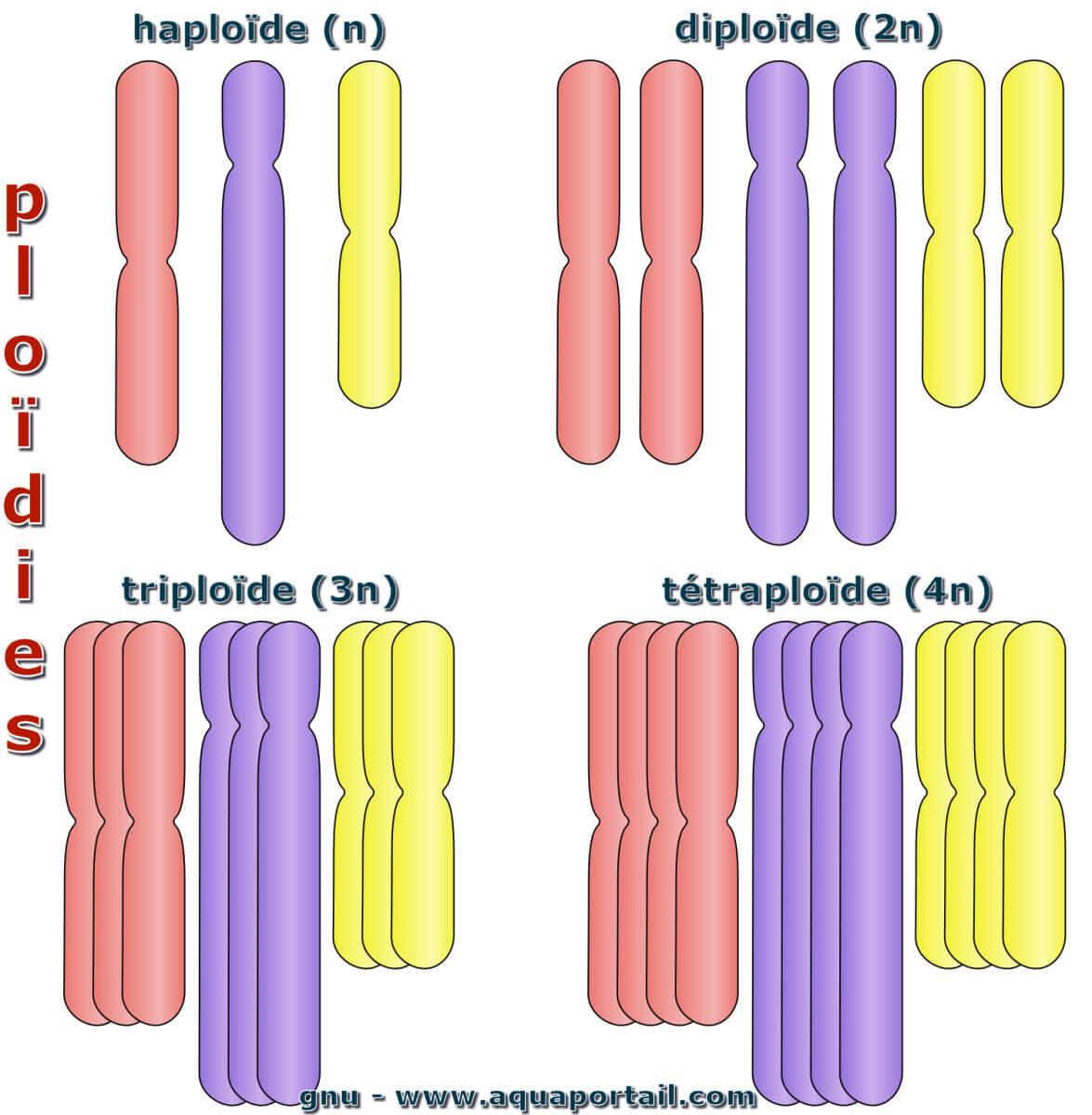
Diploid cells (2n) are cells that have a double set of chromosomes (unlike gametes), meaning they possess two sets of chromosomes. This is one of the forms of ploidy.
Explanations
Diploid cells are those whose chromosomes are arranged in pairs of homologous chromosomes, so for each trait there are at least two genes, each located on a homologous chromosome. The same genetic information is stored in two places, which is important, for example, in mutations.
Human somatic cells contain 46 (23 × 2) chromosomes; this is their diploid number. Gametes, produced in the gonads via meiosis of germ cells, have only half that number, 23, which constitutes their haploid number, since during meiotic division their 46 chromosomes are distributed following DNA duplication (2c → 4c) into 4 cells, each with 23 chromosomes and half the genetic material, leaving each cell without a complete pair of chromosomes.
The diploid genome has 2n chromosomes (generally two alleles of each gene), resulting from the pairing of two haploid genomes. Such pairing occurs, for instance, during fertilization with cell nucleus fusion.
Diploid genetic information is therefore twice as abundant as in a haploid organism. The somatic cells of most plants and animals are diploid.
✅ In addition to diploidy, see also the special phenomenon in certain insects called haplodiploidy.
Normally, in the human life cycle, the proper alternation of haploid and diploid phases occurs during cellular development. Haploid cells are formed following meiosis and meiotic division of diploid cells. Thereafter, cells can multiply by mitosis and mitotic division to form a multicellular body composed of diploid somatic cells and several generations of haploid germ cells (offspring).
Diploid cells are formed from haploid cells following the sexual process (fertilization, fusion of gametes) with the formation of a zygote. See also merozygote. For each character, there are at least two genes, each situated on a homologous chromosome.
The term diploid was proposed in 1905 by the German botanist Eduard Strasburger. ⭐ The term diplont must not be confused with diplobiont. See also haplodiploid.
Diploidy is used in genetics when a double set of chromosomes (2n) exists within a cell nucleus. If there is only a single set of chromosomes, it is called haploidy. In certain organisms, other ploidy levels occur, such as triploid (3n) or tetraploid (4n).
✅ Sexually reproducing diploid organisms arise from the germ cells of both parents during fertilization and embryonic development. Two gametes unite and their cell nuclei, each carrying a single set of chromosomes, fuse into the common nucleus of the zygote (karyogamy). Consequently, in these animals, haploid and diploid developmental phases alternate (nuclear phase shift). The transition from the diploid state to the haploid state is meiosis.
In most multicellular animals (and also in humans), most body cells are diploid and only the gametes are haploid; they are therefore called diplonts. By contrast, plants have a more or less pronounced haploid phase in their life cycle and are thus called diplohaplonts. The diploid phase is shortest in haplonts, where it is restricted to the zygote; these include many algae and certain protozoa.
In plants
In mosses (bryophytes), the haploid generation (gametophyte) is what is seen as the green moss plant (leafy or thalloid). After fertilization, a smaller diploid sporophyte emerges, growing from the moss plant and forming a spore capsule in which meiosis takes place to form haploid spores. The spores are dispersed by wind or rain, germinate, and form a new haploid gametophyte.
In ferns (pteridophytes), horsetails (Equisetopsida), and clubmosses (Lycopodiopsida), the large visible sporophyte plant is diploid. It produces haploid spores following meiosis, resulting in a small gametophyte, the prothallus. The sporophyte grows again from its fertilized eggs. However, polyploid ferns (sporophytes) also exist.
In seed plants (spermatophytes), the diploid sporophyte is what we see as trees, shrubs, or herbaceous plants. The gametophytes are greatly reduced: pollen grains and the embryo sac of the ovule represent the haploid generation, whereas in naked-seed plants (gymnosperms), pollen arrives directly on the ovule, which is not enclosed within an ovary and thus lacks a stigma and style. After pollination, the pollen tube grows through the style to the ovule in the embryo sac where fertilization occurs.
In animals
As a rule, multicellular animals develop by fusing a paternal and a maternal haploid germ cell into a diploid zygote. The zygote divides repeatedly, with the animal's body composed of diploid cells. Finally, gametogenesis once again produces haploid germ cells.
There are, however, numerous exceptions to this general rule, some of which are described below:
- in certain insects, sex determination is based on whether an individual is haploid or diploid (haplodiploidy); for example, bees and ants are diploid (workers and queens), whereas males (drones) are haploid
- in certain truly diploid insects, such as the fruit fly Drosophila melanogaster, most cells of adult animals are polytene, meaning large sections of chromosomes have replicated many times without cell division
- some animals reproduce via parthenogenesis
- mammalian red blood cells (erythrocytes) contain no nucleus and therefore no chromosomes
- platelets (thrombocytes) likewise contain no nucleus; they are formed from megakaryocytes, which can contain up to 64 sets of chromosomes
Synonyms, antonyms
Spanish translation: diploide
1 synonym (similar meaning) for "diploid":
1 antonym (opposite meaning):
Related words and expressions to DIPLOID are directly connected by general or specific meaning.
The word DIPLOID is listed on page 1 of words starting with D in the dictionary glossary.
Related to "diploid"
diplobiontic
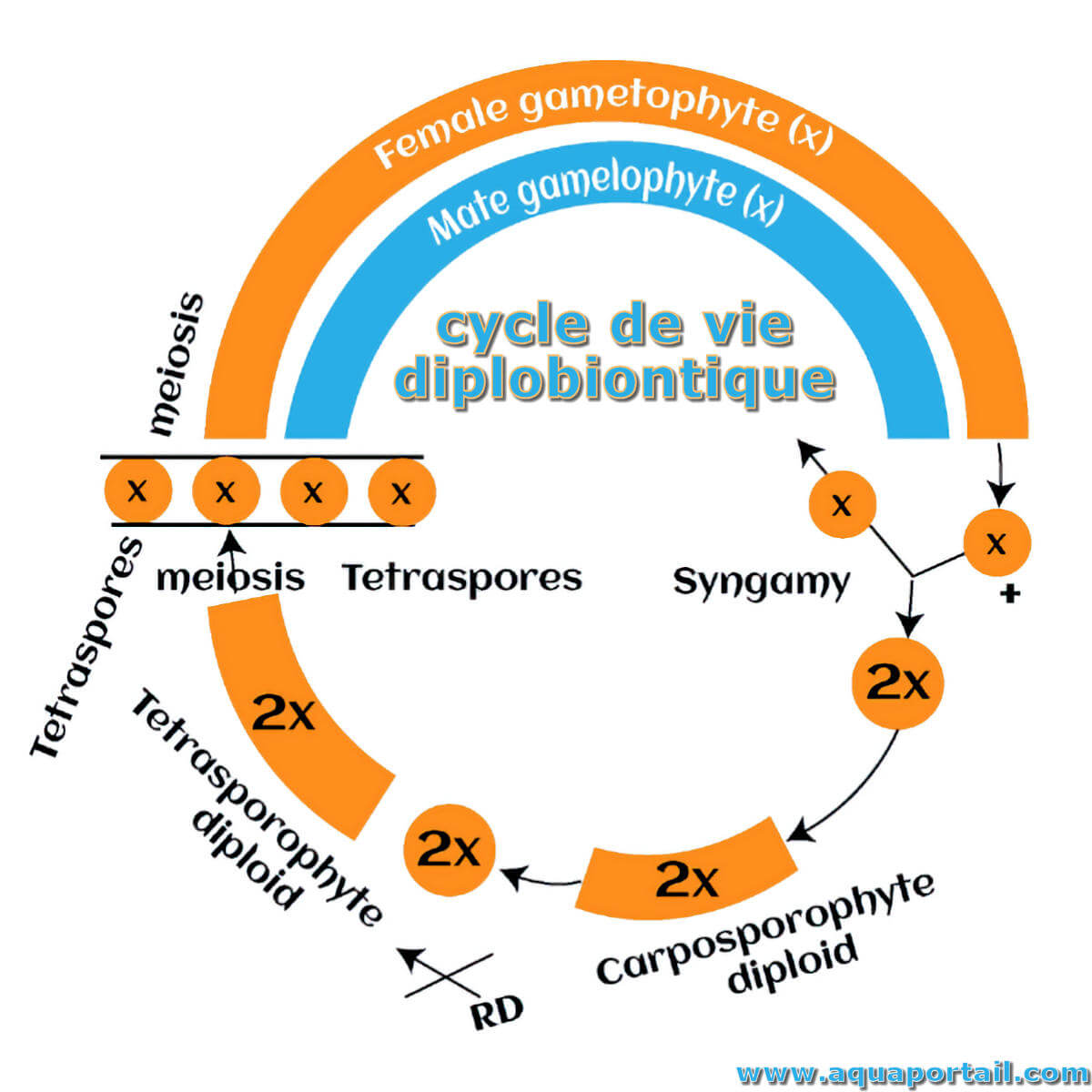
An organism is diplobiontic when it is represented by two types of individuals in nature, as opposed to haplobiontic.
diplont

A biological organism is a diplont when it is diploid, as opposed to a haplont. Every diplont experiences a phase essentially having 2n chromosomes.
diplophasic
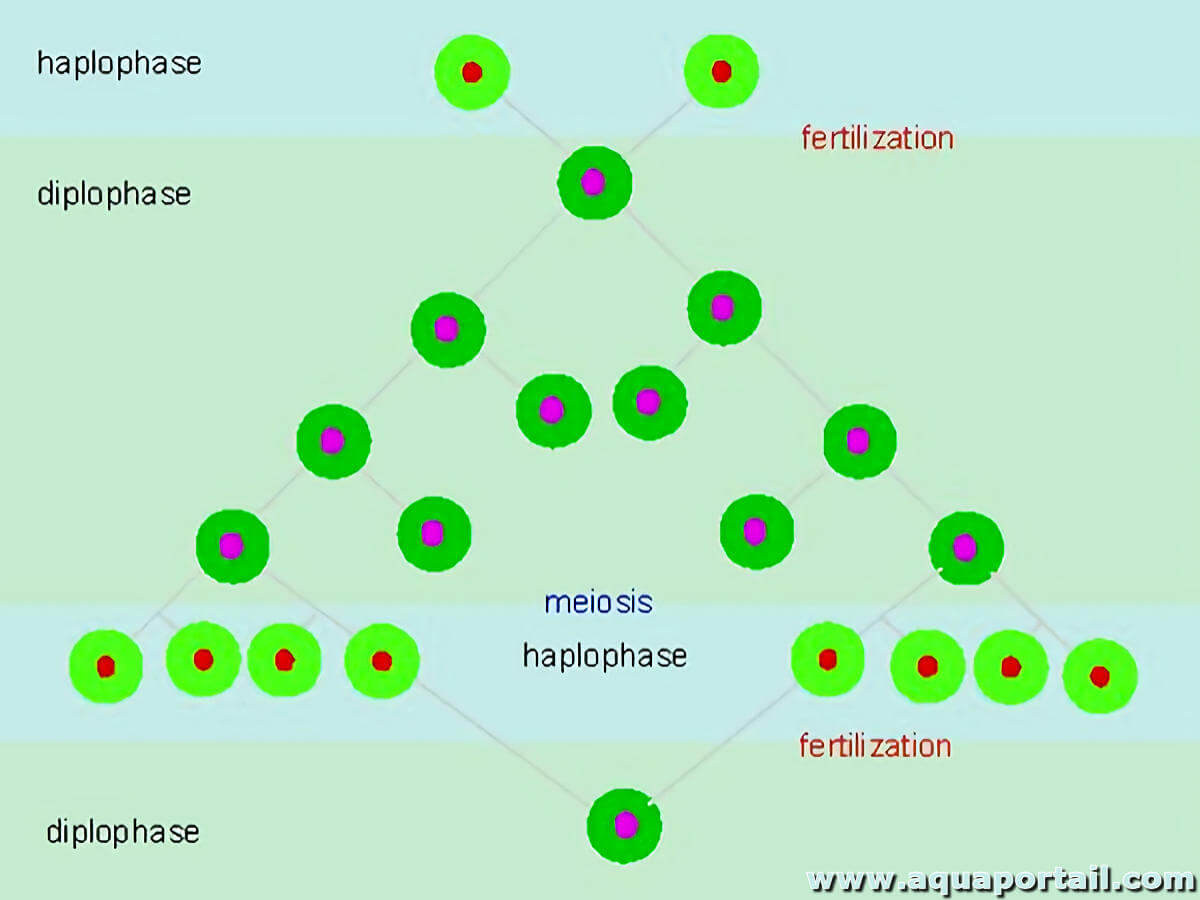
In sexual reproduction, a diplophasic cycle is diplontic among sexual life cycles involving alternating haploid (n) and diploid (2n) stages—that is, a shift...
dale

A dale is a small valley or glen that does not (or no longer) contains a watercourse. The concave hollowed space of a dale is not large enough to build...
