Optimum temperature
noun phrase (n. phr.)
Definition
Optimum temperature is a temperature at which an organism's metabolic activity achieves homeostasis. The organism's energy expenditure is at a minimum for regulating metabolic processes, without any stress.At the optimum temperature, body temperature is ideal for the organism (e.g., enzyme function). Overall, optimum, ideal, or preferred temperatures are around 20 °C / 68 °F (17 to 24 °C / 62.6 to 75.2 °F).
Optimum temperatures correlated with humidity:
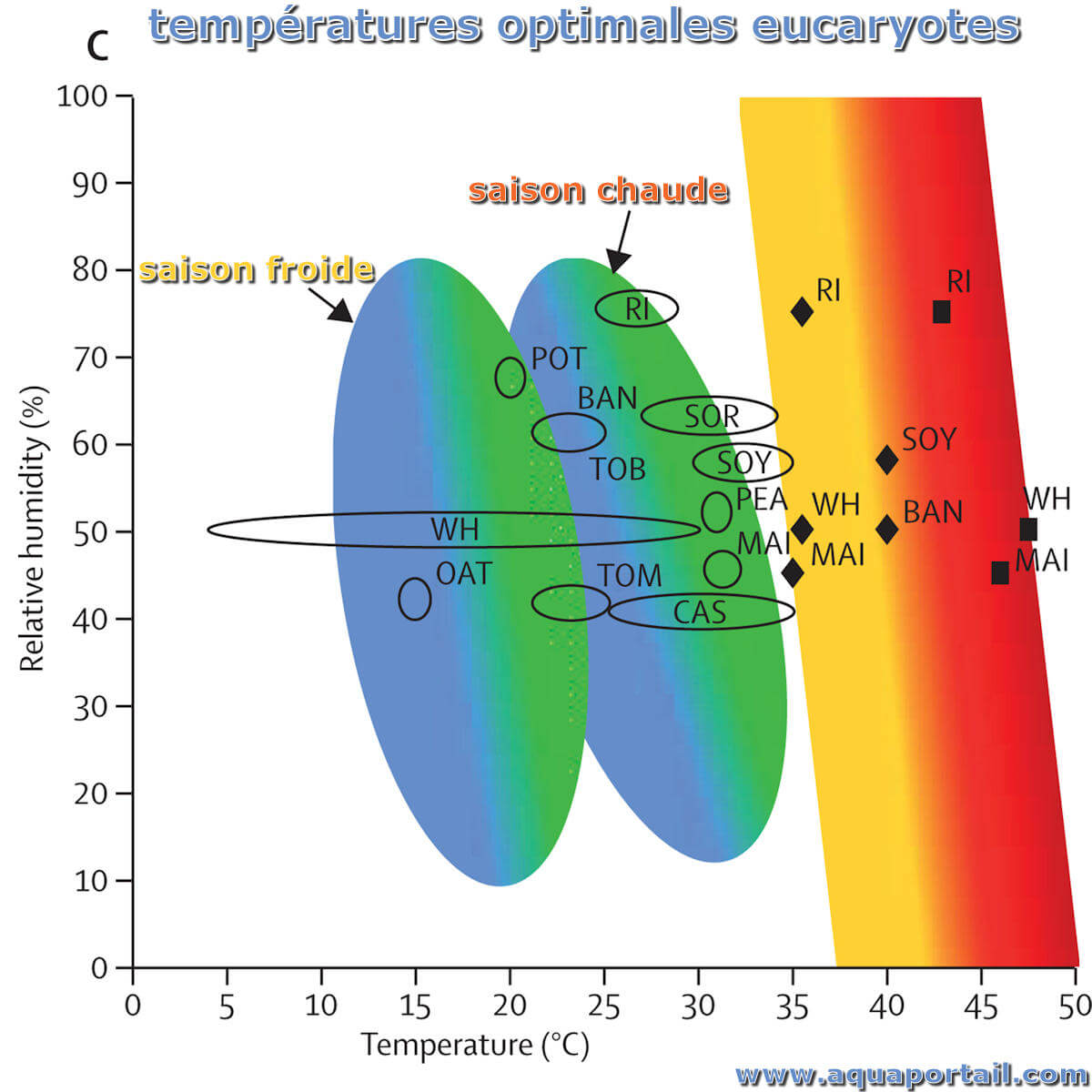
The optimum temperature for the highest energy yield with the lowest carbohydrate expenditure varies with humidity.
Explanations
An optimum temperature is also called ideal temperature, preferred temperature, or temperature optimum. See also ecological optimum for an ecosystem.
Temperature is an integral part of all life habitats and is the most studied physical impact parameter. Temperature affects physical, chemical, biological, and ecological factors at all scales. The optimum temperature may differ according to sex, not being the same for a female or a male.
For example, by influencing states of matter, temperature determines whether frost forms on a leaf or sweat evaporates from the skin. Temperature influences the dissolution and diffusion rates of essential chemicals and the thermodynamics of metabolic reactions.
At the cellular level, temperature can affect membrane fluidity, protein folding, and regulation of gene expression; indicators of thermal strain include protein alteration and fluctuations in tissue protein profiles.
At the macroecological level, temperature can influence the abundance of food, water, competitors, and predators, and depending on the species, temperature can also affect development, maturation, reproduction, migration, or dormancy.
habitat temperatures across different ecosystems naturally fluctuate according to daily and seasonal cycles; however, living organisms are also subject to intermittent or prolonged extreme temperature events.
Although ectotherms and endotherms are known to respond differently to high ambient temperatures, this overview focuses on endotherms and plants.
The effects of temperature can be influenced by other key parameters, such as humidity, pressure, light, ultraviolet radiation, air composition, oxygen availability, etc.
Optimum temperature of eukaryotes
Temperature affects many life processes, and its effect might be expected to differ from one eukaryotic organism to another inhabiting similar environments. In fact, however, preferred (or, conversely, harmful) temperatures are found to be similar for humans, cattle, pigs, poultry, fish, and agricultural crops.
However, perceived temperature depends on several environmental factors, such as ambient temperature, atmospheric pressure, humidity, etc. The optimum temperature therefore differs accordingly.
For example, stress temperature thresholds are lower when humidity is higher. Thus, climate, with its severities or excesses, influences an organism's optimum temperature.
Thus, prolonged exposure to temperatures above 25 °C (77 °F) with high humidity can cause heat stress in many organisms, without any water stress. Short exposures to temperatures above 35 °C (95 °F) with high humidity, or above 40 °C (104 °F) with low humidity, can be fatal.
Increased exposure, frequency, and duration of stressful and lethal temperatures increase physiological stress and bodily damage suffered by humans, livestock, poultry, fish, and agricultural crops.
Differences between growth and living temperatures
The principle of optimum temperature can also incorporate the developmental stage of an organism (and also of an organelle) as a variable. Thus, the optimum growth temperature may differ from that of adult life.
For example, while the optimum temperature range of an adult mesophilic organism is best at moderate temperatures between 25 °C (77 °F) and 40 °C (104 °F), the optimum growth temperature of mesophiles is between 15 °C (59 °F) and 35 °C (95 °F).
✅ The optimum temperature of many pathogenic mesophiles is 37 °C (98.6 °F), normal human body temperature.
Optimum temperature of cellular organelles and prokaryotes
The optimum (ideal or preferred) temperature of a prokaryote or eukaryotic organelle (enzyme, plastid, etc., for various biosyntheses) varies under the same conditions as for eukaryotes. However, for cells, for example, osmotic pressure may play a role in their proper functioning.
Optimum temperatures for an enzyme relative to oxygen consumed:
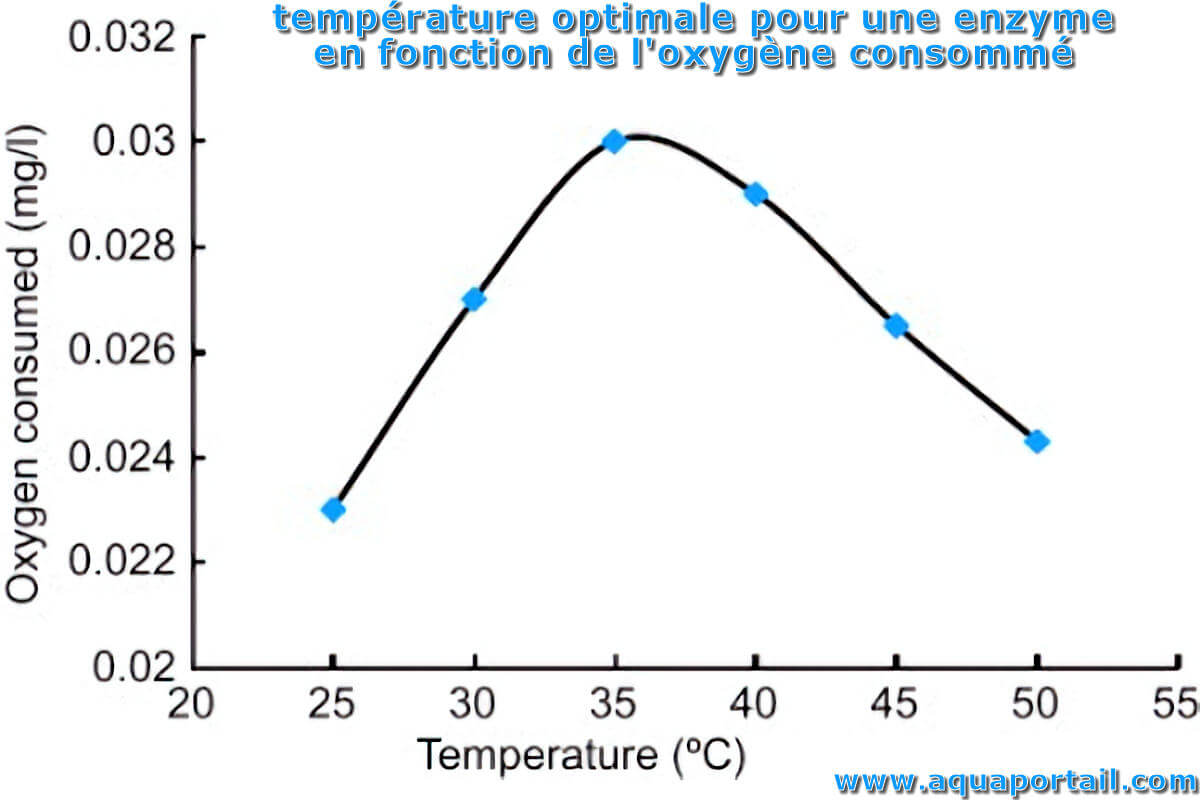
The optimum activity temperature of an enzyme is 35 °C (95 °F) with maximum oxygen consumption.
✅ The optimum temperature of immobilized enzyme nanoparticles shows a substantial increase compared to that of the free enzyme; for example, an increase of 10 °C (18 °F) for uricase (urate oxidase) and 5 °C (9 °F) for notatin (glucose oxidase) has been reported.
Immobilized enzyme nanoparticles exhibit improved thermostability compared to the free enzyme, for example, immobilized glucose oxidase enzyme nanoparticles compared to the free form.
This may be due to inter- and intramolecular covalent cross-links that prevent conformational changes of the enzyme at higher temperatures and thus enzyme deactivation.
Generally, enzyme nanoparticles show increased activity due to a higher specific surface area, better stability, and biocompatibility. Although the size, shape, color, and chemical bonding of enzyme nanoparticle aggregates have been studied, their kinetic properties in native form have not been reported.
However, the kinetic properties of enzyme nanoparticles of a few enzymes have been studied after covalent immobilization on an artificial membrane (nitrocellulose membrane) or on metal wire (Au/Pt). A comparison of the kinetic properties of immobilized enzyme nanoparticles with those of free enzymes revealed changes in the properties of free enzymes following nanoparticle preparation and subsequent immobilization.
Reflections on the effects of climate change
All living organisms are affected by temperature, and the effect of temperature change can be expected to vary across kingdoms of life and geographic regions.
However, as global average temperature rises with climate change, the effect on certain eukaryotic life forms will have direct and indirect consequences for society.
High temperature will lead to heat strain and affect human functioning and health, livestock and poultry growth and productivity, as well as crop growth and yield.
Organisms respond to heat stress physiologically and by altering their behavior. Physiological responses include increased body temperature, increased heart and respiratory rates, vasodilation, increased sweating, and muscle cramps (an early symptom of heat illness).
Heat stress leads to reduced growth in beef and dairy cattle, pigs, chickens, and other farm animals, resulting in lower yields and reproductive performance.
For example, under heat strain, the milk yield of lactating dairy cows can be reduced by 10–20%.
Behavioral coping mechanisms for humans and animals include drinking more, eating less, limiting activity, and, for humans, dressing appropriately. Increased sweating can result in water and salt loss that must be compensated by increased water intake to prevent dehydration.
Dairy cows experience severe dehydration when 12% of their body weight is lost as water, while in camels and Bedouin goats, the effect occurs at 30–40% body weight water loss.
At very high temperatures, exposure becomes fatal.
Strategies to mitigate rising thermal pressure often require additional resources and are therefore not accessible to everyone, but could include: increased natural shading (e.g., trees) and built shading; redesigning cities and buildings to be more thermally passive (e.g., lighter, reflective roof and wall colors, better wall and roof insulation, and windows oriented away from sunrise and sunset); and increasing airflow, indoor air conditioning, and personal cooling systems.
In livestock farming, barn designs have been developed to reduce solar radiation and, depending on location, sophisticated water devices and fans are used to promote active cooling.
However, some farm animals are still raised outdoors, particularly during summer months, when heat stress (mainly due to direct exposure to solar radiation) may become an issue.
Synonyms, antonyms
Spanish translation: temperatura óptima
3 synonyms (similar meaning) for "optimum temperature":
- ideal temperature
- preferred temperature
- temperature optimum
0 antonyms (opposite meaning).
Related words and expressions to OPTIMUM TEMPERATURE are directly connected by general or specific meaning.
The expression OPTIMUM TEMPERATURE is listed on page 1 of words starting with O in the dictionary glossary.
Related to "optimum temperature"
temperature threshold

A temperature threshold is the thermal physical condition, such as comfort conditions for humans, preference for animals, and optimum for crops, in which...
ocean basin

An ocean basin is a benthic environment taking the form of a depression in the ocean floor bounded by the lower part of the continental slope.
ocean floor

The ocean floor (seafloor) is the region of the deep seabed where the topography flattens out, typically just beyond the continental rise at the level...
oceanic

What is oceanic relates to the ocean and designates the marine zone, or ecological province, located far from the coast, beyond the continental shelf.
