Temperature threshold
noun phrase (n. phr.)
Definition
A temperature threshold is the thermal physical condition, such as comfort conditions for humans, preference for animals, and optimum for crops, in which minimal physiological effort is required to maintain life and reproduction.
Living organisms thrive best within their preferred thermoneutral temperature zone. A range of temperature thresholds determines the optimum temperatures for an organism.
Comfort and preferred temperature thresholds:

The threshold temperature for a heat wave can generally be defined as the epidemiological threshold at which heat effects begin to cause heat-attributable excess mortality. These thresholds also mark the activation of prevention plans based on public health actions to respond to high temperatures.
Explanations
Beyond the thermoneutral zone, elevated ambient temperatures lead to thermal strain, i.e., physiological responses of a body. An endothermic body produces its own heat from metabolic reactions required for activities such as walking or lifting, and also gains heat from solar radiation.
Humans and many animals dissipate heat through: convection of heat warming the surrounding air; conduction of heat through direct contact with a surface; respiration by inhaling cool, dry air and exhaling warm, moist air; evaporation through sweating; and radiation.
Thermal tension
Thermal tension begins when body heat loss is less than body heat gain, resulting in an increase in body temperature. When skin temperature exceeds ambient temperature, convection and radiation contribute to heat loss rather than heat gain.
However, if high-temperature surfaces are present, such as rocks, concrete, or asphalt, their radiation will also contribute to heat gain; the only effective dissipative mechanisms operating under such circumstances are evaporation through sweating (e.g., in humans and horses), or evaporation solely through panting in animals unable to sweat effectively or at all (e.g., cattle, pigs, dogs, and poultry).
Thermal load
To estimate the thermal load an organism can withstand, information on the environmental parameters determining the rate of heat exchange is needed. These parameters are ambient temperature and humidity, air movement, solar radiation, and precipitation. To estimate the degree of thermal strain, physiological response parameters of a body are also required.
There are numerous approaches to characterizing heat stress (i.e., environmental conditions) and thermal strain (i.e., physiological responses of living organisms).
More than 100 indices have been proposed to describe heat stress and strain in humans alone, ranging from simple relationships to highly sophisticated models. Simple heat stress indices consider only environmental parameters, primarily temperature and humidity.
More advanced indicators are based on mathematical modeling of environmental heat exchange and passive (physiological) and active (behavioral) thermal responses of the human body by incorporating central nervous system (CNS) activities.
These complex indices using detailed three-dimensional human geometry were developed to model and monitor people working in hazardous thermal conditions, such as furnace workers, military personnel, and athletes. Despite their complexity, these indices do not account for the effects of cumulative thermal load over time, though they can be applied repeatedly and accumulated. The indices are also subject to uncertainties arising from wide individual variability in input parameters, including sex, ethnicity, age, physical fitness, and other factors, particularly social aspects.
Thus, low-income individuals or those living in social isolation have far less capacity to mitigate adverse environmental conditions than others. Children (under 5 years) and older adults (over 60 years), as well as people with pre-existing chronic health conditions, are likely to be more vulnerable to heat stress than healthy adults.
Most temperature indices focus on the imminent short-term risk of harmful heat, such as the Predicted Heat Strain (PHS) index and the Wet-bulb Globe Temperature (WBGT) index, which has been declared by the International Labour Organization as "the most common heat stress index in occupational health".
Universal Thermal Climate Index (UTCI)
A group of international experts developed the Universal Thermal Climate Index (UTCI) at the initiative of the International Society of Biometeorology to provide an easy-to-use assessment of thermal strain in humans. The Universal Thermal Climate Index (UTCI) incorporates measurements of temperature, humidity, wind, and radiation as environmental inputs.
The UTCI is based on the most advanced thermophysiological model, the UTCI-Fiala model, which combines an advanced, dynamic multi-node physiological model for a human with a state-of-the-art adaptive clothing insulation model for outdoor conditions.
Since Blazeczyk and colleagues established the standard, a typical modeled person is a properly clothed male with a body weight of 73.5 kg (162 lb), a surface area of 1.86 m2 (20 sq ft), a body fat content of 14%, and a metabolic heat production of about 135 W/m2 (the equivalent of walking at 4 km/h or 2.5 mph).
The physiological model accounts for heat and mass transfer within the human body and thermoregulatory responses of the CNS.
The UTCI uses the air temperature of a reference environment that would elicit the same thermoregulatory responses in the human body as in the actual environment (e.g., air temperature, humidity, wind, and radiation), such as sweat production, shivering, skin wetness, skin blood flow, and changes in mean rectal, skin, and facial temperatures.
The reference environment has the same temperature as the actual environment, a relative humidity of 50% (capped at 20 hPa for air temperatures above 29 °C / 84.2 °F), no additional irradiation (i.e., radiant temperature equals air temperature), and calm air (wind speed 0.5 m/s or 1.6 ft/s at 10 m or 32.8 ft above ground). The reference person has a metabolic rate of 135 W/m2.
The reference temperature depends on actual temperature, humidity, wind speed, and mean radiant temperature, where mean radiant temperature characterizes the body's net radiant energy exchange caused by short-wave and long-wave radiation fluxes.
Exact calculation of the UTCI is time-consuming, but it can be replaced by a sixth-order polynomial equation with sufficient accuracy and a root-mean-square error of 1.1 °C (2 °F). Climatological UTCI forecasts can be computed using data from the international meteorological information service.
A comfortable temperature range for humans is 17 °C to 24 °C (62.6 °F to 75.2 °F), though it may be a few degrees lower with high humidity and a few degrees higher with low humidity. According to the UTCI, slight thermal strain begins at about 23 °C (73.4 °F) with high humidity or about 27 °C (80.6 °F) with low humidity.
At moderate humidity, thermal strain is considered strong (or severe) at 32 °C (89.6 °F), very strong (or very severe) at 36 °C (96.8 °F), and extreme at temperatures above 40 °C (104 °F).
Related to "temperature threshold"
optimum temperature
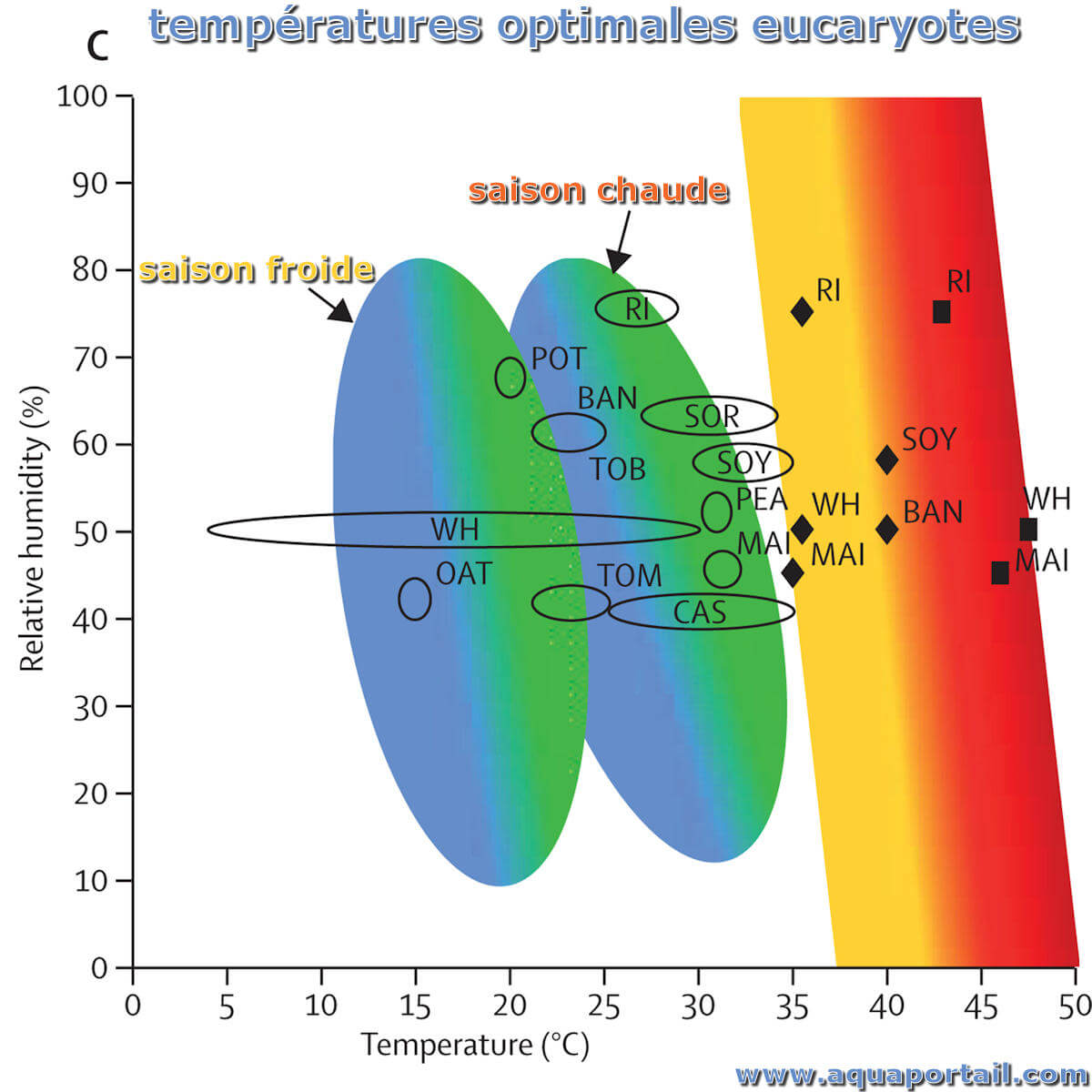
Optimum temperature is a temperature at which an organism's metabolic activity achieves homeostasis.
tagma

A tagma is a group of fused segments formed by series of metameres differentiated from the rest of an arthropod's body.
tapeworm

The tapeworm, or solitary worm, is a long, ribbon-like, segmented flatworm, a parasitic cestode of the genus Taenia.
taxon

In biology, a taxon is a taxonomic unit recognized by international codes within a given classification, or a systematic unit such as a family, genus...
