Operculum
noun (n.)
Definition
An operculum is a structure characteristic of fish and larval amphibians that covers the gills, leaving only a posterior opening or gill slit.
In osteichthyans, the operculum is a cutaneous fold supported by the opercular bones that protects the gills and gill slits by enclosing a branchial chamber opening posteriorly via an opercular slit.
In amphibians, the operculum is a small bone connecting the pectoral girdle to the oval window. It has no equivalent in other vertebrates.
The operculum of a snail:
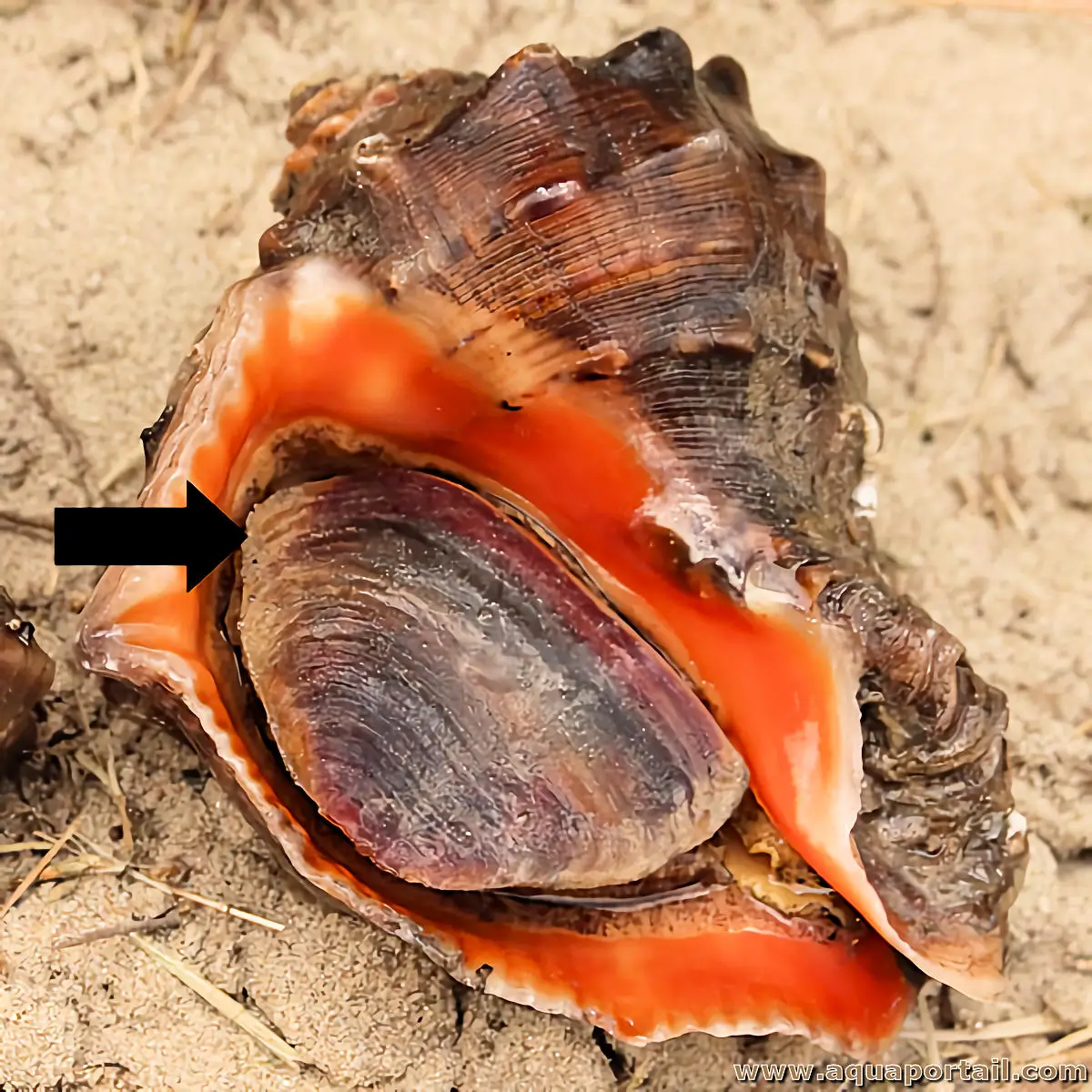
The operculum occurs in aquatic snails (gastropods), enabling them to seal the entrance of their shell fairly tightly. It is clearly visible in Rapana venosa, the veined rapa whelk of the Black sea. In this marine snail, the operculum is a calcareous structure acting as a small "trapdoor" to seal it safely inside its shell.
Explanations
It is also a lid-like organ whose presence prevents spore dispersal. It occurs:
- in operculate Discomycete Ascomycetes, at the tip of the asci;
- in mosses, at the apex of the sporophyte capsule;
- in certain gastropods, a calcareous or horny piece that closes the shell;
- in bees, a wax cap sealing the cells of honeycombs.
In fish, it is a bony plate, the largest of the bones covering the gills, whose beating movements drive water circulation through the branchial cavity. By extension, it refers to the entire set of these bones. In bony fish, the operculum is supported by skeletal elements articulated on the hyomandibula and may be extended ventrally by the branchiostegal membrane.
Gastropods
In invertebrates, the operculum acts as a plug closing the opening of a tube or shell. In certain gastropods, it is a horny or calcified plate borne on the posterior dorsal surface of the foot, serving to seal the shell aperture when the animal withdraws inside. Opercula also occur in certain tubeworms.
When, for instance, the tide recedes, leaving a marine snail stranded too far from water, the gastropod can retreat deeply into its shell and pull the operculum shut behind it. Some opercula, such as that of the wavy turban snail, fit the exact shape of the shell aperture, allowing the snail to seal itself inside, safe from desiccation. It also serves as defense against predators such as sea stars, octopuses, and carnivorous snails.
As a rule, an operculum is attached to the snail's muscular foot. When the snail extends outside its shell, the operculum opens and folds back; when it is time to retreat to safety, the snail's soft yet strong body pulls this operculum tightly against its shell aperture.
Not all marine snails produce hard, shell-like opercula: some species secrete thin layers of a cuticle-like substance for protection. Because these opercula are much more fragile, however, it is the calcareous "shells" that have captured human attention for thousands of years.
Various cultures, from antiquity to modern times, have used opercula in incense, grinding the shells into a powder used to stabilize and preserve other fragrances. Some historians believe it may have been an ingredient in the sacred incense burned in the ancient Temple of Solomon.
Synonyms, antonyms
Spanish translation: opérculo
1 synonym (similar meaning) for "operculum":
0 antonyms (opposite meaning).
Related words and expressions to OPERCULUM are directly connected by general or specific meaning.
The word OPERCULUM is listed on page 1 of words starting with O in the dictionary glossary.
Related to "operculum"
retinaculum

Retinacula ensure smooth movement of the distal extremities by anchoring tendons close to joints.
ocean basin

An ocean basin is a benthic environment taking the form of a depression in the ocean floor bounded by the lower part of the continental slope.
ocean floor

The ocean floor (seafloor) is the region of the deep seabed where the topography flattens out, typically just beyond the continental rise at the level...
oceanic

What is oceanic relates to the ocean and designates the marine zone, or ecological province, located far from the coast, beyond the continental shelf.
Simple summary
The operculum generally refers to a structure serving as a protective covering or lid in various biological contexts. In fish, it commonly denotes the bony flap covering and protecting the gills. In mollusks, it is the rigid plate that seals the shell opening when the animal retracts inside. In botany, the term may refer to a lid-like structure covering a capsule or other opening in certain plants.
