Osmosis
noun (n.)
Definition
Osmosis is the spontaneous movement of solvent molecules from a region of low solute concentration to a region of high solute concentration across a semipermeable membrane in order to equalize their concentrations on both sides of the membrane.Reverse osmosis (RO) water is obtained using an RO unit. Reverse osmosis also exists.
Comparison between diffusion and osmosis:
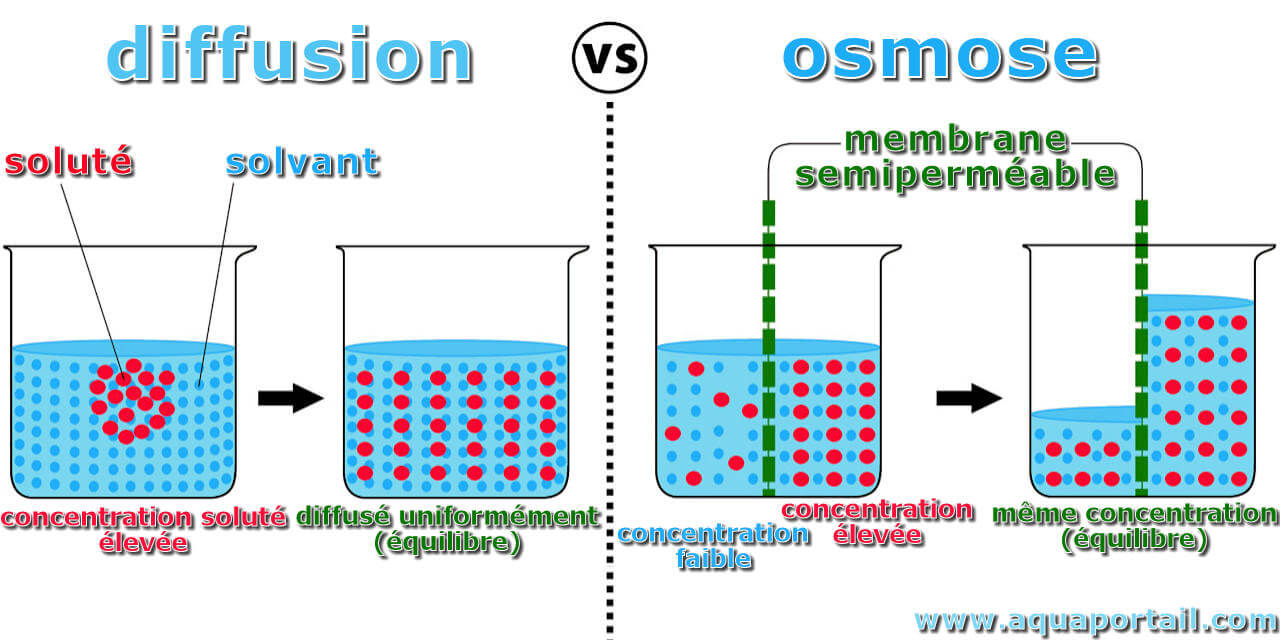
Comparison diagram between an osmosis phenomenon (right) and diffusion (left).
Explanations
Normal osmosis is a phenomenon of water diffusion across a semipermeable partition, such as a cell membrane. This osmotic phenomenon, typically osmoregulation, occurs due to a difference in osmotic pressure.
Many questions must be asked to make the best choice of an RO unit in fishkeeping.
See also endosmosis, exosmosis.
Causes of the osmotic phenomenon
When two solutions of different concentrations are separated by a semipermeable membrane, water molecules tend to move from the region of low solute concentration (high water potential) to the region of high solute concentration (low water potential), to equalize their concentration on both sides of the membrane or reach a state of equilibrium.
This is an important phenomenon that exists in both animals and plants.
Osmosis was first studied in 1877 by the German plant physiologist Wilhelm Pfeffer. The general term "osmosis" was introduced in 1854 by the British chemist Thomas Graham.
Characteristics
The main characteristics of (simple) osmosis are:
- Requires a semipermeable membrane
- A slow and spontaneous process
- Occurs only in a liquid medium
- Requires no energy expenditure and is therefore also called passive diffusion
- Water movement occurs from a region of high water potential to a region of low water potential
- The process continues until the solution concentration becomes uniform on both sides of the semipermeable membrane.
Osmosis of saltwater
In the case of salinity, when two waters of different salt concentrations come into contact across a permeable wall, the liquid tends to move from the less salty water to the saltier water.
Many marine creatures prevent their bodies from absorbing too much water, or losing too much, by maintaining a salt concentration identical (isohaline) to that of the water in which they live. For example, estuarine animals can "swell" dangerously when entering freshwaters. They counter this danger either by rapidly reducing the salt concentration in their tissues or by expelling the incoming water as it enters.
Process and alternatives
Ultimately, osmosis consists of the diffusion of a solvent across a semipermeable membrane separating two solutions. Diffusion takes place from the solution where water activity is highest (dilute solution) toward the solution where water activity is lowest (concentrated solution).
See also microfiltration, ultrafiltration, and nanofiltration for other water purification processes in domestic use.
Thermo-osmosis is heat-driven osmosis.
Differences between diffusion and osmosis
Diffusion and osmosis are two important passive transport methods where molecules move to equalize the concentration of the region undergoing the process, reaching equilibrium. Although both processes share many common properties, they contrast in many ways.
In diffusion, the movement of solutes existing in any solid, liquid, or gaseous state occurs from a region of higher concentration to a region of lower concentration, without a semipermeable membrane. It occurs in any solid, liquid, and gaseous medium. It depends on the size and electrical charge of the molecules. Movement is direct and does not always require a semipermeable membrane or cell membrane. The process is rapid.
In osmosis, the movement of the solvent, particularly water, occurs from the region of low solute concentration to the region of high solute concentration across a semipermeable membrane. It occurs exclusively in a liquid medium. It depends solely on particle concentration. Movement always occurs across a semipermeable membrane or cell membrane. The process is slow.
On the other hand, both processes share many common points:
- Neither process can initiate unless there is a difference in particle concentration between two regions
- Processes are complete only when particle concentration becomes uniform in both regions (equilibrium)
- Both are spontaneous transport processes, meaning they require no additional energy input to occur
- In both cases, particles move from an area of higher concentration to an area of lower concentration
- Internal factors such as solute potential and water potential affect neither process.
In animals
Osmosis is important in animals for maintaining cell water potential, nutrient transport, and cell-to-cell diffusion.
The human body infected with cholera-causing bacteria undergoes osmosis that reverses the water absorption flux in the intestine, causing excessive water loss, leading to severe dehydration and sometimes death.
If a freshwater fish is transferred to saltwater or vice versa, the fish will die from excessive osmosis, disrupting the salt balance in its body.
Cells absorb nutrients and minerals and also dispose of their waste via osmosis.
In plants
In plants, osmosis maintains turgor, provides mechanical support, prevents excessive water loss, and aids in soil water absorption. For example, plant root hairs absorb water from the soil.
Plant roots have a higher solute concentration than the surrounding soil, so water flows into the roots and is absorbed by the plant via osmosis.
The opening and closing of guard cells, responsible for gas exchange in plants, depend on water absorption by osmosis.
Synonyms, antonyms
Spanish translation: ósmosis
7 synonyms (similar meaning) for "osmosis":
- association
- combination
- endosmosis
- exosmosis
- interpenetration
- reciprocal influence
- synergy
2 antonyms (opposite meaning):
Related words and expressions to OSMOSIS are directly connected by general or specific meaning.
The word OSMOSIS is listed on page 1 of words starting with O in the dictionary glossary.
Related to "osmosis"
anastomosis

An anastomosis is a fusion of adjacent branches leading to the formation of a network. It is thus a connection between structures of the same kind termed...
ocean basin

An ocean basin is a benthic environment taking the form of a depression in the ocean floor bounded by the lower part of the continental slope.
ocean floor

The ocean floor (seafloor) is the region of the deep seabed where the topography flattens out, typically just beyond the continental rise at the level...
oceanic

What is oceanic relates to the ocean and designates the marine zone, or ecological province, located far from the coast, beyond the continental shelf.
Simple summary
Osmosis is a fundamental biological and chemical process characterized by the movement of solvent molecules (water) across a selectively permeable membrane. This movement takes place from an area of low solute concentration to an area of higher concentration. The process aims to equalize solute concentrations on both sides of the membrane, thereby reaching a state of equilibrium. Osmosis plays a role in maintaining cellular homeostasis and in numerous physiological processes, such as nutrient absorption and waste elimination in living organisms.
