Glycoside
noun (n.)
Definition
Glycosides are a group of chemical compounds occurring naturally primarily in plants. They consist of a sugar (glycone) and a non-sugar moiety (aglycone). Glycosides often exert significant physiological or pharmacological effects.
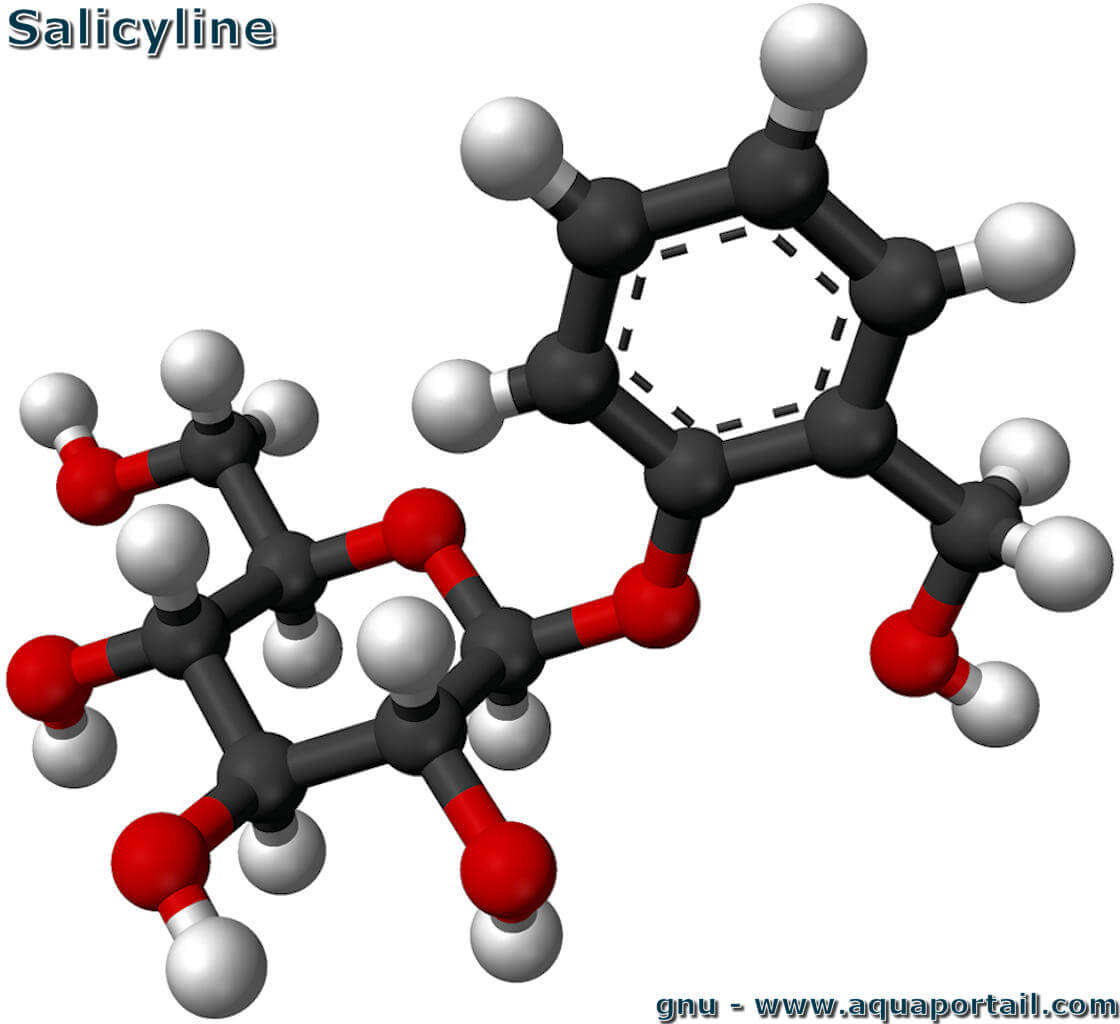
Salicin is a glycoside:

Glycosides, such as salicin, comprise a class of chemical compounds formed by the union of carbohydrate molecules (glycones or monosaccharides) and a non-carbohydrate compound, also called an aglycone.
Explanations
Glycosides are molecules composed of a carbohydrate (usually monosaccharides) and a non-carbohydrate compound. Glycosides perform numerous vital roles in living organisms. Many plants store important chemicals in the form of inactive glycosides; when needed, these are hydrolyzed in the presence of water and an enzyme, releasing sugars important in plant metabolism. Many plant-derived glycosides are used as pharmaceuticals.
According to IUPAC
Formally, a glycoside according to IUPAC (International Union of Pure and Applied Chemistry) is a molecule in which a carbohydrate is bound via its anomeric carbon to another compound of different chemical nature through an O-glycosidic bond or an S-glycosidic bond; the latter are known as thioglycosides.
Alpha-glycosides are also called heterosides and can play an important role in living organisms.
Many authors also emphasize that the carbohydrate is bonded to a non-carbohydrate molecule in order for the compound to qualify as a glycoside.
The carbohydrate portion of a glycoside is known as the glycone, and the non-carbohydrate group as the aglycone or genin. The glycone may consist of a single monosaccharide or several linked oligosaccharides.
Physicochemical properties
The glycone and aglycone moieties can be chemically separated by acid hydrolysis. Numerous enzymes can form and cleave glycosidic bonds. The most important enzymes of this type are glycoside hydrolases, while the most important biosynthetic enzymes in nature are glycosyltransferases. Mutant enzymes called glycosynthases synthesize glycosides in higher yields.
Classification
Glycosides are classified according to the structure of the glycone and the aglycone, with the latter being the most important and useful in biochemistry and pharmacology:
- Anthraquinone glycosides: anthraquinone glycosides contain an aglycone derived from anthraquinone. Rhubarb and the genera Aloe, Rheum, and Rhamnus contain them; they exert a laxative effect
- Simple phenolic glycosides (arbutosides): the aglycone has a simple phenolic structure. An example is arbutin, found in the shrub Lithodora fruticosa, which acts as a urinary antiseptic. Arbutin is a constituent of the leaves of bearberry Arctostaphylos uva-ursi and bilberry Vaccinium, and is normally excreted unchanged by the kidneys. Only in alkaline urine is arbutin cleaved into hydroquinone, exerting an antiseptic effect in the urinary tract. Salicin (converted to salicylic acid in the body), populin, and gaultherin share nearly identical pharmacological properties, namely:
- antipyretic, analgesic, and antirheumatic
- disinfection of the gastrointestinal tract mucosa
- the mixed glycoside complex of black poplar (Populus nigra), namely salicin and populin, increases the solubilization and excretion of uric acid
- diuretic action of gaultherin in meadowsweet Filipendula ulmaria.
Salicylic acids occur, among others, in white willow Salix alba, meadowsweet Filipendula ulmaria, and black poplar Populus nigra - Alcoholic glycosides: an example of an alcoholic glycoside is salicin, found in trees of the genus Salix. When ingested, salicin is converted into salicylic acid, closely related to aspirin, exerting analgesic, antipyretic, anti-inflammatory, and anticoagulant effects
- Flavonoid glycosides: here, the aglycone is a flavonoid derivative. This is a very large group of glycosides, including hesperidin, naringin, rutin, and quercetin. These glycosides exert antioxidant effects and are also known to reduce capillary fragility. Plants containing flavone glycosides include hawthorn Crataegus oxyacantha, heather Calluna vulgaris, European ash Fraxinus excelsior, common toadflax Linaria vulgaris, spiny restharrow Ononis spinosa, blackthorn Prunus spinosa, and common rue Ruta graveolens
- Cardiac glycosides: structurally, the aglycone is a steroid nucleus. These cardiotonic glycosides occur in plants of the genera Digitalis, Scilla, and Strophanthus and the family Apocynaceae. They are used in treating heart conditions such as arrhythmia and heart failure. They are found in the leaves of plants of the genus Digitalis (foxglove) and also in lily of the valley Convallaria majalis, sea squill Drimia maritima, as well as common figwort Scrophularia nodosa and water figwort Scrophularia umbrosa
- Coumarin glycosides: here, the aglycone is a coumarin derivative. An example is apterin, used to dilate coronary arteries and block calcium channels. In general, coumarin-containing plants exert a mild anticoagulant effect and are also used as fragrances. At high doses, coumarins can act as vitamin K antagonists. Plants containing coumarin glycosides include sweet woodruff Galium odoratum, yellow sweet clover Melilotus officinalis, horse chestnut Aesculus hippocastanum, German chamomile Matricaria recutita, English lavender Lavandula angustifolia, burnet saxifrage Pimpinella saxifraga, and common rue Ruta graveolens
- Cyanogenic glycosides: in this case, the aglycone contains a cyanide group, and the glycoside can release toxic hydrocyanic acid. An example is amygdalin, a glycoside characteristic of almonds. Cyanogenic glycosides occur in the seeds of fruits (and wilted leaves) of the family Rosaceae (cherries, apples, plums, almonds, peaches, apricots, etc.). Cassava, a crop of major nutritional value in Africa and South America, contains cyanogenic glycosides, so the roots must be grated and washed with hot water before consumption
- Saponins: these compounds generate a persistent foam upon contact with water and cause hemolysis through the destruction of erythrocytes. Saponins occur in plants such as licorice, whose active constituent is glycyrrhizin; they exert an expectorant effect and have been studied for blood cholesterol control
- Aucubin glycosides: this glycoside occurs in certain herbaceous plants of the family Scrophulariaceae as well as the plantain family Plantaginaceae. Its pharmacological action resembles that of saponins in many respects. Examples of plants containing aucubin glycosides include eyebright Euphrasia officinalis, common speedwell Veronica officinalis, and ribwort plantain Plantago lanceolata
- Isothiocyanate glycosides (mustard oil glycosides): now called glucosinolates, they stimulate digestion in cases of anorexia and dyspepsia. As their name implies, these compounds contain sulfur. Plants containing mustard oil glycosides include shepherd's purse Capsella bursa-pastoris, white mustard Sinapis alba, scurvygrass Cochlearia officinalis, horseradish Armoracia rusticana, and watercress Nasturtium officinale. Sinigrin and sinalbin occur in mustard seeds
- Anthocyanidin glycosides: these pigment glycosides are closely related to flavone glycosides. Their physiological action is similar to that of flavone glycosides, though milder. Plants containing anthocyanin glycosides include cornflower Centaurea cyanus, common mallow Malva sylvestris, common peony Paeonia officinalis, common poppy Papaver rhoeas, lungwort Pulmonaria officinalis, dog rose Rosa canina, sweet violet Viola odorata, and wild pansy Viola tricolor.
Synonyms, antonyms
Spanish translation: glucósido
2 synonyms (similar meaning) for "glycoside":
0 antonyms (opposite meaning).
Related words and expressions to GLYCOSIDE are directly connected by general or specific meaning.
The word GLYCOSIDE is listed on page 1 of words starting with G in the dictionary glossary.
Related to "glycoside"
floridoside

Floridoside is a compatible solute, a heteroside synthesized by red algae that has attracted considerable attention due to its promising antifouling...
heteroside
A heteroside is a type of glycoside formed by the union of a sugar molecule and a non-carbohydrate constituent called an aglycone.
polyholoside

A polyholoside is a natural carbohydrate in the form of a polymer composed of several monosaccharides (holosides), like a polysaccharide, whose glycosidic...
riboside

A riboside is a ribonucleoside (preferred term). Nicotinamide riboside is a form of pyridine, a vitamin B3 nucleoside that functions as a precursor...
