Glycopeptide
noun (n.)
Definition
A glycopeptide is a compound formed of a peptide covalently linked to a carbohydrate moiety. Glycopeptide antibiotics constitute a class of peptides containing sugars attached to amino acids, targeting the bacterial cell wall. This class comprises cyclic or polycyclic non-ribosomal glycosylated peptides.
Some structures of glycopeptides:
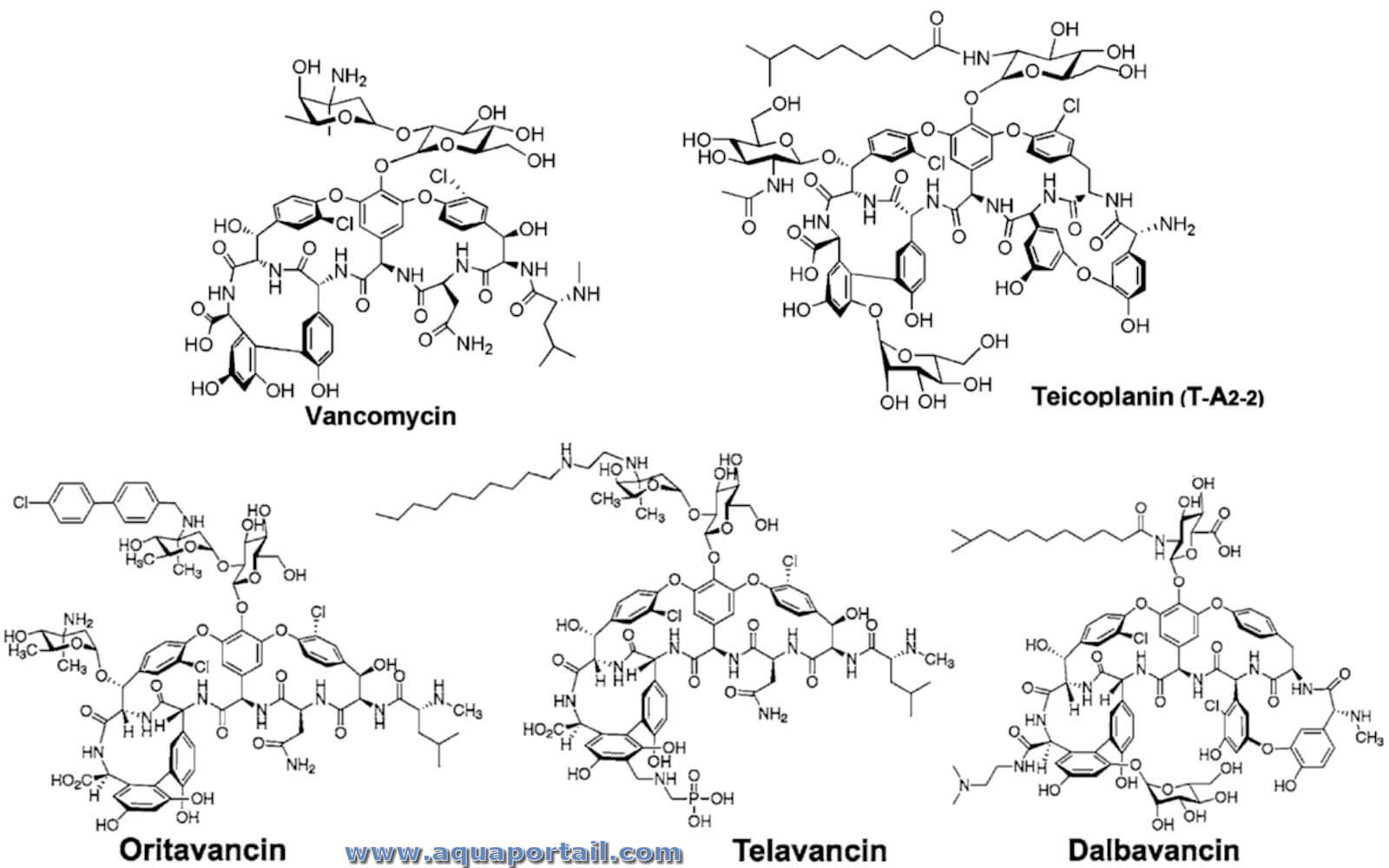
Structures of 5 glycopeptides: vancomycin, teicoplanin, oritavancin, telavancin, dalbavancin. Structures of natural and semi-synthetic glycopeptide antibiotics (GPAs). Vancomycin and teicoplanin are natural products. In the case of teicoplanin, the clinically used antibiotic is a mixture of five lipoglycopeptide molecules differing in the length (C10-C11) and branching of the fatty acid tail, the main component of which—shown in the figure—bears 8-methylnonanoic acid (iso-C10:0) and is designated T-A2-2. Oritavancin and telavancin are second-generation semi-synthetic GPAs belonging to the vancomycin family. Dalbavancin is the semi-synthetic derivative of teicoplanin A40926.
Explanations
Glycopeptides are used as antibiotics: they act by inhibiting peptidoglycan synthesis at a metabolic step different from and earlier than beta-lactam agents. They alter cell wall permeability and inhibit RNA synthesis. They act by blocking bacterial cell wall synthesis and affect only Gram-positive bacteria (having no activity against Gram-negative bacteria).
Glycopeptides included in this group are:
- vancomycin
- teicoplanin
- bacitracin
- bleomycin
- ramoplanin
Glycopeptides are currently used for severe infections caused by Gram-positive bacteria that cannot be treated with β-lactam antibiotics, either because the patient is allergic to β-lactams or because the bacteria have developed resistance to them.
Glycopeptides are bactericidal antibiotics. Vancomycin binds to the D-alanyl-D-alanine dipeptide, blocking transpeptidase and interfering with the polymerization of peptidoglycan, a fundamental constituent of the bacterial cell wall. Bacitracin inhibits the action of bactoprenol, a bacterial lipid required for the transmembrane transport of NAM-NAG-5aa (N-acetylmuramic acid + N-acetylglucosamine + pentapeptide), causing intracellular accumulation of NAM-NAG-5aa (and concomitant absence of peptidoglycan). By contrast, polymyxin penetrates the bacterial cell and acts by disrupting its plasma membrane.
Indications include bacterial infections caused by the genera Staphylococcus, Streptococcus, Enterococcus, and Corynebacterium. In addition, these agents are used for the local treatment of intestinal inflammation caused by Clostridium difficile.
See also glycolipid, glycoside, oligopeptide, polypeptide, and lipoglycopeptide.
Glycopeptide antibiotics (action and resistance)
Glycopeptides are regarded as last-resort antibiotics for treating life-threatening infections caused by clinically relevant Gram-positive human pathogens, such as Staphylococcus aureus, Enterococcus spp., and Clostridium difficile.
The emergence of glycopeptide-resistant clinical isolates, first in enterococci and later in staphylococci, has driven research into second-generation glycopeptides and extensive efforts to elucidate resistance mechanisms and their evolution. Glycopeptides are glycosylated non-ribosomal peptides produced by a diverse group of soil actinomycetes. They target Gram-positive bacteria by binding to the acyl-D-alanyl-D-alanine (D-Ala-D-Ala) terminus of nascent peptidoglycan on the outer surface of the cytoplasmic membrane.
Glycopeptide-resistant organisms evade this fate by replacing the D-Ala-D-Ala terminus with D-alanyl-D-lactate (D-Ala-D-Lac) or D-alanyl-D-serine (D-Ala-D-Ser), markedly reducing antibiotic affinity for the cellular target. Resistance in enterococci and staphylococci has largely arisen through the expression of genes (designated van) encoding proteins that reprogram cell wall biosynthesis and thereby escape antibiotic action.
These resistance mechanisms were most likely co-opted by glycopeptide-producing actinomycetes, which use them to avoid self-killing during antibiotic production, rather than being newly devised by pathogenic bacteria under continuous therapy. Van-like gene clusters, similar to those described in enterococci, have indeed been identified in numerous glycopeptide-producing actinomycetes, such as Actinoplanes teichomyceticus, which produces teicoplanin, and Streptomyces toyocaensis, which produces the glycopeptide A47934.
A thorough understanding of glycopeptide immunity in this producing microorganism may prove particularly valuable for predicting and potentially controlling the evolution of resistance that could follow the clinical introduction of dalbavancin and other second-generation glycopeptides.
Synonyms, antonyms
Spanish translation: glucopéptido
1 synonym (similar meaning) for "glycopeptide":
0 antonyms (opposite meaning).
Related words and expressions to GLYCOPEPTIDE are directly connected by general or specific meaning.
The word GLYCOPEPTIDE is listed on page 1 of words starting with G in the dictionary glossary.
Related to "glycopeptide"
peptide

A peptide is a molecule comprising at least two amino acid residues linked by a CO-NH peptide bond, formed by dehydration condensation between the NH₂ group...
glycoprotein

A glycoprotein is a heteroprotein consisting of a peptide moiety covalently linked to a carbohydrate moiety.
glycoproteic

Glycoproteic describes anything exhibiting the characteristics of, relating to, or involving a glycoprotein, a protein conjugated with carbohydrates.
glycogen

Glycogen is the stored form of glucose, composed of numerous interconnected glucose molecules, that animals use as an energy reserve.
Simple summary
A glycopeptide is a type of molecule consisting of a peptide covalently bound to a carbohydrate (sugar) moiety. This association enables processes such as cell signaling, immune response, and structural functions within organisms. Glycopeptides are also of medical importance, with certain members acting as antibiotics, such as vancomycin.
