Endosymbiosis
noun (n.)
Definition
Endosymbiosis refers to an evolutionary theory proposing that the plastids and mitochondria of eukaryotic cells originated from endosymbiotic bacteria. The term also describes any symbiosis in which one partner, called an endosymbiont, lives inside the cells or tissues of its host, a process known as symbiogenesis. cnidarians (corals, sea anemones, etc.) harboring zooxanthellae (dinoflagellates) within their tissues provide a classic example. Endosymbiosis is the opposite of ectosymbiosis.Endosymbiosis process:
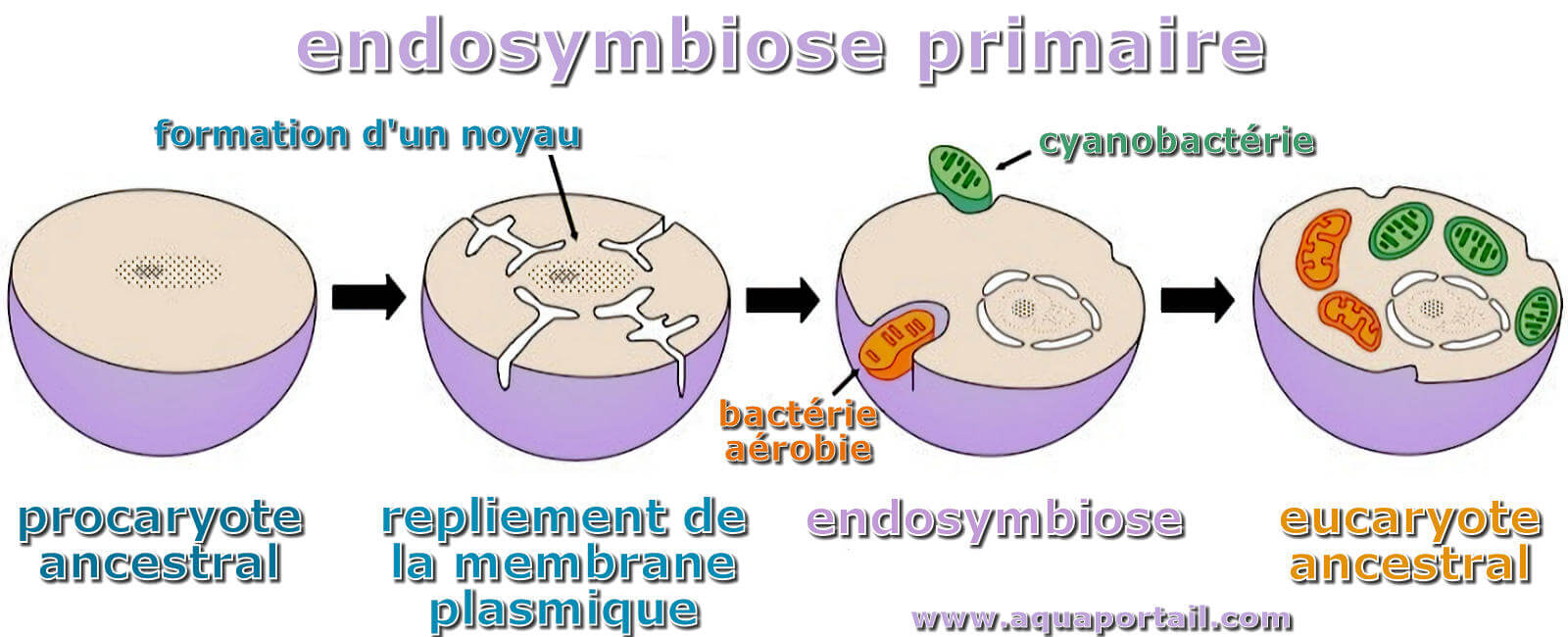
Endosymbiosis is a process that results in one cell living inside another cell with mutual benefit.
Explanations
Endosymbiosis represents a major driving force in the evolutionary history of eukaryotes. Recent studies on algal phylogeny indicate that this process occurred repeatedly, giving rise to a wide variety of eukaryotic cell lineages. Despite its fundamental importance, the molecular mechanisms governing the establishment of endosymbiosis between different protists remain only partially understood.
This phenomenon has profoundly shaped eukaryotic diversification. The energy-producing organelles of modern eukaryotic cells, namely mitochondria and plastids, evolved from free-living prokaryotes engulfed by eukaryotic host cells, within which they became permanent intracellular compartments. In modern cells, these organelles carry out cellular respiration and oxygenic photosynthesis, respectively. Whereas the endosymbiotic acquisition of mitochondria likely dates back to the common ancestor of all known eukaryotes, plastid acquisition occurred later, after the earliest major evolutionary divergences among eukaryotes had already taken place. This pivotal event enabled the emergence of diverse algal lineages as well as the spread of plastids across distantly related eukaryotic groups through secondary endosymbiosis (an association between two eukaryotes).
The ability to establish endosymbiosis with corals, combined with a highly efficient, photoprotective photosynthetic apparatus, reveals both shared features and differences among dinoflagellates that may shed light on evolutionary transitions toward parasitism.
Primary and secondary endosymbiosis
In primary endosymbiosis, a free-living organism directly engulfs a bacterium. Secondary endosymbiosis occurs when a free-living heterotrophic eukaryote ingests and retains another eukaryote that is itself the product of primary endosymbiosis. This secondary process has occurred independently multiple times, giving rise to highly diverse taxa of algae and other eukaryotes. Some organisms exhibit a transient, opportunistic version of this process: they engulf an alga to exploit its photosynthetic products, and once the prey alga dies or is lost, the host reverts to a free-living state. By contrast, partners in an established secondary endosymbiosis become dependent on their plastids and cannot survive without them. Evolutionary studies have notably highlighted the major role played by red algae (Rhodophyta) in shaping Earth's biosphere through secondary endosymbiosis.
A probable case of ongoing secondary endosymbiosis has been observed in the heterotrophic protist Hatena: it behaves as a predator until it ingests a green alga, which then loses its flagellum and cytoskeleton, while Hatena switches to photosynthetic nutrition, gains phototactic motility toward light, and loses its feeding apparatus.
Secondary endosymbiosis has left a distinctive anatomical signature in the membrane topology of plastids. Secondary plastids are bounded by three membranes (in euglenophytes and certain dinoflagellates) or four membranes (in haptophytes, heterokonts, cryptophytes, and chlorarachniophytes). The two additional membrane layers are thought to correspond to the plasma membrane of the engulfed alga and the phagosomal membrane of the host cell. In cryptophytes, the eukaryotic origin of the symbiont is evidenced by the persistence of a vestigial red algal nucleus, termed a nucleomorph, situated between the outer and inner pairs of plastid membranes.
Despite the broad diversity of plastid-bearing lineages, morphological, biochemical, genomic, and molecular phylogenetic data (from plastid RNAs and proteins) point to a single primary origin for all extant plastids, although this hypothesis remains debated.
In certain species, including the louse Pediculus humanus, the mitochondrial genome is fragmented into multiple distinct chromosomes. This organization, together with the phylogeny of mitochondrially encoded genes, indicates extensive gene rearrangements and fusions among ancestral mitochondrial chromosomes, fueling debate over possible multiple acquisitions.
Secondary endosymbiosis process:
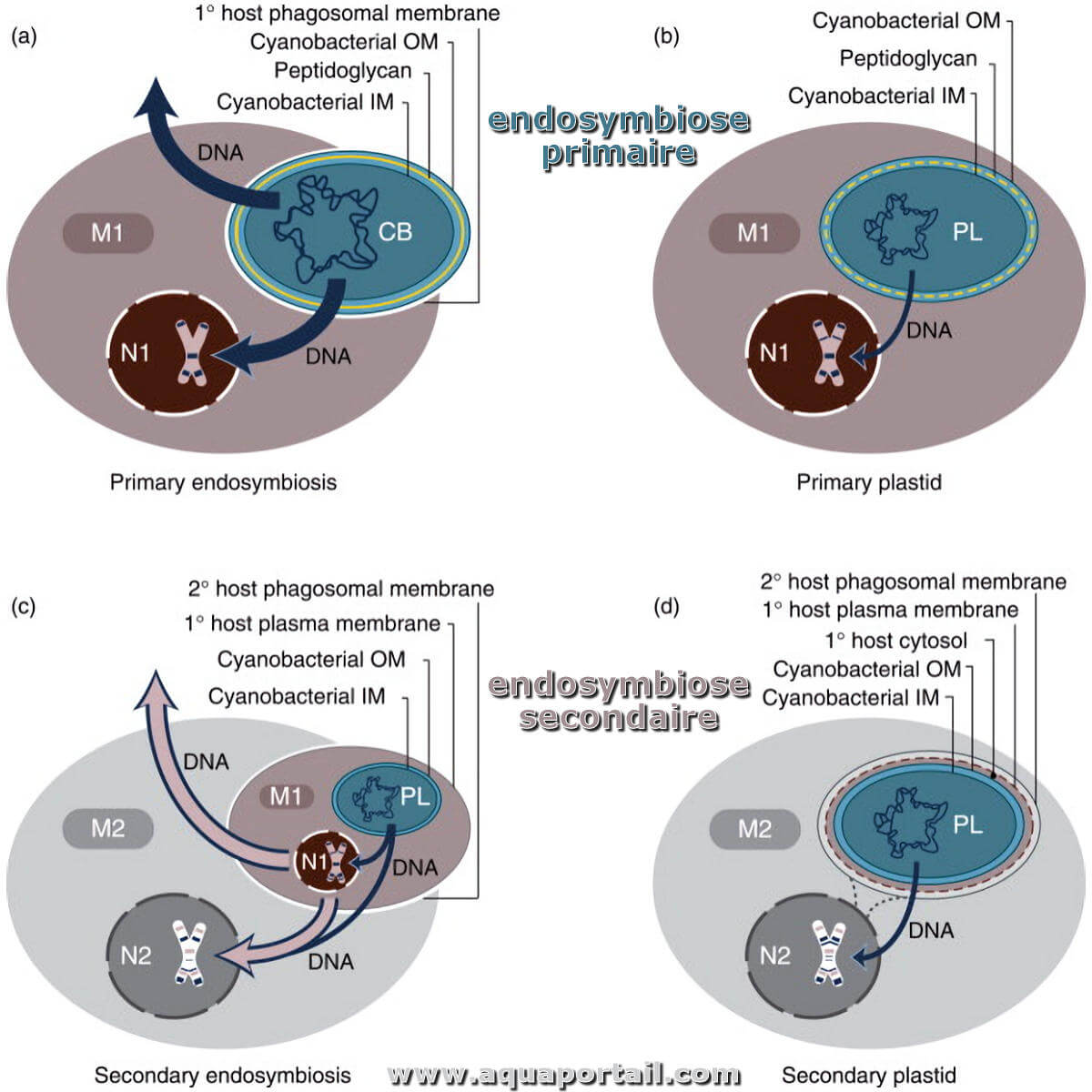
Evolutionary process of plastids through primary and secondary endosymbiosis. Abbreviations: CB, cyanobacterium; PL, plastid; OM, outer membrane; IM, inner membrane; M, mitochondrion; N, nucleus.
In the diagram above, details of both endosymbioses:
- primary endosymbiosis: (a) depiction of the primary stage in which a non-photosynthetic eukaryote engulfs a cyanobacterium, resulting in substantial DNA loss from the cyanobacterial genome and extensive gene transfer into the host nuclear genome; (b) cell containing a primary plastid surrounded by two cyanobacterial-derived membranes, with glaucophytes additionally retaining a thin peptidoglycan layer between the two membranes.
- secondary endosymbiosis: (c) diagram illustrating the uptake of a primary plastid-bearing alga by a heterotrophic eukaryote, accompanied by large-scale migration of cyanobacterial and eukaryotic DNA from the primary host nucleus (N1) to the secondary host nucleus (N2) along with DNA loss, with direct DNA transfers from the plastid to N1 or N2 also possible; (d) secondary eukaryotic cell housing a plastid surrounded by three or four membranes (the primary algal plasma membrane having likely been lost in euglenids and some dinoflagellates). The space between the inner and outer membrane pairs corresponds to the residual cytosol of the primary alga and still retains its vestigial nucleus in cryptophytes and chlorarachniophytes. In cryptophytes, haptophytes, and stramenopiles, the outermost plastid membrane is continuous with the nuclear envelope and endoplasmic reticulum (ER). For simplicity, DNA movement involving the mitochondrion is omitted.
The theory of endosymbiosis
The primary endosymbiosis model is complemented by that of secondary endosymbiosis, which accounts for plastids bounded by three or four membranes in many algae as deriving from algae that already possessed a plastid of primary endosymbiotic origin.
In certain dinophytes, tertiary endosymbioses also occur, involving plastids derived from algae that had already undergone secondary endosymbiosis.
More broadly, endosymbiosis defines any symbiotic association in which one partner (the endosymbiont) lives inside the host organism, such as symbiotic bacteria in wood-feeding flagellates, the microbial flora of the ruminant rumen, or nitrogen-fixing bacteria in Fabales.
According to the theory of symbiogenesis, mitochondria, plastids (such as chloroplasts), and potentially other eukaryotic organelles represent formerly free-living prokaryotes integrated via endosymbiosis roughly 1.5 billion years ago. During the initial stage of endosymbiosis, owing to the lack of major gene transfer to the nucleus, the host cell exerted little or no control over its endosymbiont.
Synonyms, antonyms
Spanish translation: endosimbiosis
1 synonym (similar meaning) for "endosymbiosis":
1 antonym (opposite meaning):
Related words and expressions to ENDOSYMBIOSIS are directly connected by general or specific meaning.
The word ENDOSYMBIOSIS is listed on page 1 of words starting with E in the dictionary glossary.
Related to "endosymbiosis"
endosymbiotic

Endosymbiotic describes any organism living in symbiosis inside the tissues or cells of another organism that acts as its host partner.
symbiosis

Symbiosis is an interactive relationship between two different organisms living in close physical association.
endoskeleton
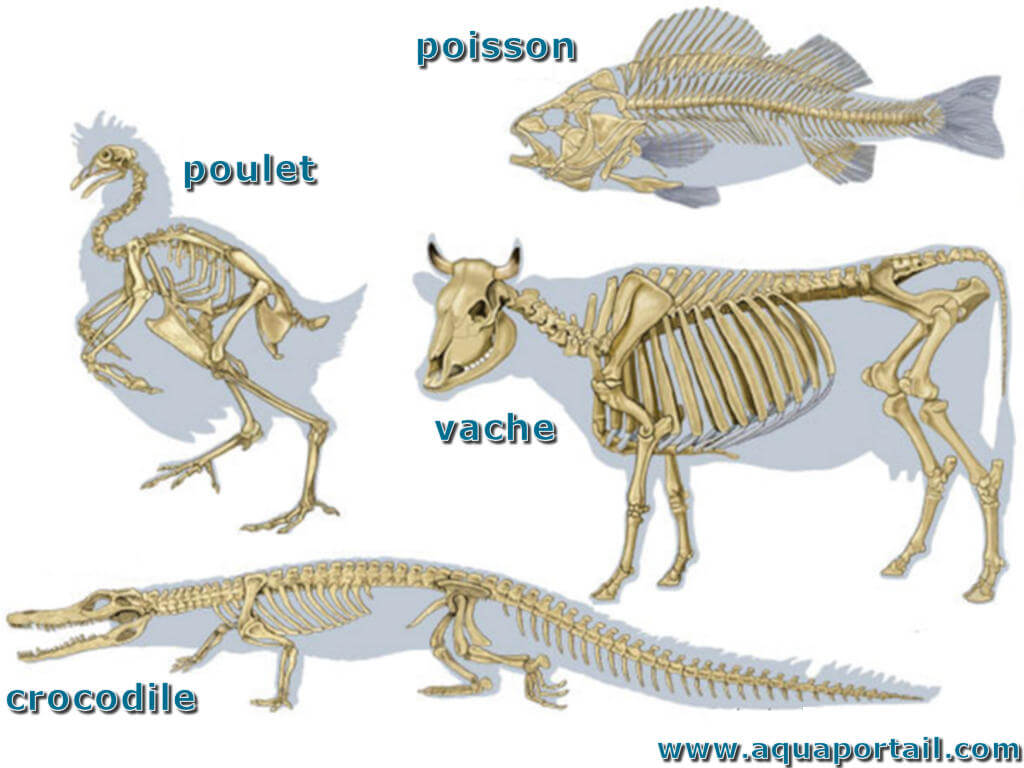
An endoskeleton is an internal skeleton and therefore contrasts with the exoskeleton (external) and the hydroskeleton.
endospore

An endospore is a dormant, tough, and non-reproductive structure produced by a small number of bacteria from the phylum Bacillota (Firmicutes).
