Carboxysome
noun (n.)
Definition
Carboxysomes are microcompartments in bacterial cells containing carbon-fixing enzymes. They are single-layered polyhedral protein bodies measuring 80 to 140 nanometers in diameter, forming the core of the CO2-concentrating mechanism.
Model for the structure of the carboxysome:
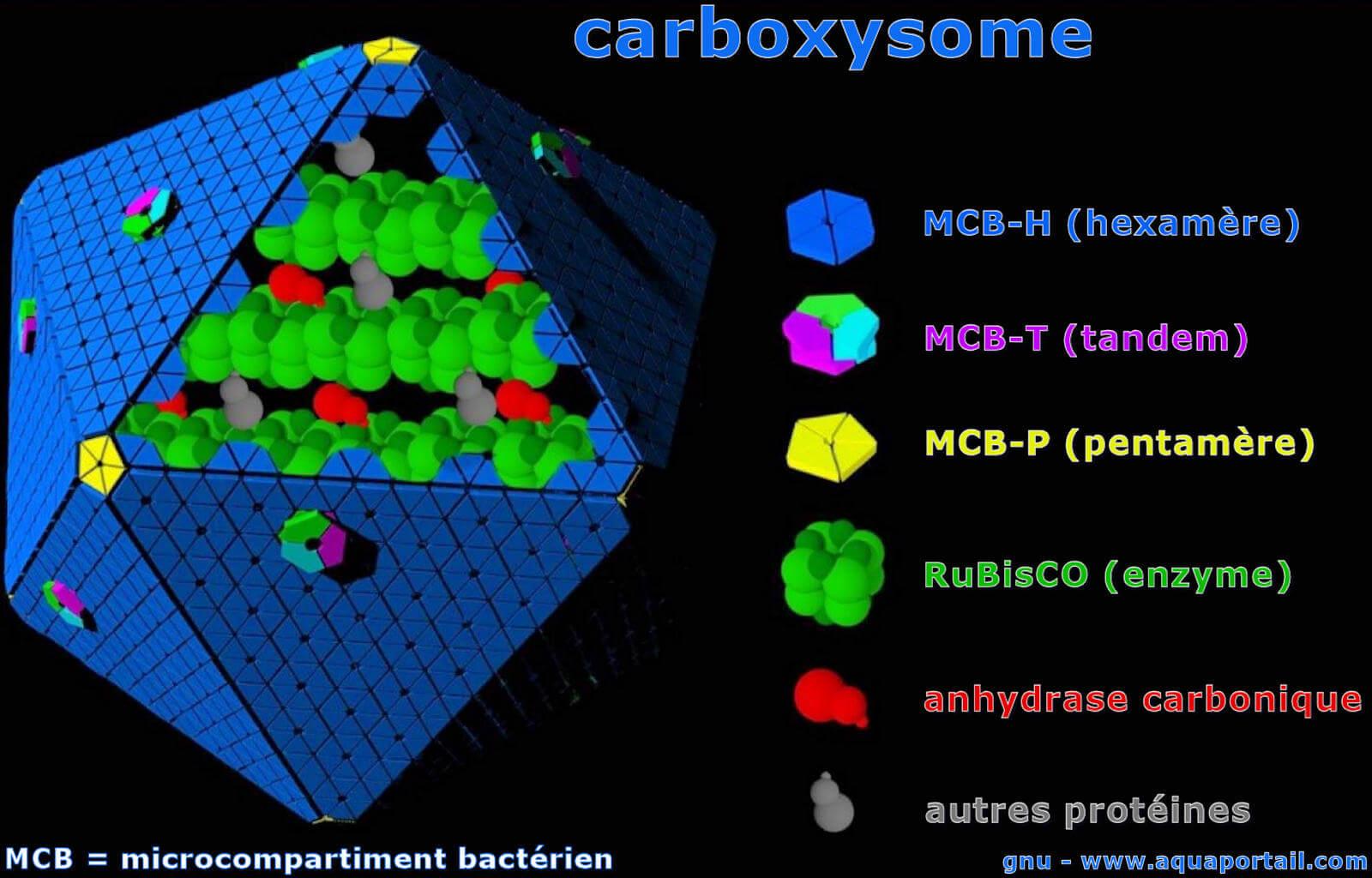
The view of the carboxysome and related bacterial structures shows rubisco and carbonic anhydrase arranged within an enzymatic core (organized by various scaffolding proteins) and encapsulated in a protein shell.
Explanations
The carboxysome, sometimes called a cytoplasmic polyhedral body, is a polyhedral cytoplasmic inclusion found in certain bacteria. It houses the enzyme ribulose-1,5-bisphosphate carboxylase-oxygenase (RuBisCO), responsible for carbon dioxide fixation during photosynthesis.
Carboxysomes belong to a larger group of bacterial microcompartments (BMCs) with diverse functions but similar architectures, based on homology among shell protein families.
Carboxysomes are bacterial microcompartments containing enzymes involved in carbon fixation. They consist of polyhedral protein shells approximately 80–140 nanometers in diameter. Their function is to concentrate carbon dioxide to compensate for the catalytic inefficiency of RuBisCO, the predominant carbon-fixing enzyme and the rate-limiting enzyme of the Calvin cycle.
⭐ These microcompartments occur in all cyanobacteria and in many chemotrophic bacteria that fix carbon dioxide. Carboxysomes in cyanobacteria appear as polyhedral organelles containing RuBisCO, notably in nitrifying bacteria, photosynthetic bacteria, and chemolithotrophic bacteria. Specifically, carboxysomes are found in all cyanobacteria and in thiobacilli (Thiobacillus).
Structure, architecture
Structurally, carboxysomes have 20 facets, or quasi-icosahedral geometry, typically about 80 to 120 nanometers in diameter. The carboxysome has an outer shell composed of several thousand protein subunits, encapsulating two enzymes: carbonic anhydrase and ribulose-bisphosphate carboxylase.
Two types of carboxysomes exist: α-carboxysomes and β-carboxysomes, which differ in protein composition. In α-carboxysomes, Form I RuBisCO is distributed in multiple layers, and the genes encoding carboxysome shell proteins are organized into a single operon. In β-carboxysomes, Form II RuBisCO lacks small regulatory subunits and is arranged in a dense paracrystalline array via a specialized scaffolding protein, while its genes form several independent clusters. Cyanobacteria with α-carboxysomes inhabit environments where dissolved carbon dioxide is abundant (such as oligotrophic ocean waters), whereas cyanobacteria with β-carboxysomes live where dissolved carbon dioxide is limiting (alkaline lakes with high densities of photosynthetic organisms).
Properties and functions in the cell
Carboxysomes form part of an efficient concentrating mechanism enabling autotrophic bacteria to take up CO2 effectively under almost any condition. Bicarbonate (HCO3-) is actively transported into the cell and enters the carboxysome. Inside, carbonic anhydrase and local pH conditions accelerate the conversion of HCO3- into CO2, which is fixed by RuBisCO into 3-phosphoglycerate. This generates a localized elevation in carbon dioxide concentration at the site of highest RuBisCO density. The abundance of carboxysomes increases when inorganic carbon (HCO3-, CO2) in the surrounding medium decreases.
Beyond conventional carboxysomes housing carbon-fixing enzymes, at least seven types of virus-like microcompartments perform diverse functions. Several have been identified in non-photosynthetic bacteria, where they participate in catalytic reactions linked to carbon release, nitrogen metabolism, and energy production. For instance, Escherichia coli, Klebsiella, Clostridium, Fusobacterium, Shigella, Listeria, and Yersinia use such microcompartments to harvest carbon for energy by breaking down 1,2-propanediol, ethanolamine, or both. Notably, Salmonella enterica grown on propanediol exhibits the key enzyme of this pathway, dehydrogenase, within these microcompartments. Because these bacteria do not perform inorganic carbon fixation, their bacterial microcompartments are designated as enterosomes. Furthermore, enterosome formation in these bacteria occurs during infection of animals or humans, directly linking them to microbial pathogenicity.
Indirectly, the cellular importance of the carboxysome was confirmed in studies where cyanobacterial carboxysomes were tagged with green fluorescent protein molecules. Carboxysomes were observed aligned along straight lines, facilitating equal partitioning during cell division.
Value in the evolution of microorganisms
Many viral capsids are also built from hexagonal and pentagonal protein subunits. Cryo-electron microscopy studies confirmed the quasi-icosahedral (twenty-sided) geometry of the carboxysome and visualized the internal enzyme molecules arranged in concentric layers. Moreover, the non-hexagonal shapes of certain carboxysomes can be explained by variations in heterogeneous thin-shell theory. Because carboxysomes closely resemble viruses in appearance and architecture, and due to early reports of DNA isolation, many scientists were initially tempted to link the origin of the carboxysome to bacteriophages. Subsequent studies refuted these conclusions, demonstrating that DNA isolated from icosahedral bodies actually originated from the bacterial nucleoid.
Scientists believe carboxysomes evolved in cyanobacteria as an adaptation to lower CO2 concentrations, particularly in water, where CO2 diffuses ten thousand times more slowly than in air and its solubility depends strongly on pH. Furthermore, RuBisCO is highly sensitive to high oxygen concentrations, which compete directly at its active site, making compartmentalization and protection critical. Alongside carboxysomes, highly specific transporters and pumps evolved for the HCO3- ion. Such CO2-concentrating mechanisms enabled cyanobacteria to colonize numerous ecological niches and spread across virtually all aquatic habitats.
Potential uses of the carboxysome in biotechnology
As with other bacterial microcompartments, the carboxysome attracts substantial research interest for synthetic biology applications. Transfer of a genetic module encoding an alpha-carboxysome has been shown to produce carboxysome-like structures in E. coli.
Bioengineering of carboxysome "shells" has been demonstrated, and beta-carboxysomes constructed with chimeric proteins or chimeric shells have been reported. If successfully installed in crops, carboxysomes could enhance plant photosynthetic efficiency. To this end, beta-carboxysomal proteins and Form IB RuBisCO have been expressed in tobacco, though fully functional carboxysomes have not yet been achieved.
History of discovery
Carboxysomes were first detected by electron microscopy in 1956 in the cyanobacterium Phormidium uncinatum, and later in the 1960s similar polyhedral bodies were found in other cyanobacteria. In 1961, these structures were termed polyhedral bodies and were subsequently discovered in certain chemotrophic bacteria that fix carbon dioxide (for example, Halothiobacillus, Acidithiobacillus, Nitrobacter, and Nitrococcus).
Due to the resemblance of carboxysomes to phage particles, scientists long remained skeptical that they could be functional organelles of the bacterial cell. This skepticism quickly faded when, in 1973, Jessup Shively and colleagues at Clemson University isolated carboxysomes from Thiobacillus neapolitanus, demonstrating the presence of RuBisCO and the absence of DNA. The authors proposed naming these organelles carboxysomes, as they were involved in carbon fixation.
Synonyms, antonyms
Spanish translation: carboxisoma
0 synonyms (similar meaning) for "carboxysome".
0 antonyms (opposite meaning).
Related words and expressions to CARBOXYSOME are directly connected by general or specific meaning.
The word CARBOXYSOME is listed on page 1 of words starting with C in the dictionary glossary.
Related to "carboxysome"
carboxamide
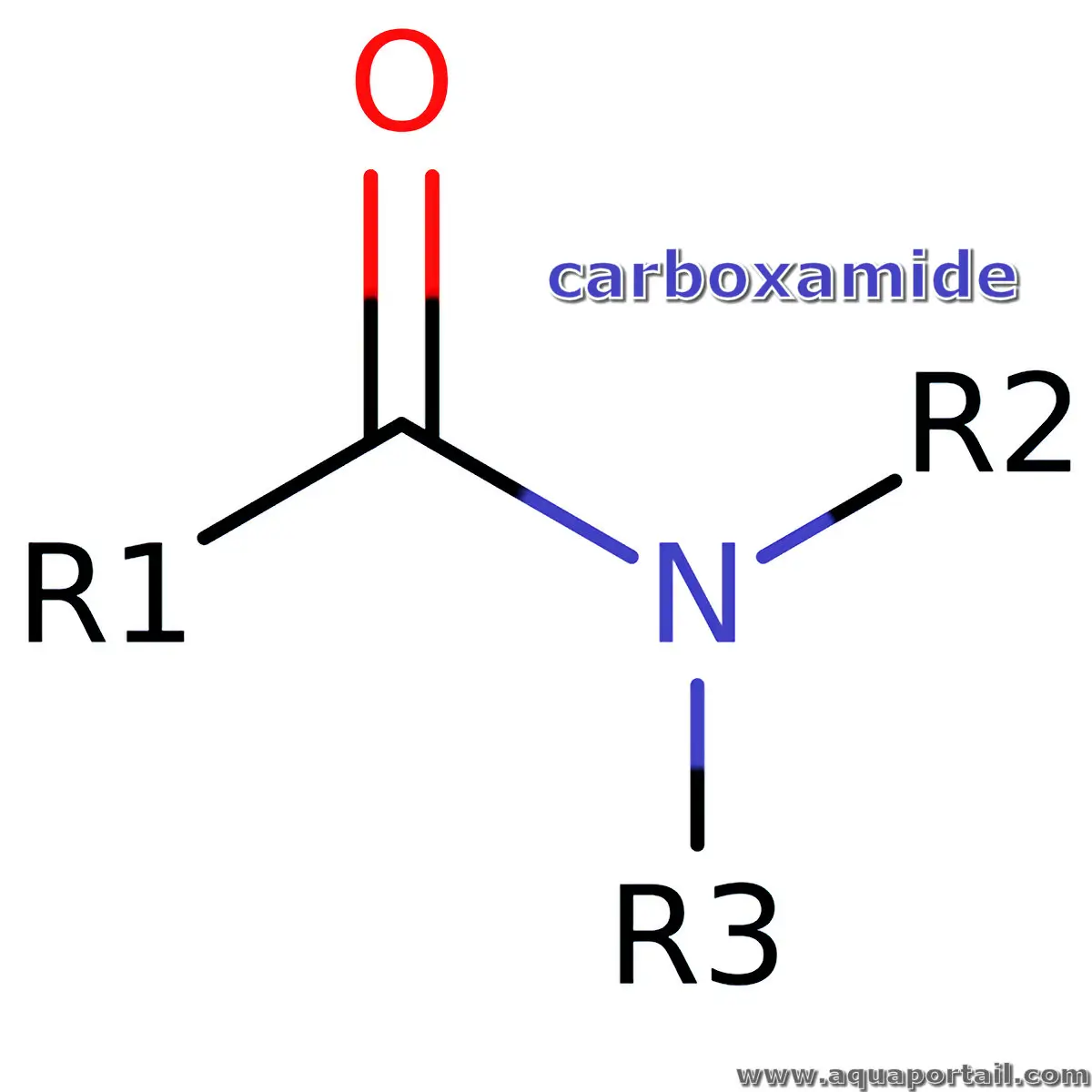
A carboxamide is a carboxylic acid amide having the structure RC(=O)NR₂. The term is used as a suffix in systematic nomenclature to designate the group...
carboxylate

A carboxylate denotes the anionic form of a salt or ester of a carboxylic acid, characterized by the deprotonation of the hydroxyl group (−OH) of the carboxyl...
carbohydrate

A carbohydrate is an organic compound, a biomolecule composed of carbon, hydrogen, and oxygen.
carbohydrate catabolism

Carbohydrate catabolism is a series of chemical reactions (redox reactions) that lead to the breakdown (catabolism) of carbohydrate molecules into smaller...
