Nitrogen
noun (n.)
Definition
Nitrogen (N) is the 7th element of the periodic table, a colorless and odorless non-metallic element of group 15. Its gaseous form is molecular nitrogen (N2). The chemical symbol N comes from the Latin Nitrogenium.Nitrogen in the periodic table :

Close-up of nitrogen in a periodic table, with detail of the Bohr atomic model of a nitrogen atom. Nitrogen is a chemical element discovered and isolated from air in 1772 by Daniel Rutherford, a Scottish physician. It has an atomic number of 7 (meaning each nitrogen atom has 7 protons) and is represented by the letter N in the periodic table of elements. The name of this substance, however, is attributed to Antoine Laurent Lavoisier, a French chemist, who named it azote, meaning absence of life (a = absence, zote = life).
Explanations
Nitrogen is found in the soil beneath our feet, in the water we drink, and in the air we breathe. In fact, nitrogen is the most abundant element in Earth's atmosphere: about 78% of the atmosphere consists of nitrogen!
Nitrogen may not be talked about as much as other atmospheric chemicals like oxygen or carbon dioxide, but that does not mean it is any less important. In fact, all life on Earth needs nitrogen to survive. The nitrogen cycle is one of the most useful biogeochemical cycles to understand.
Nitrogenous compounds are major, essential plant nutrients. It is a colorless, odorless, inert, gaseous element with an atomic weight of 14 that makes up about 79% (by volume) of the atmosphere. Above every hectare (2.47 acres) of land at sea level, approximately 78,000 metric tons (85,980 short tons) of N2 are present. It is absorbed by plant roots in the form of NH4+ and NO3-. Agriculture receives nitrogen through organic amendments, BNF, precipitation, and recycled waste.
Atom
Nitrogen (N) is a non-metallic element belonging to group 15 of the periodic table. It occurs as a colorless, odorless, and tasteless gas, making it the most abundant element in Earth's atmosphere and an essential constituent of all living organisms.
Nitrogen atom according to the Bohr model:

A nitrogen atom represented in the Bohr model shows protons and neutrons in the nucleus and electrons arranged in shells (atomic orbitals) around it.
Nutrient
Nitrogen is the most limiting nutrient for increasing crop productivity, which is why N is the predominant nutrient applied via fertilizers. Atmospheric nitrogen (N2) is the source of all fixed N in fertilizer manufacturing industries or through BNF. In general, the content in plant dry matter is 1 to 5% N. It is the key constituent of all amino acids and therefore of all proteins. On average, plant protein content = 6.25 × N content. Non-protein nitrogen also exists.
The condition associated with an inadequate supply of N in soils or plants is called nitrogen deficiency. N–deficient plants are stunted and take on a yellowish-green color. This yellowing usually appears first on the lower leaves while the upper leaves remain green because they receive nitrogen from the older leaves.
In cases of severe nitrogen insufficiency, leaves turn brown and die. Crop yield as well as protein content are reduced. A soil is generally considered N–deficient if it contains less than 0.5% organic carbon or less than 280 kg/ha (250 lb/acre) of alkaline permanganate-oxidizable N. Such parameters and their applicability vary greatly from one soil-crop-climate system to another.
Nitrogen is an essential constituent of proteins and nucleic acids. Nitrogen nutrition in autotrophs occurs through assimilation of mineral nitrogen or fixation of atmospheric dinitrogen by Bacteria (diazotrophy). See nitrogen organization in genes.
See also nitrite, nitrate, ammonia and ammoniacal nitrogen, ammonium ion, ammonium thiosulfate, and nitrogenases.
✅ The bacterial genus Lignobacter groups together microorganisms capable of fixing nitrogen. Lignobacter bacteria are necessarily associated with non-leguminous woody plant species. These bacteria participate in the synthesis of wood lignin in trees.
Synonyms, antonyms
French translation:
azoteSpanish translation: nitrógeno
2 synonyms (similar meaning) for "nitrogen":
0 antonyms (opposite meaning).
Related words and expressions to NITROGEN are directly connected by general or specific meaning.
The word NITROGEN is listed on page 1 of words starting with N in the dictionary glossary.
Related to "nitrogen"
nitrate

A nitrate (NO₃⁻) is a polyatomic ion representing the final stage in the breakdown of nitrogenous substances by bacteria decomposing organic matter.
nitrite

The nitrite ion is NO₂⁻. It is a bent anion with an electronic configuration and angular geometry similar to those of ozone. Nitrites can form salts or esters...
nitrogenase
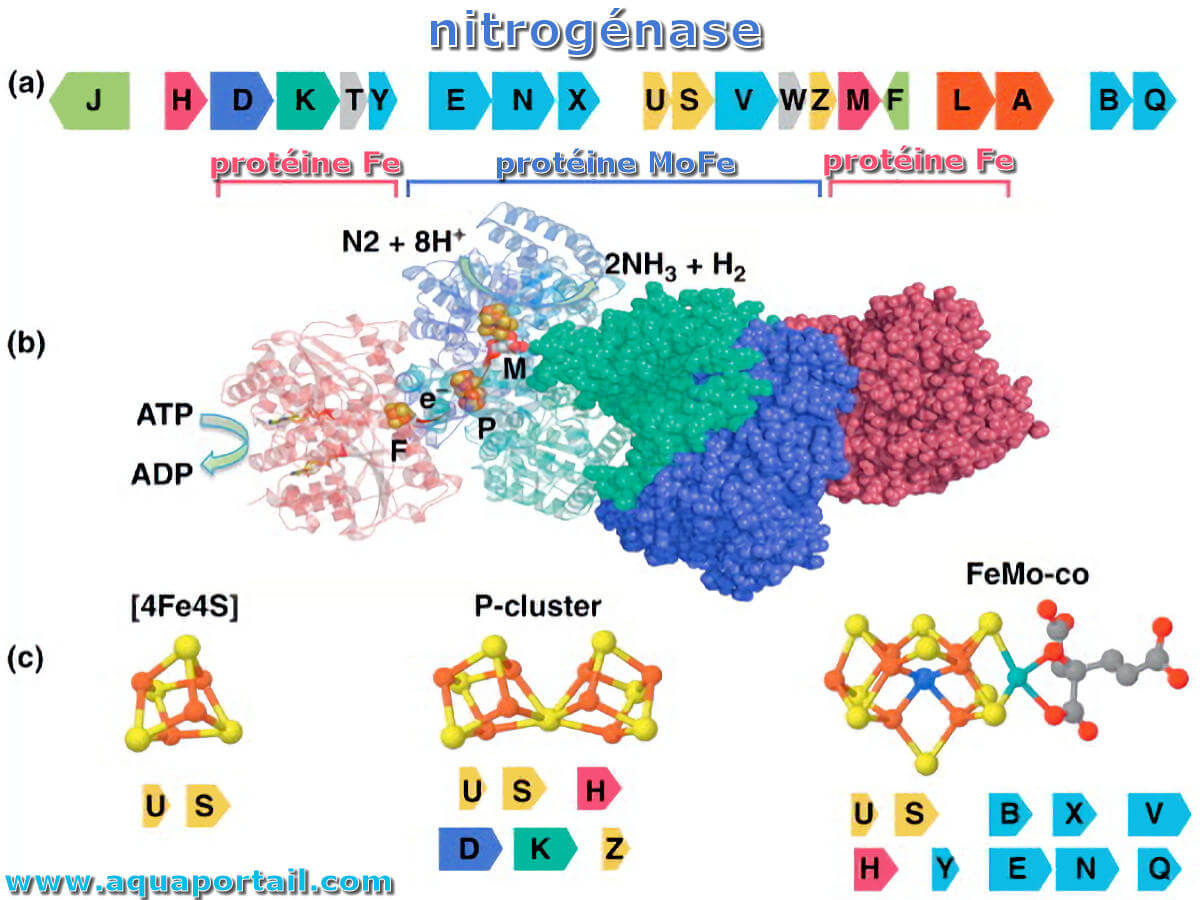
Nitrogenase denotes a highly oxygen-sensitive enzyme catalyzing the reduction of gaseous nitrogen N₂ into ammonium ion NH₄⁺, combining it with hydrogen H.
nanandrous

A nanandrous organism refers to a dwarf male individual. The root of the word dwarfism is easily identifiable and defines nanandry. Females, in fish...
