Periodic table
noun phrase (n. phr.)
Definition
The periodic table of elements is an arrangement of chemical elements in tabular form, ordered by their atomic number (number of protons), electron configuration, and chemical properties. This table displays periodic trends, such as elements with similar behavior appearing in the same column.
The periodic table of chemical elements:
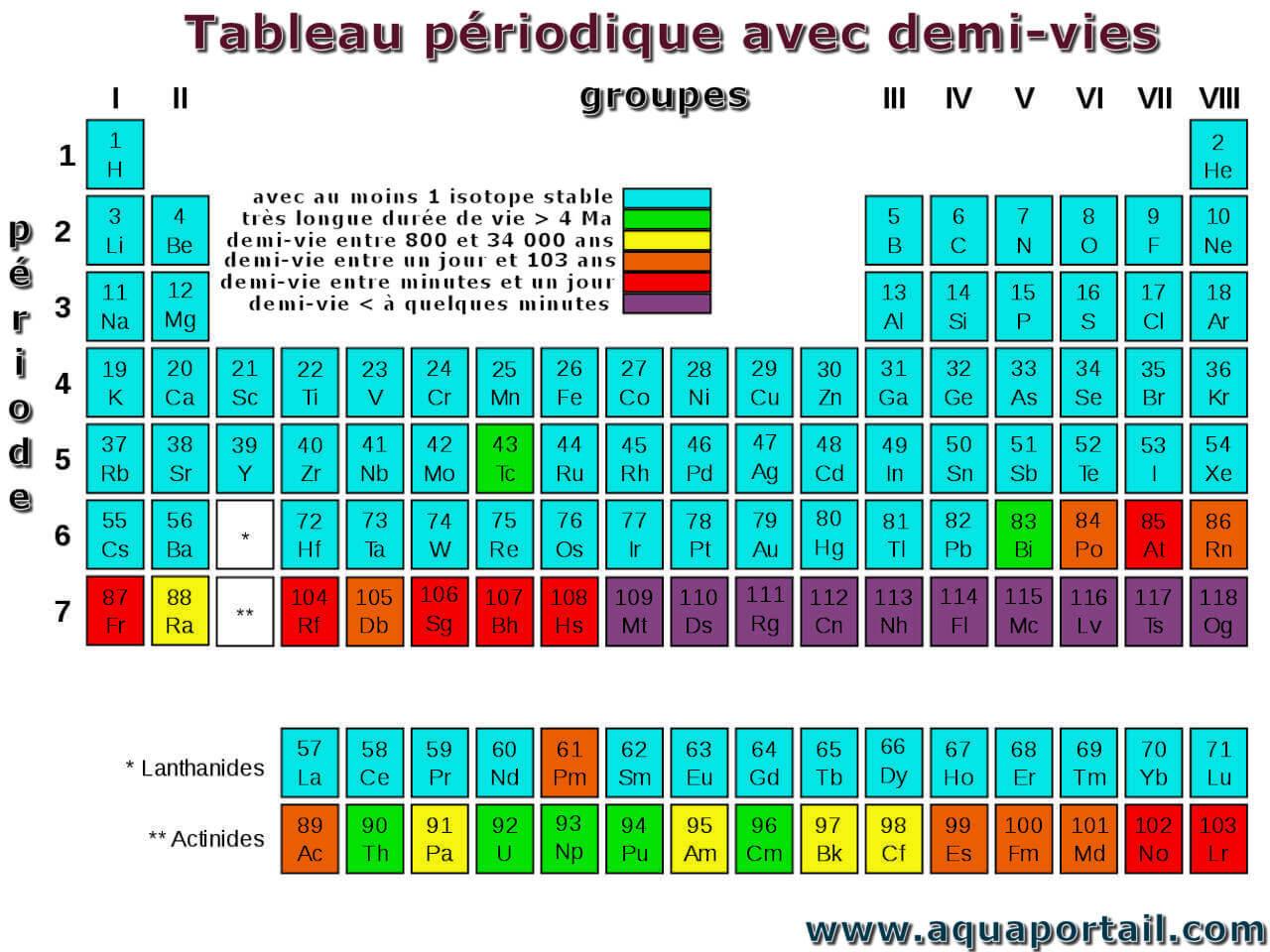
Mendeleev's periodic table of elements is a tabular display classification of all chemical elements. The current periodic table is a system in which all currently known elements are classified. They are arranged from left to right and top to bottom in increasing order of their atomic numbers. The elements are organized into seven horizontal rows called periods, and 18 vertical columns called groups or families. Moving down and to the left increases atomic radius and ionic radius. Moving up and to the right increases ionization energy, electron affinity, and electronegativity.
Explanations
The rows of the periodic table are called periods and the columns are groups. This classification gives this table another name: the periodic classification. Certain groups have specific names. For example, group 17 is the halogens and group 18 is the noble gases. The table is also divided into four blocks with similar chemical properties.
Because positions are ordered, the periodic table can be used to derive relationships between element properties, or to predict the properties of new elements not yet discovered or synthesized. The periodic table provides a useful framework for analyzing chemical behavior and is widely used in chemistry and other sciences.
History and developments
Dmitri Mendeleev published the first widely recognized version of the periodic table in 1869: Mendeleev's table. He developed it to illustrate periodic trends in the properties of then-known elements, ordering elements according to their chemical properties, although Julius Lothar Meyer, working independently, arranged them based on the physical properties of atoms.
Mendeleev also predicted several properties of then-unknown elements that he anticipated would occupy the empty spaces in his table. Later, most of his predictions were proven correct when the elements in question were discovered.
Since then, Mendeleev's periodic table has been expanded and refined with the discovery or synthesis of new elements and the development of new theoretical models to explain chemical behavior.
The current layout was designed by Alfred Werner from Mendeleev's version. Other periodic arrangements also exist according to different properties and intended uses (didactic, geological, etc.).
Periodic table with 120 chemical elements (2021):
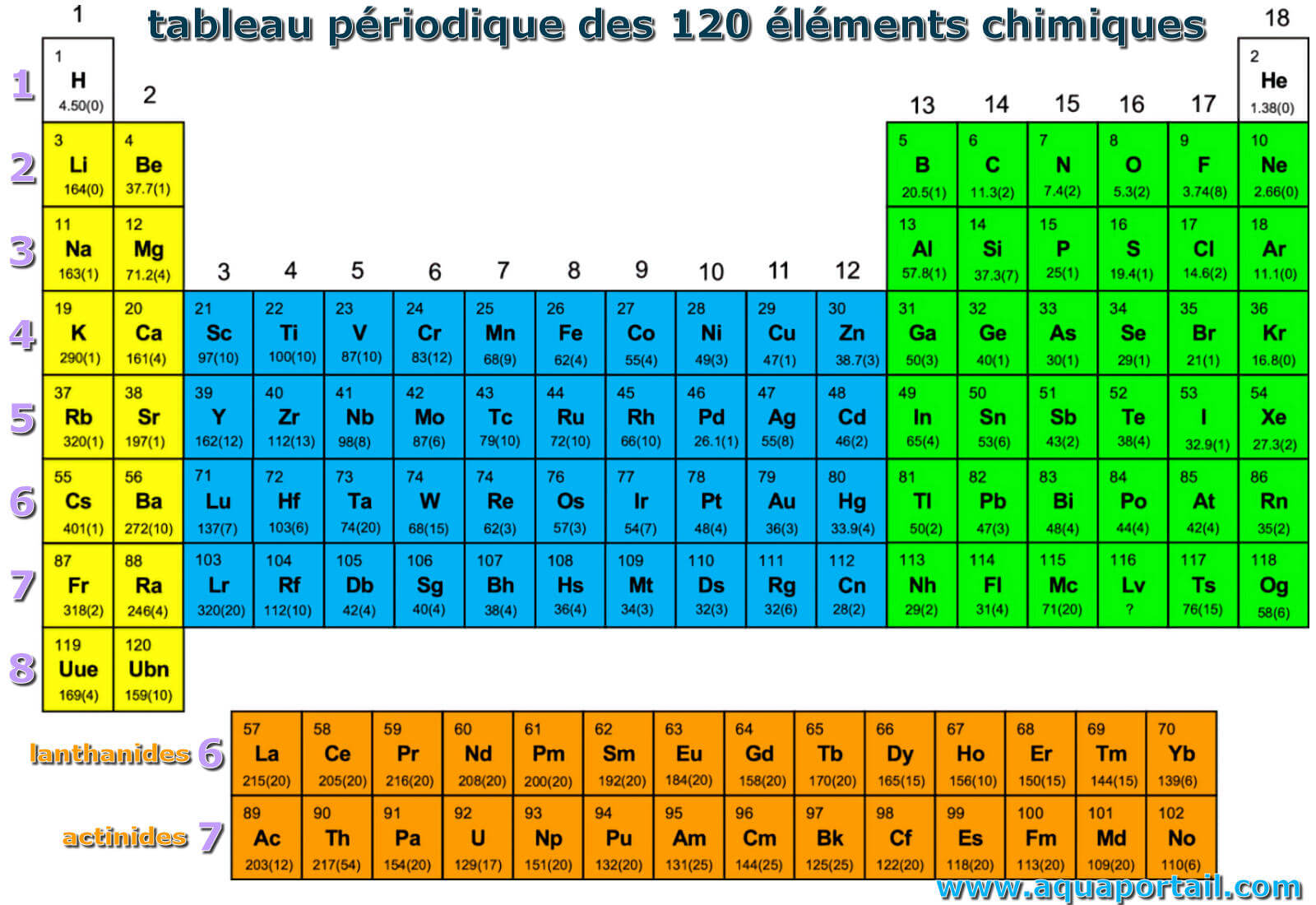
Recent periodic table (2021) with 120 chemical elements. Recommended periodic table values for atomic polarizabilities (atomic units; estimated uncertainties in parentheses) of elements Z = 1–120. The different blocks of elements are color-coded: s-block, yellow; p-block, green; d-block, blue; f-block, orange.
All elements from atomic number 1 (hydrogen) to 118 (oganesson), and up to 120 (unbinilium), have been discovered or synthesized.
IUPAC confirmed elements 113 (Nh, Nihonium), 115 (Mc, Moscovium), 117 (Ts, Tennessine), and 118 (Og, Oganesson) on December 30, 2015, and their official names and symbols were made public on November 28, 2016. Elements 119 (Uue, Ununennium) and 120 (Ubn, Unbinilium) were not yet confirmed as of 2021. However, a 2018 update of the most accurate calculated and experimental static dipole polarizabilities of neutral atoms in the periodic table for nuclear charge Z = 1 to 120 has been proposed.
The first 94 occur naturally, although some were only found in trace amounts and were synthesized in the laboratory before being discovered in nature.
Elements with atomic numbers 95 through 118 have only been synthesized in the laboratory. Numerous synthetic radioisotopes of naturally occurring elements have also been produced.
Elements 95 through 100 existed in nature in the past but do not today. Research to synthesize new elements of higher atomic numbers continues.
In the words of Theodor Benfey, the periodic table and periodic law are the heart of chemistry, comparable to the theory of evolution in biology (which succeeded the concept of the Great Chain of Being), and to the laws of thermodynamics in classical physics.
Synonyms, antonyms
Spanish translation: tabla periódica
2 synonyms (similar meaning) for "periodic table":
- Mendeleev's table
- periodic classification
0 antonyms (opposite meaning).
Related words and expressions to PERIODIC TABLE are directly connected by general or specific meaning.
The expression PERIODIC TABLE is listed on page 1 of words starting with P in the dictionary glossary.
Related to "periodic table"
fruit or vegetable

Is it a fruit or a vegetable ? The question consists of determining whether a plant yields fruits or vegetables, and the answer holds a few surprises.
tide table

A tide table (or tide almanac) is an annually published compilation containing predictions of tide heights relative to the chart datum of the reference port...
paedomorphosis

Paedomorphosis (juvenilization) is a phylogenetic change involving the retention of juvenile or even larval traits into a later (adult) stage.
painkiller

A painkiller, or analgesic, is a pain reliever, a medication used to soothe or eliminate pain, whether headaches, muscle aches, arthritis, etc.
Simple summary
The periodic table is a systematic arrangement of chemical elements, organized primarily according to their atomic number, electron configuration, and recurring chemical properties. Composed of rows, called periods, and columns, called groups or families, the table enables scientists to predict an element's behavior during chemical reactions based on its position.
