Oligotrophic
adjective (adj.)
Definition
An oligotrophic zone is an environment, generally a body of water, poor in nutrients and humus. See also mesotrophic and eutrophic, which are the subsequent stages in the aging process of a lake. See oligotrophic conditions and oligotrophism and the complete definition of a lake and its evolution.
An oligotrophic lake:

Oligotrophic is a term used to describe a lake that has few nutrients present and therefore low primary productivity.
Explanations
An oligotrophic natural environment or an oligotrophic soil describes entities (soil, water...) poor in organic compounds and nutrients, or organisms capable of thriving at low concentrations of organic compounds. It contrasts with a eutrophic or polytrophic biotope.
An oligotrophic environment characterizes a medium (such as soil or substrate) in which nutrient availability (nitrogen and phosphorus) is low to very low, with a pH < 4.5 and a histosol whose primary biomass production is low.
The water of an oligotrophic lake is generally clear, unturbid, or of very low turbidity. This allows light to penetrate into the lower water layers, and oxygen levels are also good because there are few algae covering the water surface, which would otherwise impair light and oxygenation levels. Concentrations of elements such as nitrogen and phosphorus are low in such a lake.
Oligotrophic lakes generally have few photosynthetic organisms present; in other words, there are few species of algae or plant life. These are also known as primary producer organisms because they produce sugars through photosynthesis and form the base of food chains and food webs in ecosystems. Primary productivity is less than 100 mg of carbon/m2 (0.00033 oz/sq ft) per day in an oligotrophic lake.
The consumers present in an oligotrophic system often differ from those in a eutrophic system because hydrological factors differ and there are fewer primary producers serving as food sources for primary consumers. However, many larger fish, such as trout, found at greater depths, are more abundant because oxygenation remains high at deep levels in these lakes.
Bacteria occur in low concentrations in oligotrophic waters. bacterial biomass is often a quarter of that in eutrophic lakes, likely due to the reduced availability of nutrients. Certain bacteria may also belong to the primary producer category, which is much lower in these water bodies.
Synonyms, antonyms
Spanish translation: oligotrófico
2 synonyms (similar meaning) for "oligotrophic":
- oligotrophile
- oligotrophique
1 antonym (opposite meaning):
Related words and expressions to OLIGOTROPHIC are directly connected by general or specific meaning.
The word OLIGOTROPHIC is listed on page 1 of words starting with O in the dictionary glossary.
Related to "oligotrophic"
eutrophic

A eutrophic environment refers to water subject to the phenomenon of eutrophication, as opposed to oligotrophic, and generally describes a lake, a eutrophic...
oligophotic
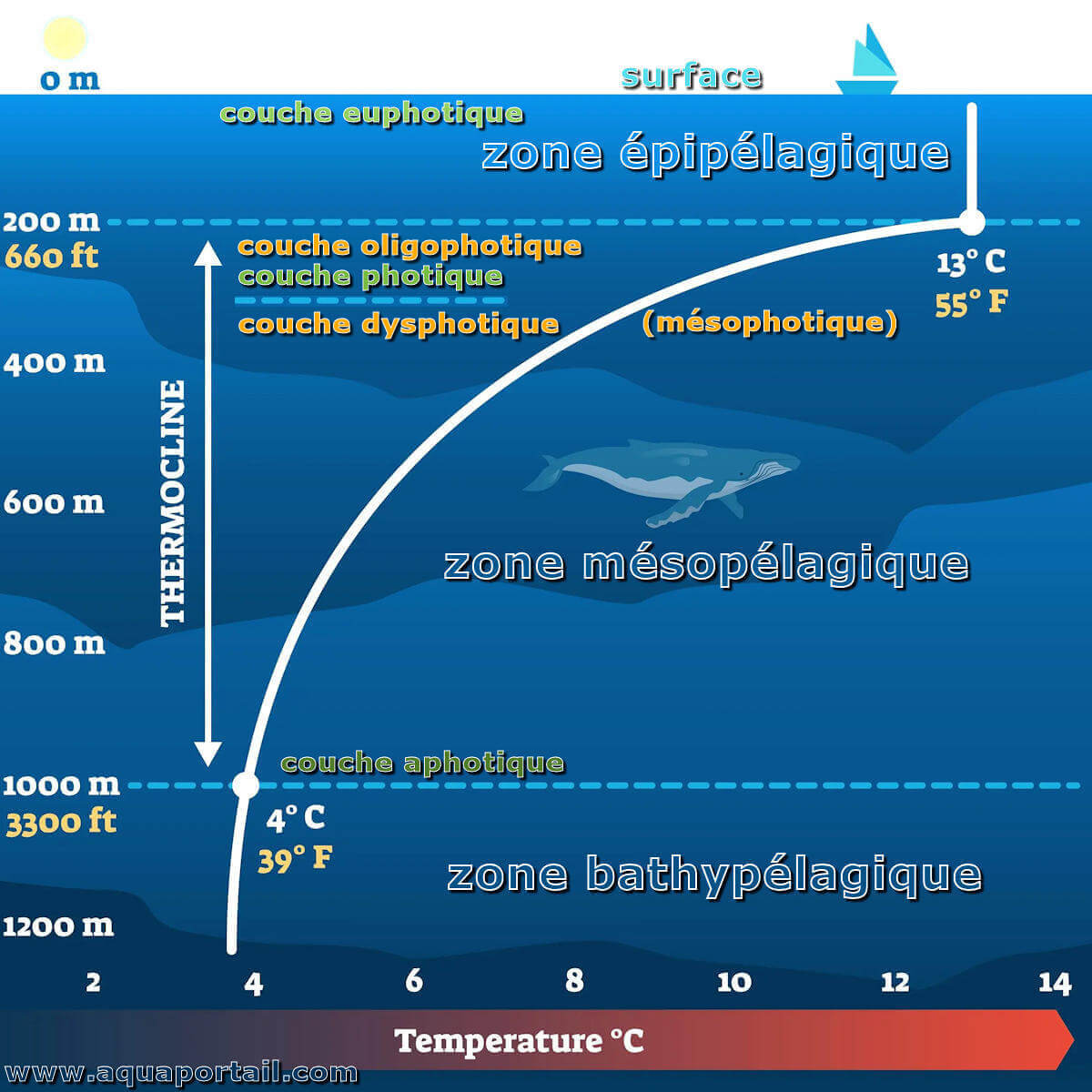
The oligophotic layer lies beneath the upper euphotic layer; light penetrates it faintly and insufficiently to allow photosynthesis.
ocean basin

An ocean basin is a benthic environment taking the form of a depression in the ocean floor bounded by the lower part of the continental slope.
ocean floor

The ocean floor (seafloor) is the region of the deep seabed where the topography flattens out, typically just beyond the continental rise at the level...
