Littoral
noun and adjective (n. / adj.)
Definition
The littoral is the terrestrial and aquatic zone near the shore of an ocean, sea, or lake, or the banks of a river or stream. It constitutes the transition zone between terrestrial and marine systems, divided into several zones: supralittoral, mediolittoral, infralittoral, and circalittoral.
A littoral with halophytic vegetation:

A littoral landscape and coastal law relate to the marine and oceanic coastal system, as well as to its organisms, typically halophytic vegetation.
The littoral identifies the contact zone between sea and land, describing a shore, coast, or coastline. The littoral zone contrasts with the pelagic zone, and littoral fish are often restricted to this oceanic zone where specific fauna and flora live. A littoral species lives near coasts.
General information and explanations
This contact zone between continents and oceans is subject to tides; it is normally exposed to tidal fluctuations and is subdivided into zones:
- supralittoral: rarely submerged
- mediolittoral: alternately submerged and exposed
- infralittoral: rarely exposed.
This zone normally contains turbulent, well-oxygenated, and well-lit waters subject to temperature variations whose amplitude depends on the local climate, and potentially subject to salinity fluctuations near the mouths of major rivers.
Conceptually in biogeography, the littoral is an ecotone, an ecological boundary characterized by intense processes of matter and energy exchange. Littoral zones are highly dynamic ecosystems in constant evolution and change.
To this littoral zone is often added the immediately underlying marine zone, characterized by the presence of chlorophyll-bearing plants. The circalittoral zone refers to the oceanic zone lying between the infralittoral zone and the bathyal zone, at the limit of light penetration.
There is no universal consensus on the definition of infralittoral, which generally describes a zone located at the very bottom of the intertidal shore, known as the infralittoral zone, always or almost always submerged and whose lower limit is the circalittoral zone where light disappears. In English, infralittoral is used, though its definition also varies among authors; sublittoral is sometimes synonymous with it or encompasses both the infralittoral and circalittoral zones together. In summary, the infralittoral is a zone (vertical space of the benthic domain) lying between the mediolittoral zone and the circalittoral zone. It is not a basin.
The littoral ecosystem
Among the factors influencing the considerable dynamism of the littoral, dominant geomorphological processes distinguish two types of coasts: erosion (cliffs) and sedimentation (beaches, sandbanks, and coastal wetlands). High inputs of sediments as well as organic and inorganic matter from drainage basins produce a coastal fertilizer effect that drives high productivity rates and helps sustain food webs.
The biological (and chemical) variety and uniqueness of the ecosystems making up the coast give it high ecological value with considerable diversity. Furthermore, in characterizing the coast, it is necessary to highlight the following values:
- social, aesthetic, and heritage value
- economic value, potential, and biological diversity of natural resources
- cultural value.
The harshness of environmental conditions to which coastal biological communities are subjected drives strong selection favoring differentiation and speciation. This imparts richness and originality, along with a considerable level of endemism, to these biodiversity-rich environments. All of this also affects their fragility. In general, coastal biological communities are arranged zonally in bands parallel to the shoreline.
Transects can be established from areas with minimal marine influence to those completely submerged in water.
For example, in France, there are notable differences between the Atlantic coast and the Mediterranean coast. The vegetation of the Mediterranean coast is historically older than that of the Atlantic, as the latter underwent regression during glacial periods. Following the retreat of ice, migrations of Mediterranean flora toward the Atlantic coast occurred. In the Mediterranean, unlike the Atlantic Ocean, virtually no tides occur, resulting in the absence of low-lying coastal expanses with wide intertidal zones.
Littoral environments
In geomorphology, the littoral is defined as a contact zone between the hydrosphere, atmosphere, and lithosphere encompassing the coast, shore, intertidal zone, and nearshore.
In zonation, the mediolittoral zone refers to the coastal zone of a sea (or ocean, of course) lying between the high-water and low-water marks of mean tides. It is synonymous with mesolittoral in oceanography.
Mesolittoral is a term primarily used in oceanography and marine biology that is synonymous with mediolittoral, the latter being more commonly used in everyday language.
The supralittoral zone designates a coastal zone (tier) situated above the level reached by tides, yet still receiving sea spray.
An adlittoral animal refers to an organism living along coastlines, at the edge of marine shores, without direct contact with the sea other than through sea spray. It is synonymous with juxtalittoral.
A whole terminology derives from littoral zones:
- littoral cordon (barrier beach)
- littoral rockpool
- longshore drift
- littoral species
- littoral tier
- coastal facade
- littoral tide pool
- coastal spit
- backshore zone
- homogeneous littoral zone
- infralittoral zone
- mediolittoral zone
- supralittoral zone.
Derived from the word littoral, littoralization refers to urbanization, anthropization, and increased human activity along the edge of a sea, ocean, or large lake.
The coastal marine environment
The coastal seabed extends from the lowest tide mark of the continental shelf to the limit of the euphotic zone, where solar radiation penetrates and photosynthesis processes are possible. It is an area particularly rich in biological resources, supported by sediment inputs from watersheds and benthic upwellings. This leads to greater availability of nutrients, such as phosphates and nitrates, which are the primary limiting factors for primary production.
The variety of submerged environments depends on tides, nutrient concentrations, light penetration depth, and bottom or substrate type. Depending on seabed type, two main environments are distinguished:
- rocky seabeds: these are the underwater extension of terrestrial rocky reliefs; they harbor a considerable diversity of algae, sponges, cnidarians, mollusks, crustaceans, echinoderms, and corals
- sandy seabeds: the communities of greatest ecological value are seagrass meadows of posidonia and eelgrass (marine phanerogams). The substrate-stabilizing capacity of posidonia creates stable meadows that provide habitat, food, shelter, and refuge for numerous species. Seagrass meadows are particularly sensitive to impacts causing fragmentation and burial, as well as pollution and the introduction of invasive species and parasites.
Synonyms, antonyms
Spanish translation: litoral
13 synonyms (similar meaning) for "littoral":
1 antonym (opposite meaning):
Related words and expressions to LITTORAL are directly connected by general or specific meaning.
The word LITTORAL is listed on page 1 of words starting with L in the dictionary glossary.
Related to "littoral"
littoral drift

Littoral drift is the transport of sediments along the coastline, a movement carried out by waves, wind, and currents along the shore of material deposited...
neritic zone

The neritic zone is the maritime zone near the coast, along the coastal shoreline, yet without direct contact with the shore, extending from 10 meters...
beach wrack
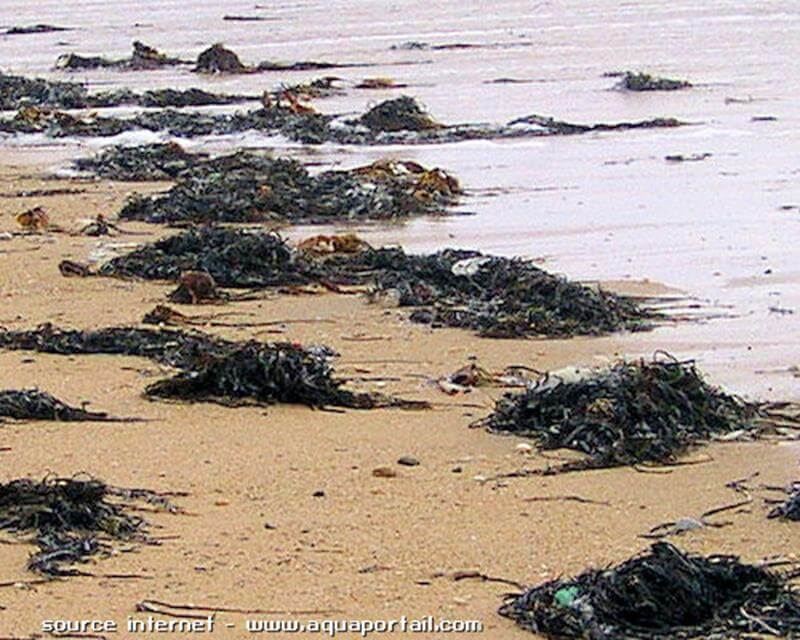
Beach wrack consists of algae, marine phanerogams (seagrasses), dead animals, debris, or various objects washed ashore along the coastline by tidal action.
foreshore

A foreshore is a coastal zone subject to tidal variations, under the influence of the rise and fall of the tides, in the intertidal or tidal zone.
Simple summary
The littoral refers to the boundary between land and a body of water, such as an ocean, sea, or lake. It represents the water's edge and is constantly shaped by natural forces such as waves, tides, and erosion, as well as human activity. This term is often used to describe various types of coasts or shorelines.
