Lizard
noun (n.)
Definition
A lizard names certain or all species of certain genera of the families Lacertidae and Gekkonidae among squamate reptiles. Lizards group together iguanas, monitor lizards, basilisks, chameleons, true lizards, and geckos, as well as certain very remarkable fossil forms, such as the mosasaurs of the Late Cretaceous.
The common wall lizard:
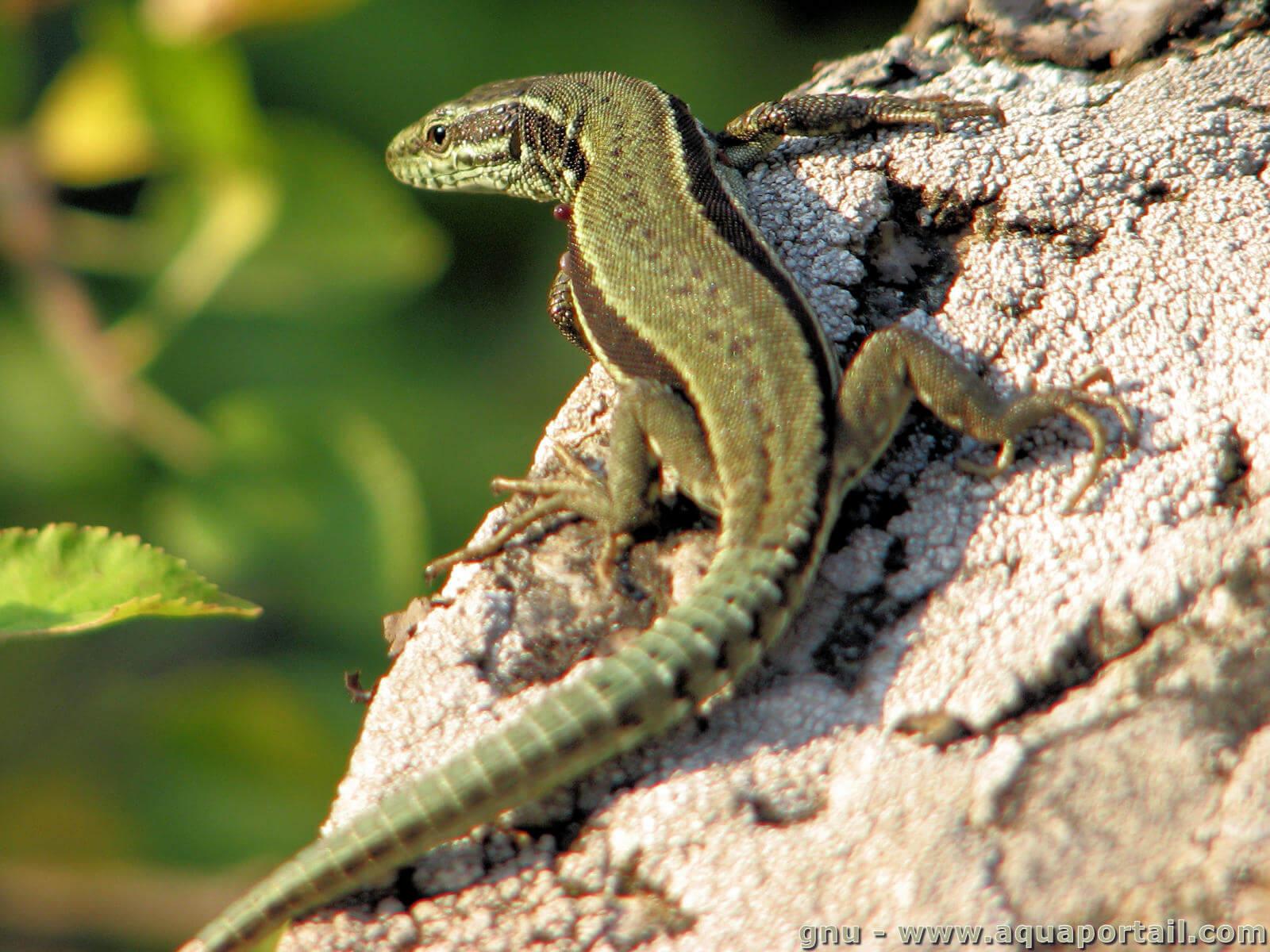
The common wall lizard Podarcis muralis is a species of scaly reptile of the family Lacertidae. It is distributed across much of Europe, from the Atlantic Ocean to northern Anatolia, and has been introduced to the United States. The snout-to-vent length of males, excluding the tail, is between 48 and 68 mm (1.9 and 2.7 in). Females can reach larger sizes, though the difference generally does not exceed one millimeter (0.04 in), and in some populations this size difference does not exist.
Explanations
Lizards feed on insects and numerous other invertebrates, and some are very abundant, mainly in Europe, Western Asia, and North Africa. Many measure about 4 to 20 cm (1.6 to 7.9 in) in length and are brownish in color. They are mainly seen in gardens and on walls.
Biology
✅ Lizards make use of a variety of antipredator adaptations, including venom, camouflage, reflex bleeding, and the ability to sacrifice their tails, which regrow (autotomy).
Most lizards are quadrupedal and run with a strong side-to-side motion. Others are legless and have long snake-like bodies. Some, such as forest flying lizards of the genus Draco, are capable of gliding. They are often territorial, with males fighting other males and signaling, often with bright colors, to attract mates and intimidate rivals. Lizards are primarily carnivorous, often being sit-and-wait predators; many smaller species eat insects, whereas the Komodo dragon eats mammals as large as water buffalo.
Together with the suborders of snakes (Serpentes) and worm lizards (Amphisbaenia), they form the order Squamata. Lacertilians comprise more than 6,000 species.
Formerly called saurians (Sauria), the group formed by lacertilians and snakes proved to be paraphyletic in the strict sense; the name Sauria is now applied to a larger clade of reptiles that includes most diapsids.
Normally, they have four legs, an ear with an external opening, and movable eyelids. Lengths range from a few centimeters (about an inch) in certain Caribbean geckos to about 3 meters (9.8 ft) in the Komodo dragon.
Certain species of lizards, called glass lizards or slow worms, have no functional legs, despite vestiges of limb skeletons. They are distinguished from true snakes by the presence of tympanic openings and movable eyelids. Their body is elongated with a well-developed tail.
Lizards of the infraorder Scincomorpha (skinks and related lizards) often have smooth, iridescent scales that look wet. Yet like the rest of lizards, they have dry skin, generally preferring to avoid water (although all lizards can swim if necessary).
Many lizards can change color depending on their environment or in case of danger. The most typical example is the chameleon, though more subtle color changes can also occur in other lizard species.
Certain species are able to break off and detach their tail when in danger or captured by a predator; this ability is called autotomy and is due to the presence of specialized fracture planes within the caudal vertebrae. After autotomy, the tail regenerates, though the new tail is not identical to the lost tail; indeed, vertebrae cannot be regenerated and are replaced by an unsegmented cartilaginous tube.
Lizards generally feed on invertebrates such as insects or arachnids, and sometimes (depending on the species) on small vertebrates, including other lizard species. A few species are omnivorous and can eat plants. Among the few venomous species is the genus Heloderma, which includes the species Heloderma suspectum (Gila monster) and Heloderma horridum (beaded lizard).
These species inhabit western Mexico and southern Texas, and possess two venom glands in the lower jaw. However, in 2009, it was discovered that the Komodo dragon is also venomous, following the discovery of a pair of venom glands in its lower jaw. Nevertheless, the actual effect of the venom following a bite remains under discussion.
Most lizards lay eggs (oviparous), although a few species retain them internally and give birth directly (ovoviviparous or viviparous).
Synonyms, antonyms
Spanish translation: lagarto
3 synonyms (similar meaning) for "lizard":
0 antonyms (opposite meaning).
Related words and expressions to LIZARD are directly connected by general or specific meaning.
The word LIZARD is listed on page 1 of words starting with L in the dictionary glossary.
Related to "lizard"
saurian

A saurian is a reptile-like animal fairly similar to a lizard. Size varies from a few centimeters (about an inch) to over one meter (3. 3 ft) from head...
L-form bacteria

L-form bacteria originate from a strain of bacteria that lack cell walls while retaining the ability to grow.
lacustrine

A lacustrine organism lives, grows, or thrives in or near a lake. The lacustrine environment sometimes designates any body of calm, standing (lentic) water...
ladybug

The ladybug (ladybird or lady beetle) refers to a group of hemispherical coleopteran insects belonging to the family Coccinellidae.
Simple summary
A lizard refers to a member of the order Squamata, a group composed mainly of reptiles characterized by an elongated body and distinct tail, movable eyelids, and external ear openings. Present in diverse habitats worldwide, lizards exhibit a wide variety of behaviors and ecological roles. This order encompasses several families, such as Gekkonidae, Iguanidae, and Varanidae, each displaying specific morphological and physiological adaptations. These reptiles often help regulate insect populations.
